カテゴリー
海外ニュース速報 [World]
海外ニュース速報 [World]
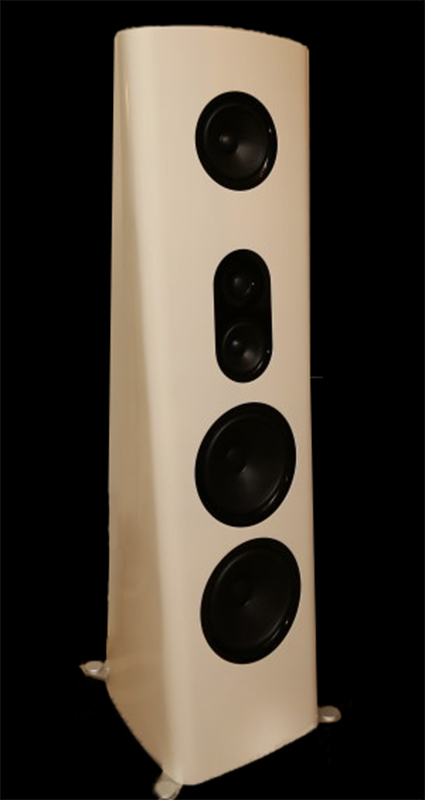
非常にかっこいいディザー広告に仕上がっています。
This video represents the celebration of 30 years of passion and great challenges, to transform a dream into reality.
We want to thank those who, like us, nourish the same passion for a dream called Sonus faber.
[youtube width=”670″ height=”542.3″]https://www.youtube.com/watch?v=koEiFQAwLi0[/youtube]
海外ニュース速報 [World]
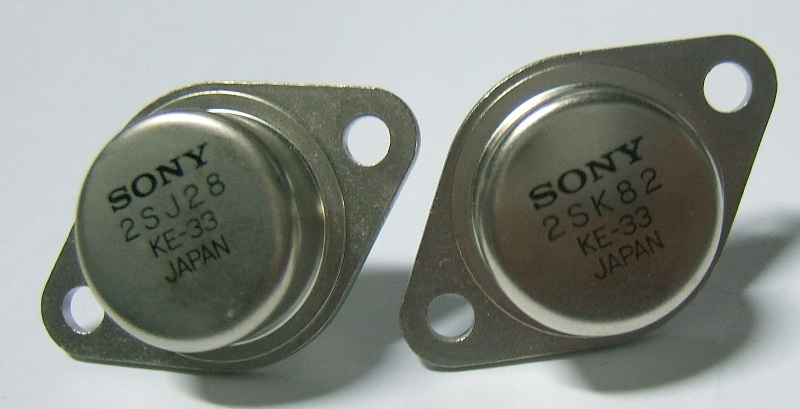
At a special press briefing held during the 2014 International CES, Sony Electronics joined with Pass Laboratories to demonstrate a unique high powered (250 watts output into 4 ohms) Class A amplifier which incorporates hand-selected Sony Vertical Field Effect Transistor (VFET) output devices.
This special model was developed specifically to commemorate the 40th Anniversary of VFET technology, which was utilized by Sony and a handful of other companies in a limited series of amplifiers in the late 1970s.
According to Nelson Pass, founder and president of Pass Laboratories, “These historic amplifiers are now prized for their exceptional sound, which is a credit to their extraordinary linearity of their VFET devices. As a result, they established a benchmark for the next generation of solid state amplifiers which followed, that have become the reference standard in high quality music reproduction today”.
“Triode-like” Sound Quality
Sony’s VFET devices, also known as Static Induction Transistors (SIT), were smaller, less costly and much more efficient than conventional vacuum tube designs and were widely acknowledged for their “Triode-like” sound quality. Additionally, these transistors serve as extremely fast switching devices, which enabled Sony to introduce the first high-powered Class D audio amplifier in 1976.
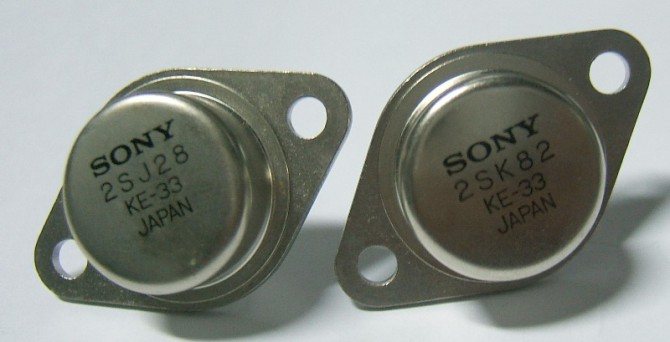
This exclusive Pass Laboratories commemorative amplifier employs complementary matched pairs (2SK82 and 2SJ28) of Sony VFETs, which were in storage for nearly 40 years. The mono block amp operates in Class A mode, with a balanced circuit from input to output and no feedback required. The amplifier also includes a highly regulated stable power supply, which enables it to achieve 250 watts peak power into a 4 ohm load, with relatively low distortion (less than 2%).
In developing this product, Pass Laboratories utilized Sony’s highly acclaimed AR-1 reference loudspeaker, which proved to be an ideal match for the amplifier’s overall performance.
To celebrate this remarkable achievement, Sony Electronics will join with Pass Laboratories following CES in sponsoring a select number of demonstrations of this amplifier at Sony and Pass authorized dealers located throughout the U.S.
海外ニュース速報 [World]
*以下のスペックは、avcatにて書き起こしたものになります。誤字等がある可能性があります。
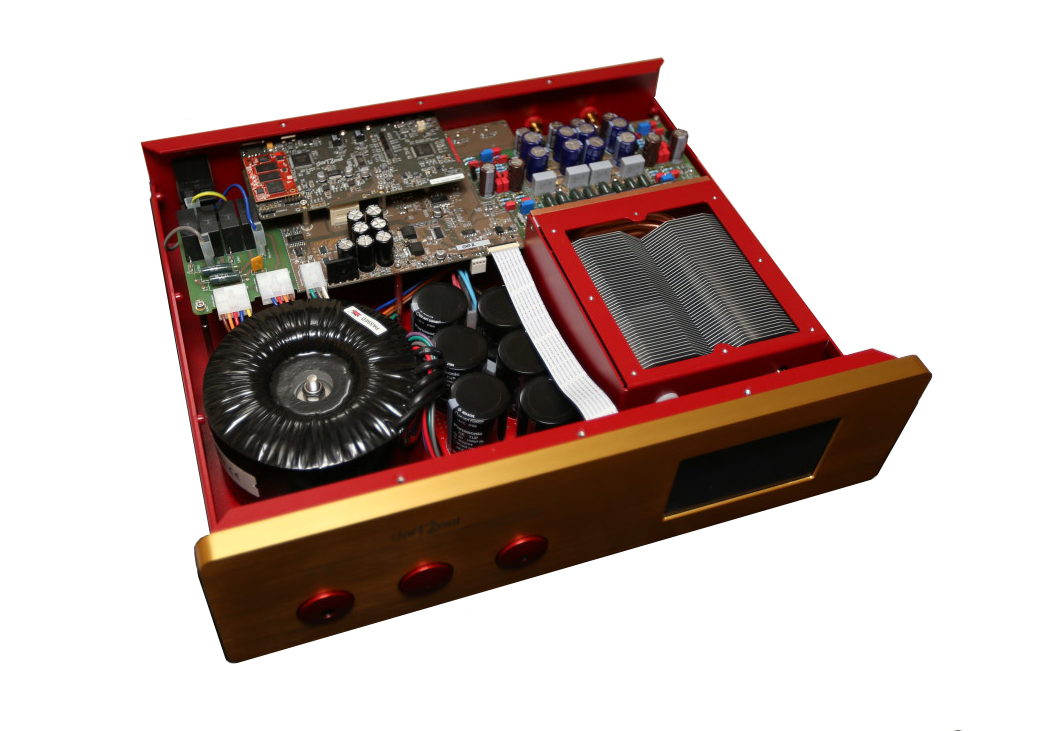
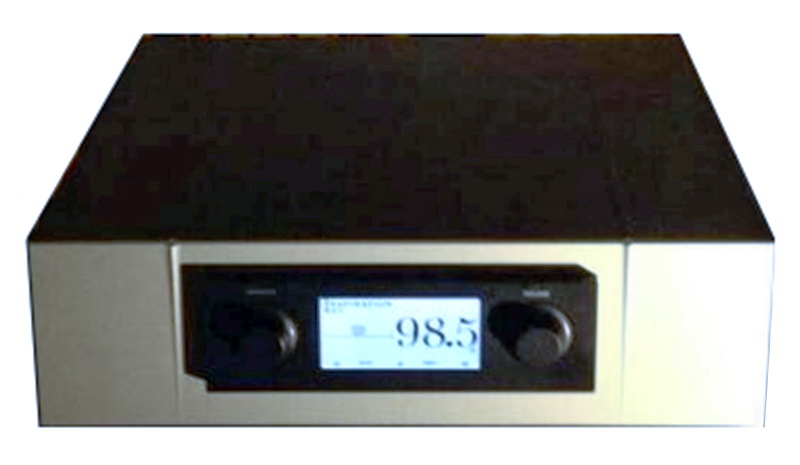
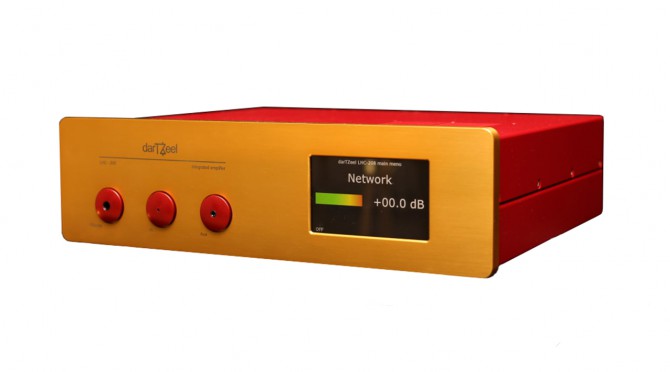
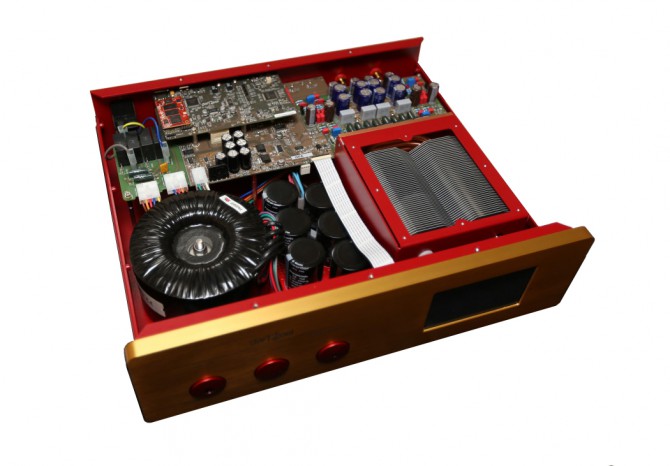
LHC-208 integrated streaming amplifier
darTZeel is proud introdusing it’s first integrated line amplifier with full digital streaming capabilities.
powerful, easy to use, extremely versatile, the LHC-208 fills the gap between conventional DACs and integrated amplifiers available so far.
Key features include:
・Newly designed TFT tactile screen for intuitive, user-friendly operation.
・4 analog inputs.
・6 digital inputs.
・Up to 352.8/24 and 2xDSD.
・Unique darTZeel Smart Clock system.
・Special darTZeel cooling control.
・Full HT bypass function.
・Remote via computer or tablet.
・Optional infrared remote control.
・Headroom for additional features.
・Full aluminium chassis.
With its innovative design, darTZeel breaks the musical frontier of dematerialized music.
Whatever the source format, the LHC-208 will treat, decode and play digital files as if they were purely analog.
Listening is believing.
Technical data
・Normal output power:
- 200watts RMS(220 watts peak)@8 ohms
- 300watts RMS(330 watts peak)@4 ohms
- 325watts RMS(375 watts peak)@2 ohms (software limited)
・Line Gain:
- 0dB normal, up to +12dB
・Power Stage Gain:
- 26dB@8ohms
・Analog Inputs:
- 1xZeel 50-ohm BNC
- 3xRCA line
- 1xAUX 3.5mm front panel jack
・Digital Inputs:
- 1xRJ45 Network
- 1xUSB
- 2xSPDIF (RCA 75 ohms)Z
- 2xTOS Link
・Analog Output:
- 1xHeadphone 6.35mm front panel jack
・Frequency response:
- 7Hz-170kHz +0,-6 dB
- 20Hz-20kHz +0,-0.5dB
・Rise time:
- <0.8μs
・Slew rate:
- >100Wμs, peak-peak
・DC output voltage:
- +- 15mV max
・Normal Harmonic Distortion:
- <1% from 7Hz to 77kHz
・temporal Distortion:
- None, at any level and load, as specified above
・Crosstalk:
- <-80dB@1kHz
・Signal to noise ratio:
- >105 dB(A) @ normal power
・Power consumption:
- 2 watts Standby, 40watts @idle, 900watts @maximum output power
・Size in mm:
- 440 x 350 x 130 (WxDxH)
・Net weight:
- 16kg
海外ニュース速報 [World]
*以下のスペックは、avcatにて書き起こしたものになりますので、誤字等が存在する可能性があります。
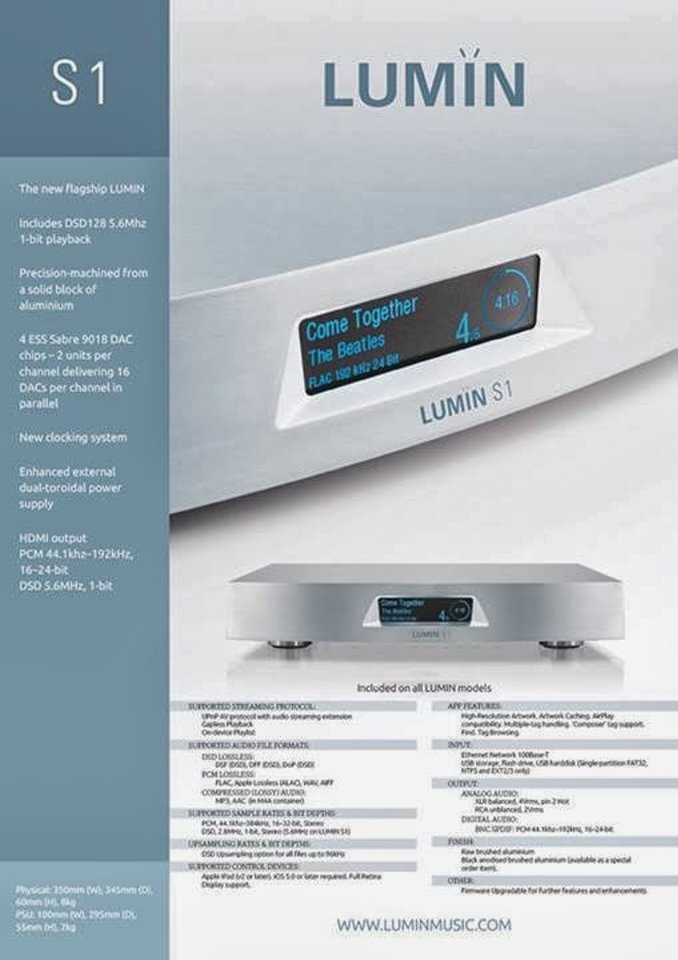
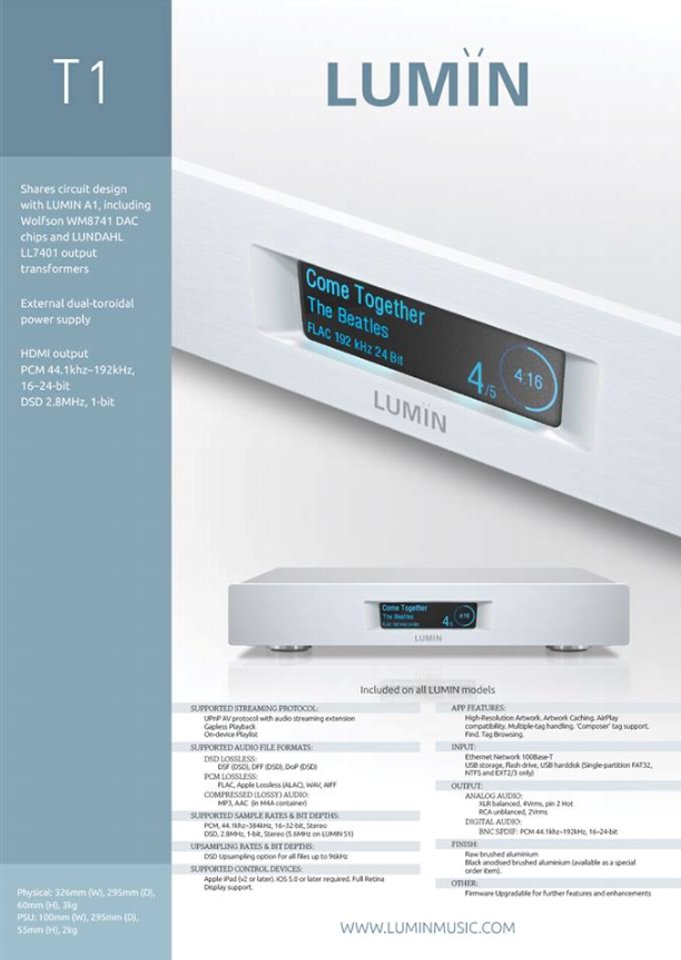
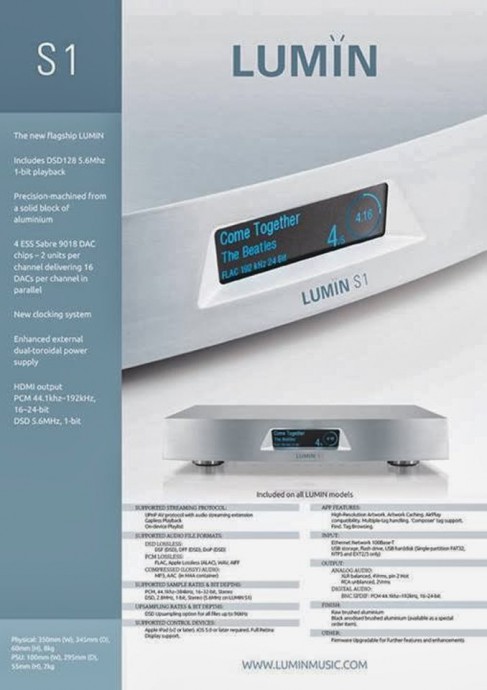
Lumin S1
・The flagship LUMIN
・Includes DSD 128 5.6Mhz 1-bit playback
・Precision-machined from a solid block of aluminium
・4 ESS Sabre 9018 DAC chips -2 units per channel delivering 16 DACs per channel in parallel
・New clocking system
・Enhanced external dual-toroidal power supply
・HDMI output
・PCM 44.1kHz-192kHz, 16-24bit
・DSD 5.6MHz, 1bit
・physical:350mm(W),345mm(D),60mm(H),8kg
・PSU:100mm(W),295mm(D),55mm(H),2kg
Lumin A1
・The original LUMIN
・One of the best-reviewed audio products of 2013
・Precision-machined from a solid block of aluminium
・Wolfson WM8741 DAC chips, 1chip per channel
・External dual-toroidal power supply
・HDMI output
・PCM 44.1kHz-192kHz, 16-24bit
・DSD 2.8MHz, 1bit
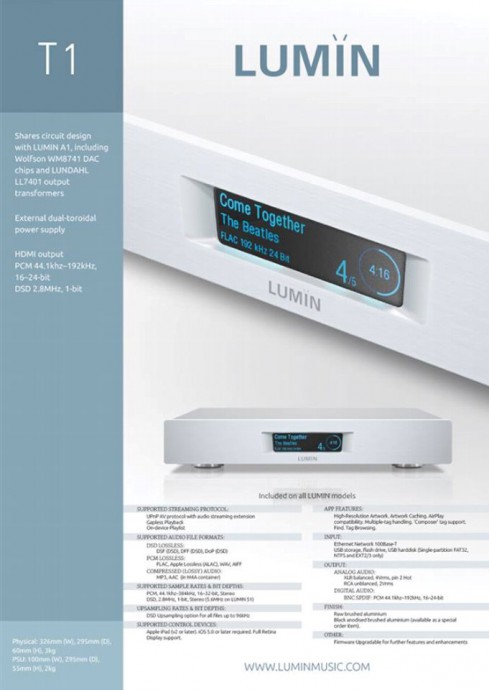
Lumin T1
・Shares circuit design with LUMIN A1, including Wolfson WM8741 DAC chips and LUNDAHL LL7401 output transformers
・External dual-toroidal power supply
・HDMI output
・PCM 44.1kHz-192kHz, 16-24bit
・DSD 2.8MHz, 1bit
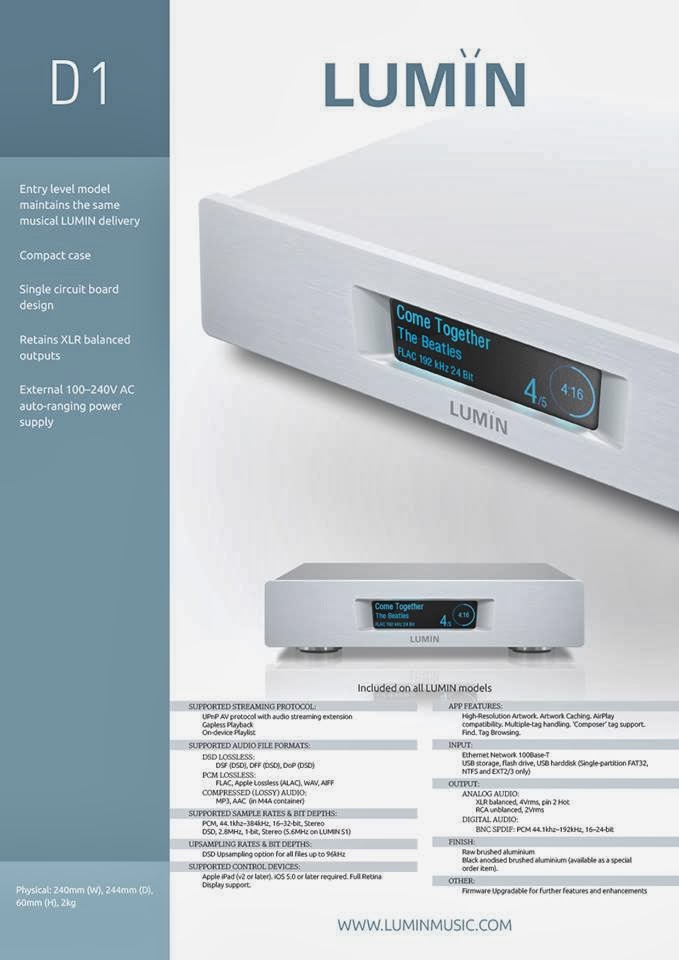
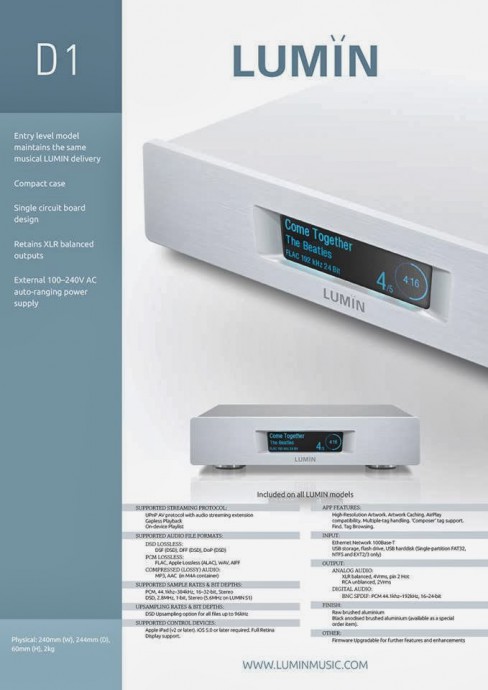
Lumin D1
・Entry level model maintains the same musical LUMIN delivery
・Compact case
・Single circuit board design
・Retains XLR balanced outputs
・External 100-240V AC auto-ranging power supply

海外ニュース速報 [World]
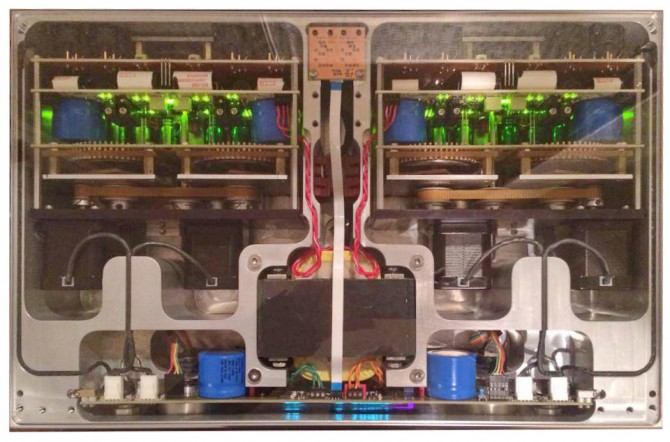
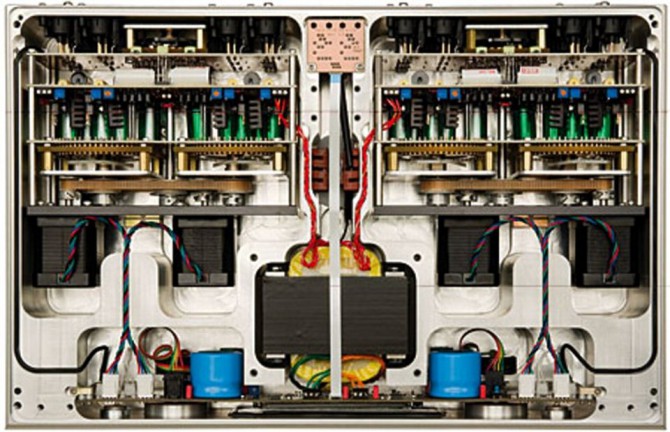
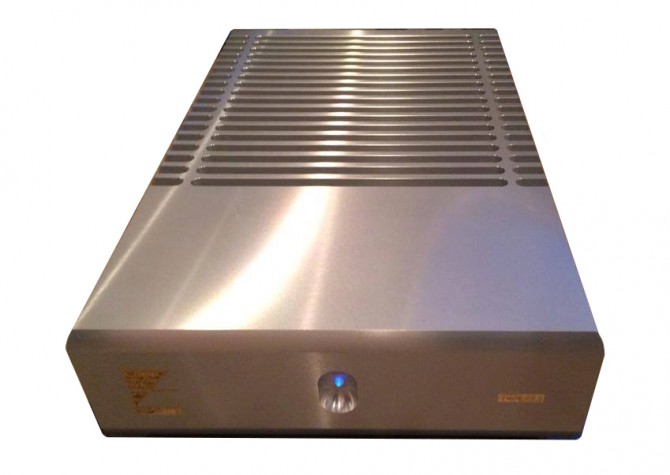
既にインターナショナルオーディオショウにて発表済みです。
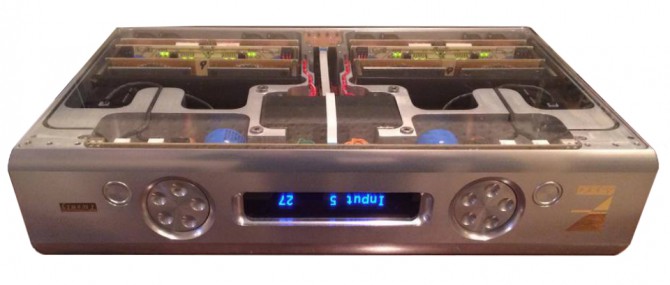
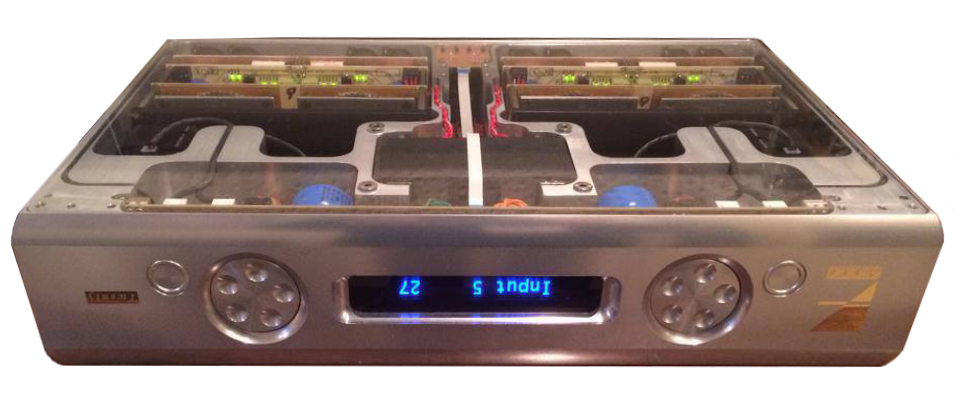
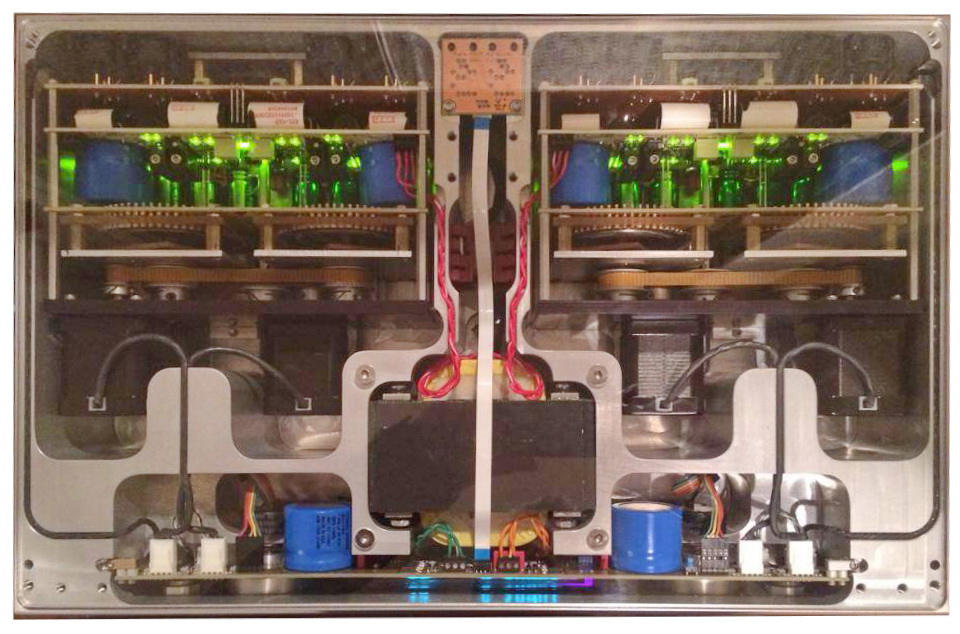
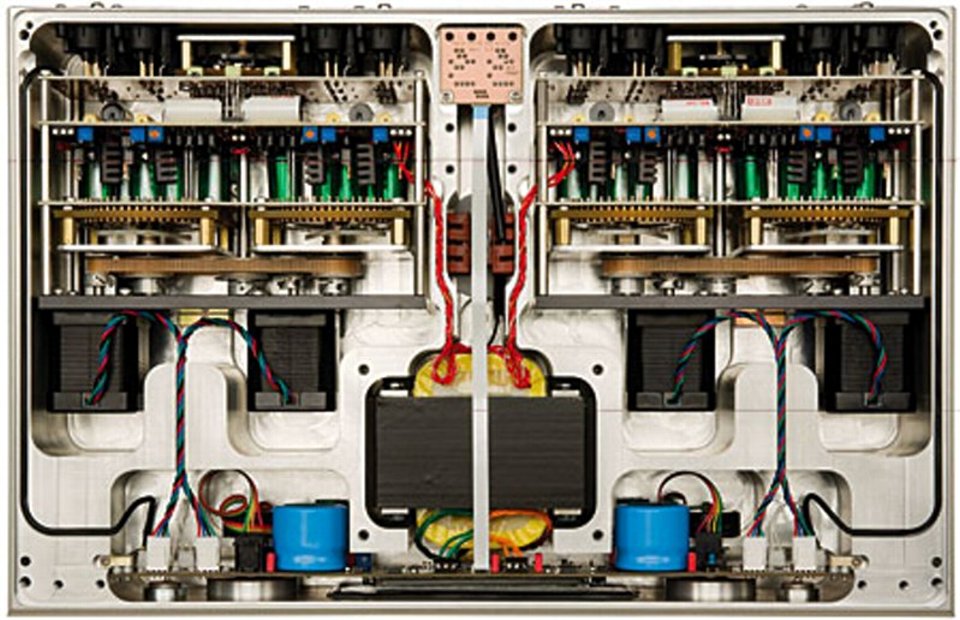
*内部写真上がKX-R Twenty、内部写真下がKX-R
海外ニュース速報 [World]
C4 Platinum
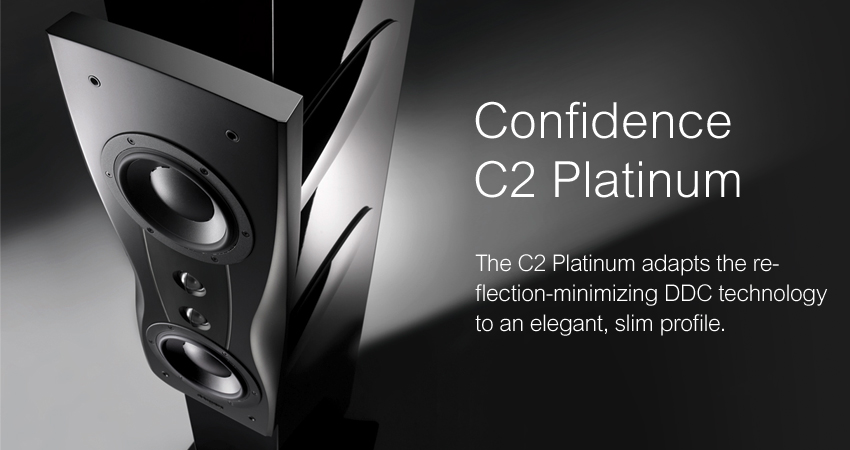
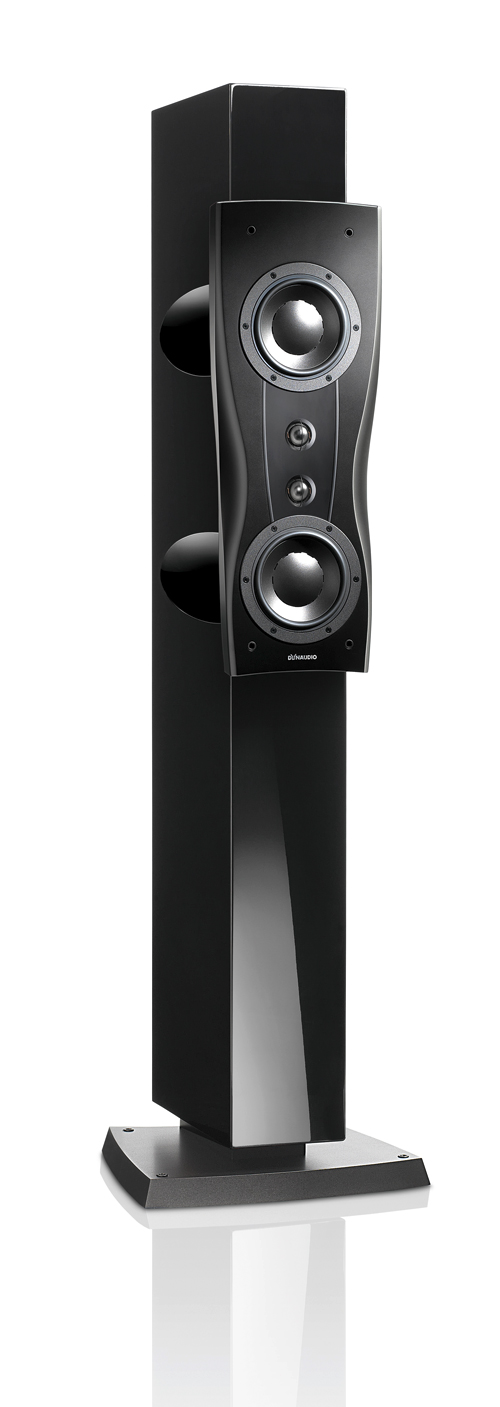
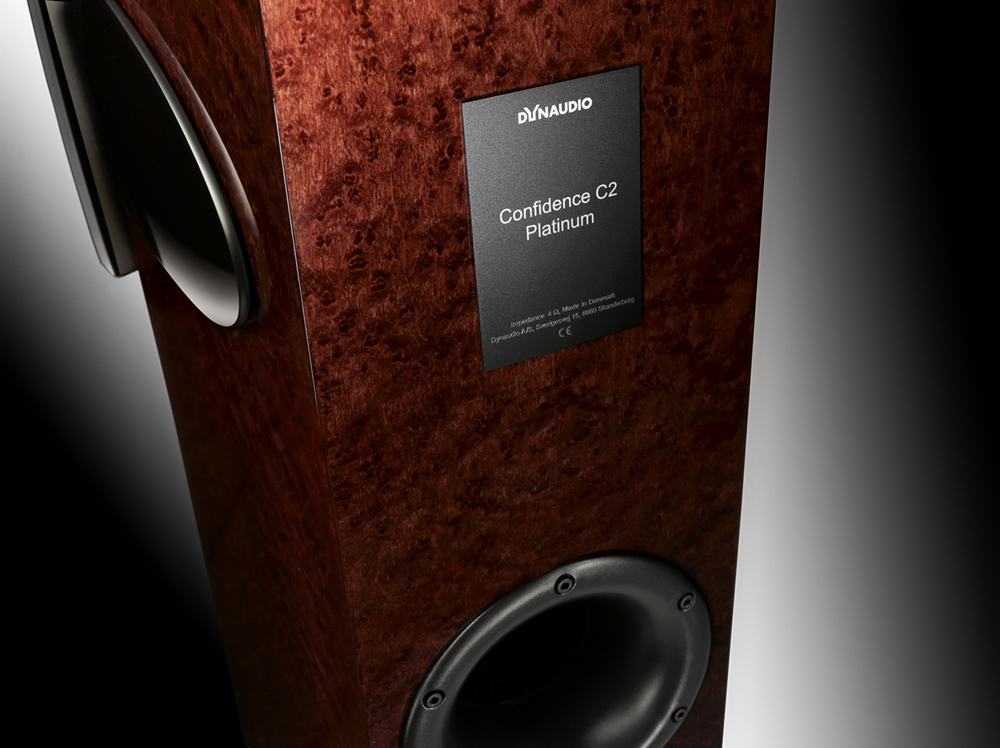
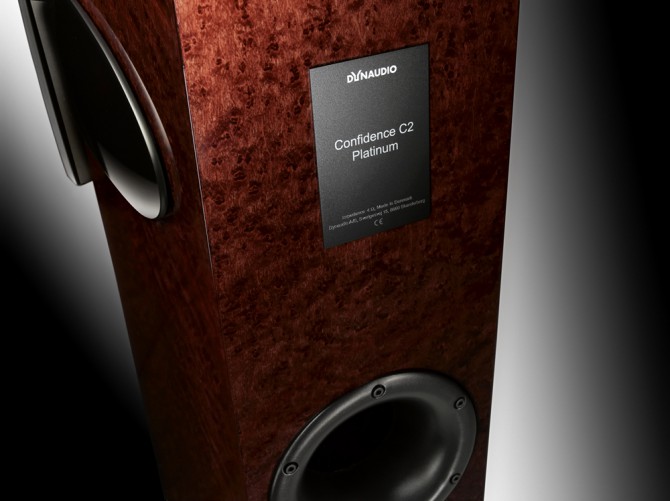
C2 Platinum
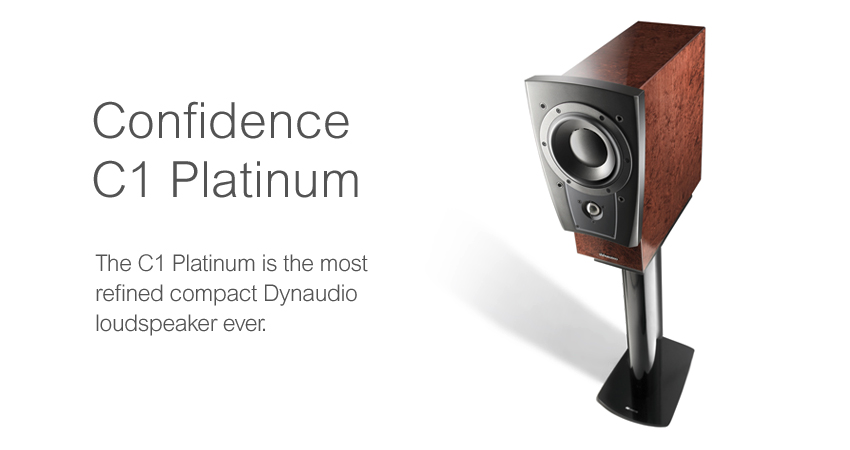
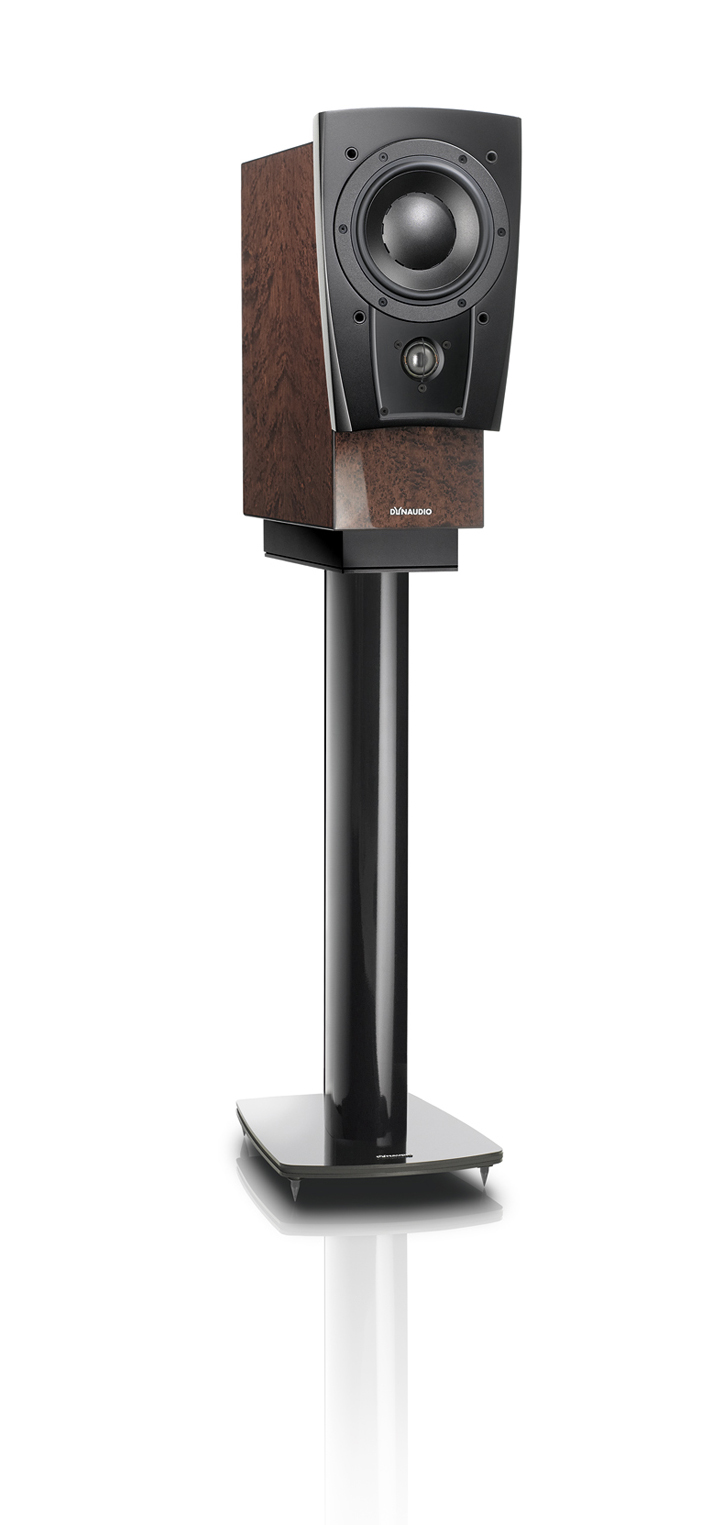
C1 Platinum
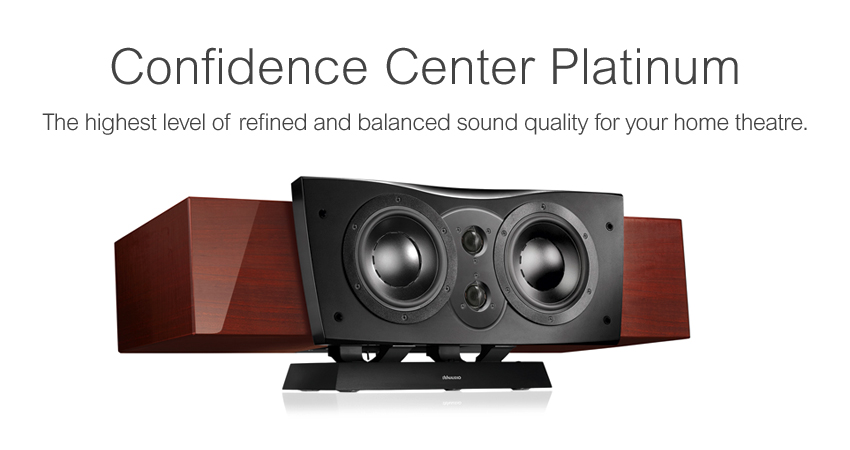
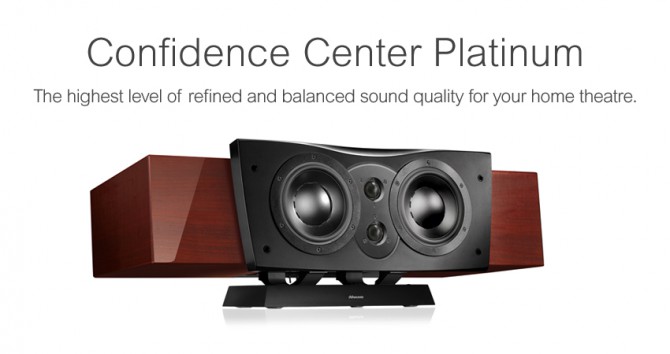
Confidence Center Platinum
メーカーサイト
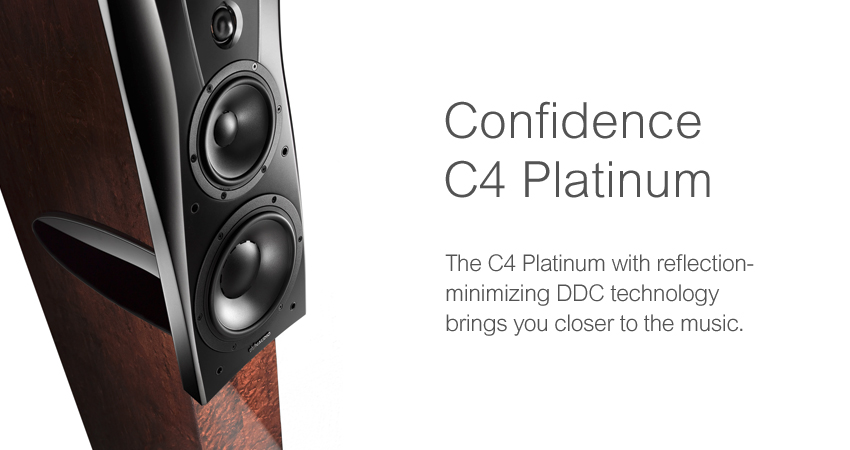
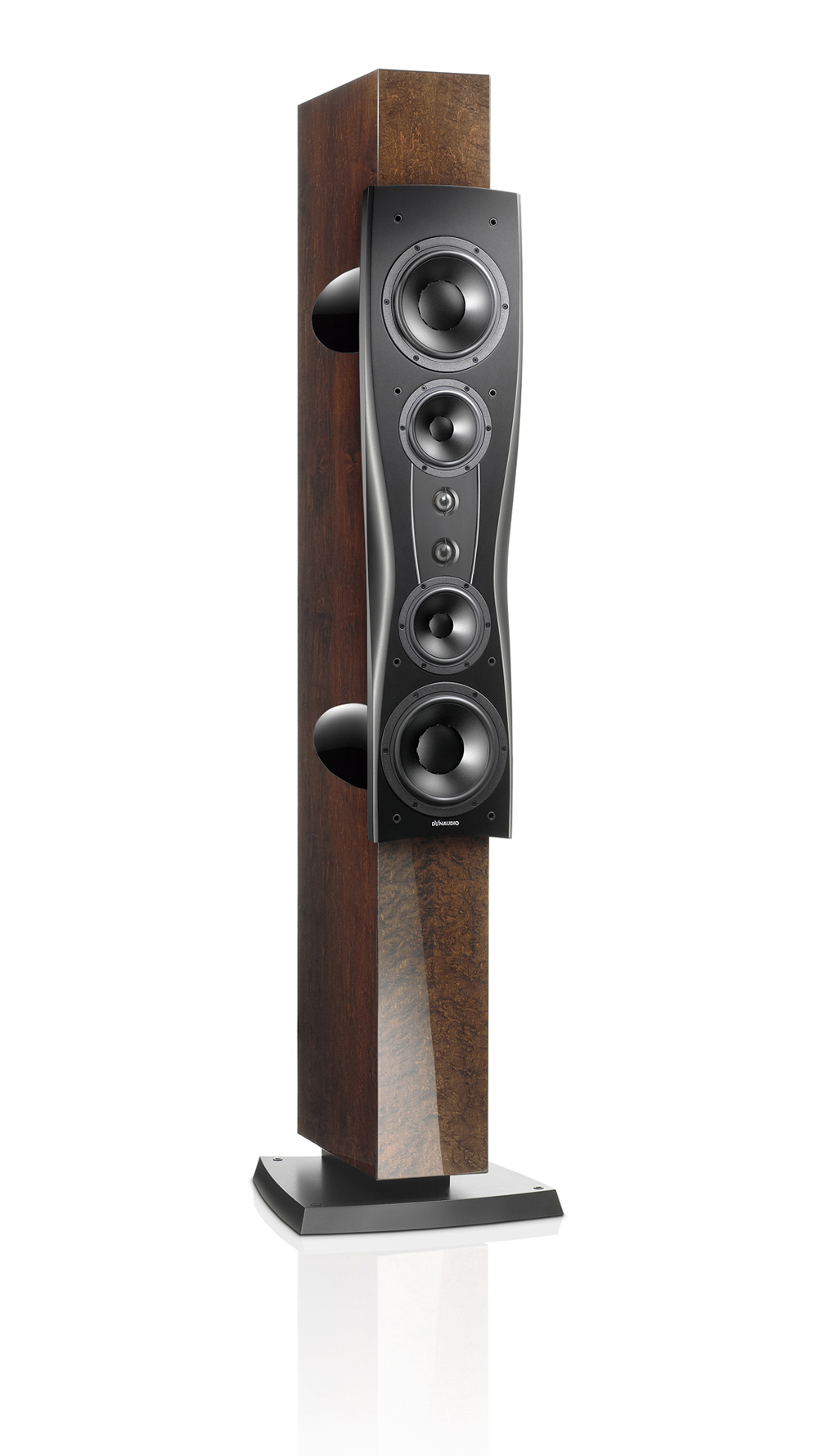
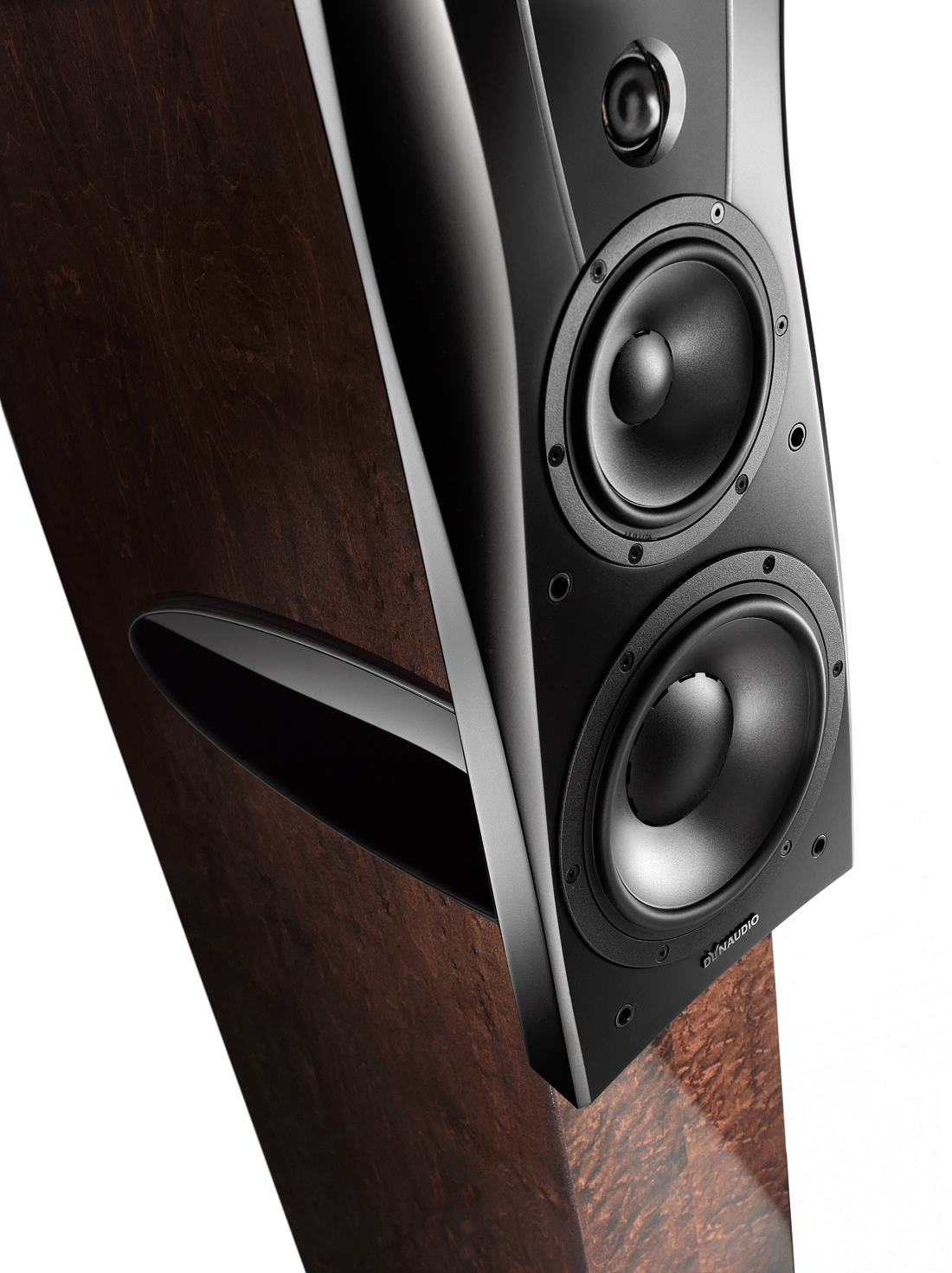
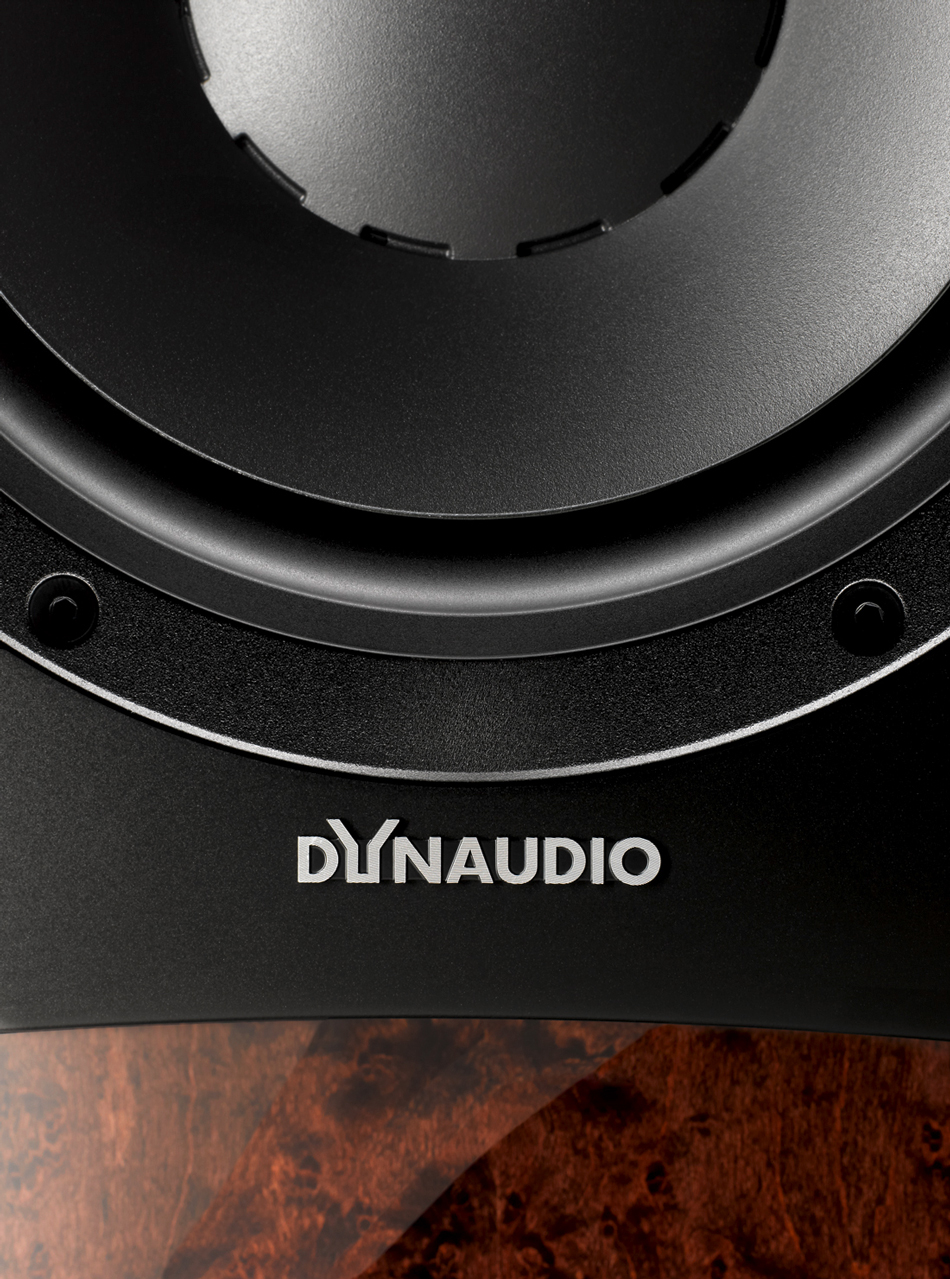
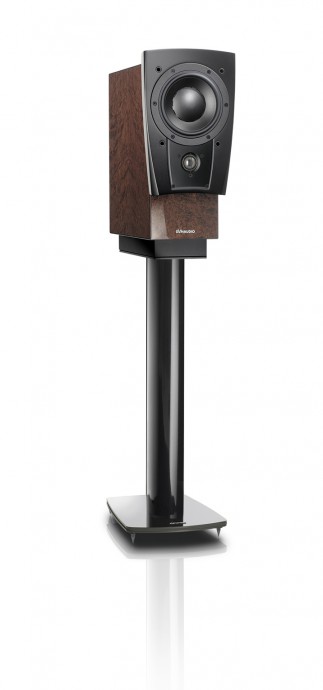
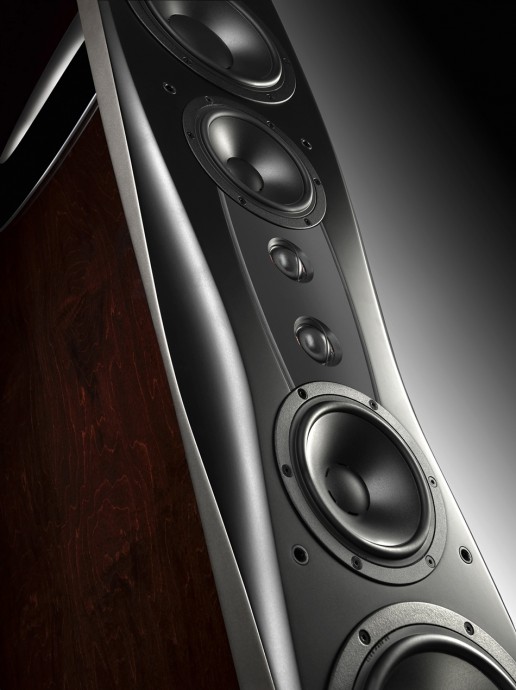
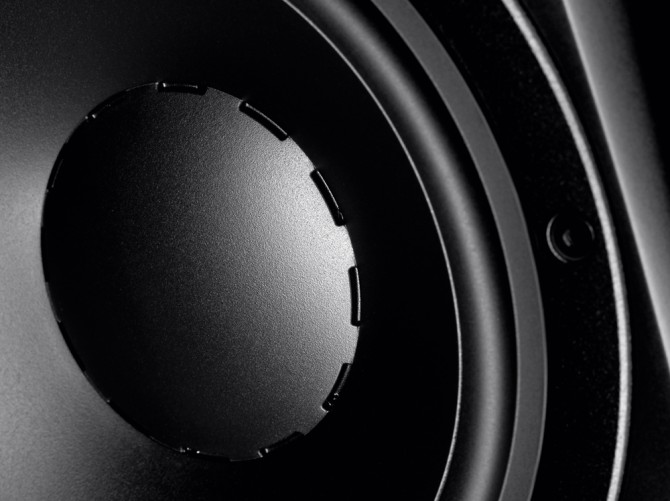
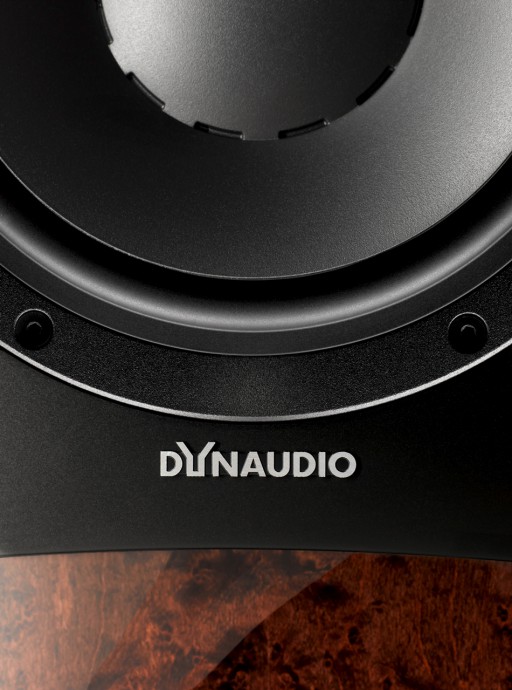
With the new Platinum version, the current Confidence series has been updated with an aesthetic evoking the fascinating finish and visual appearance of Dynaudio’s latest flagship loudspeaker, the Evidence Platinum.
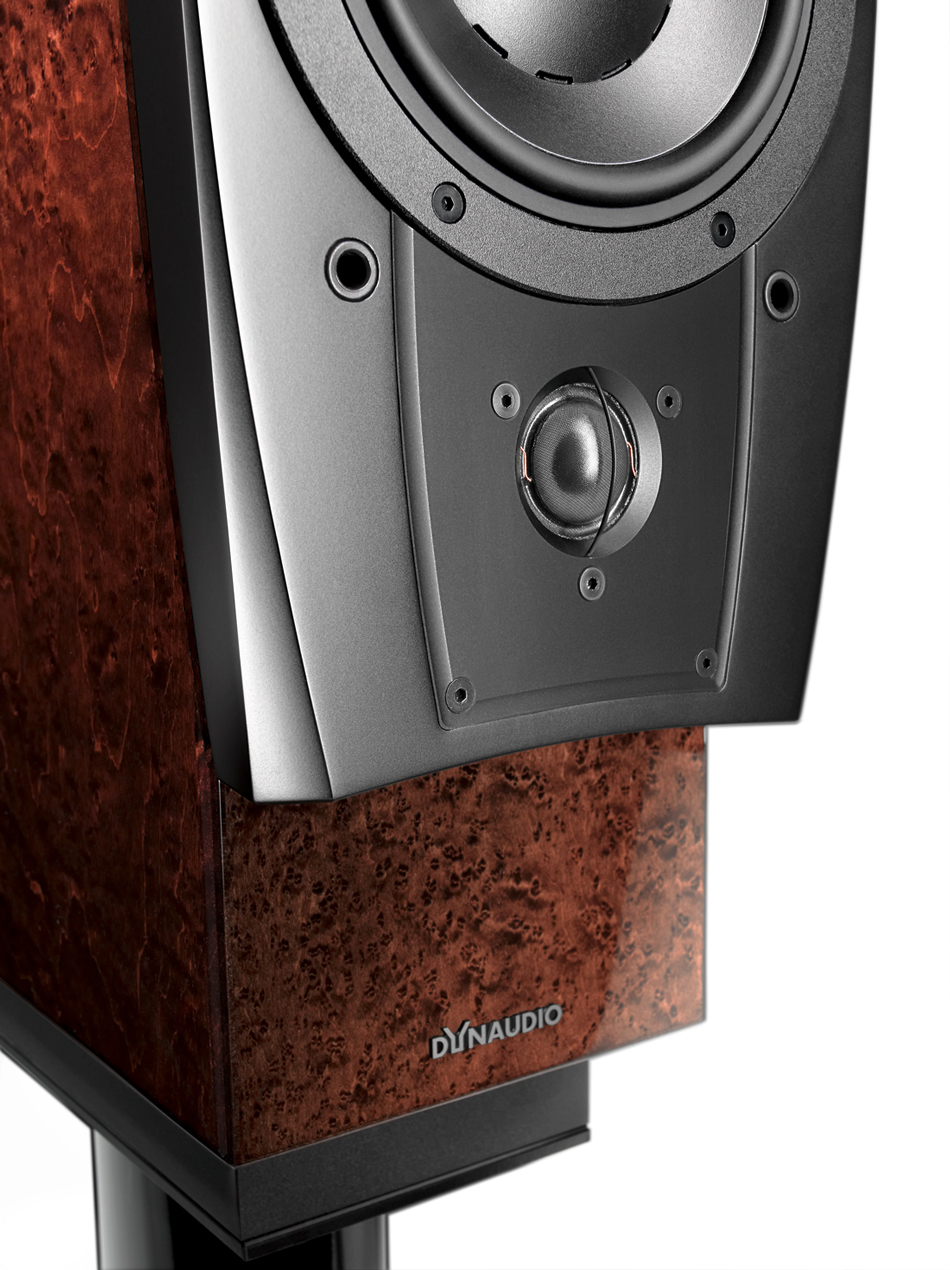
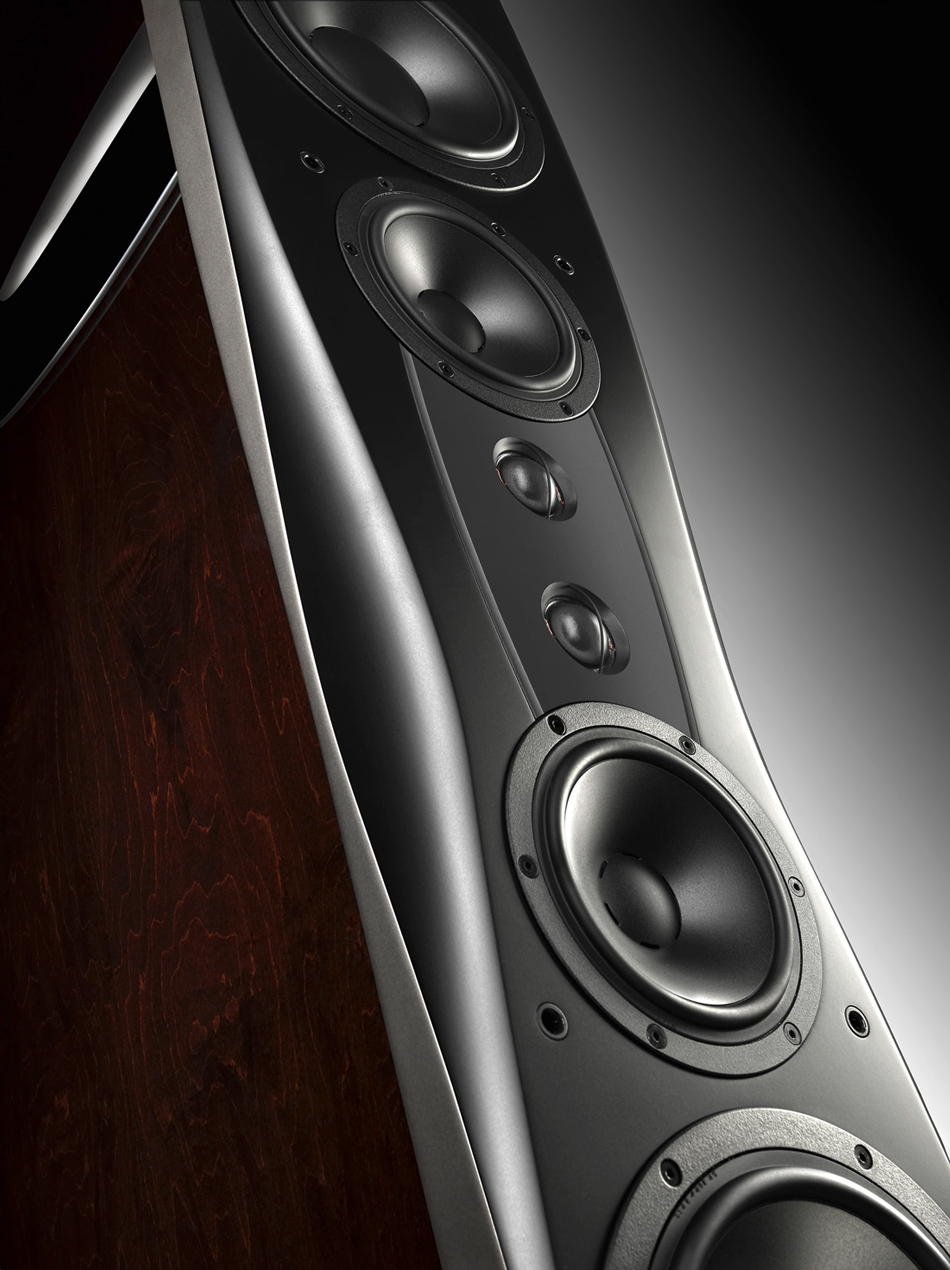
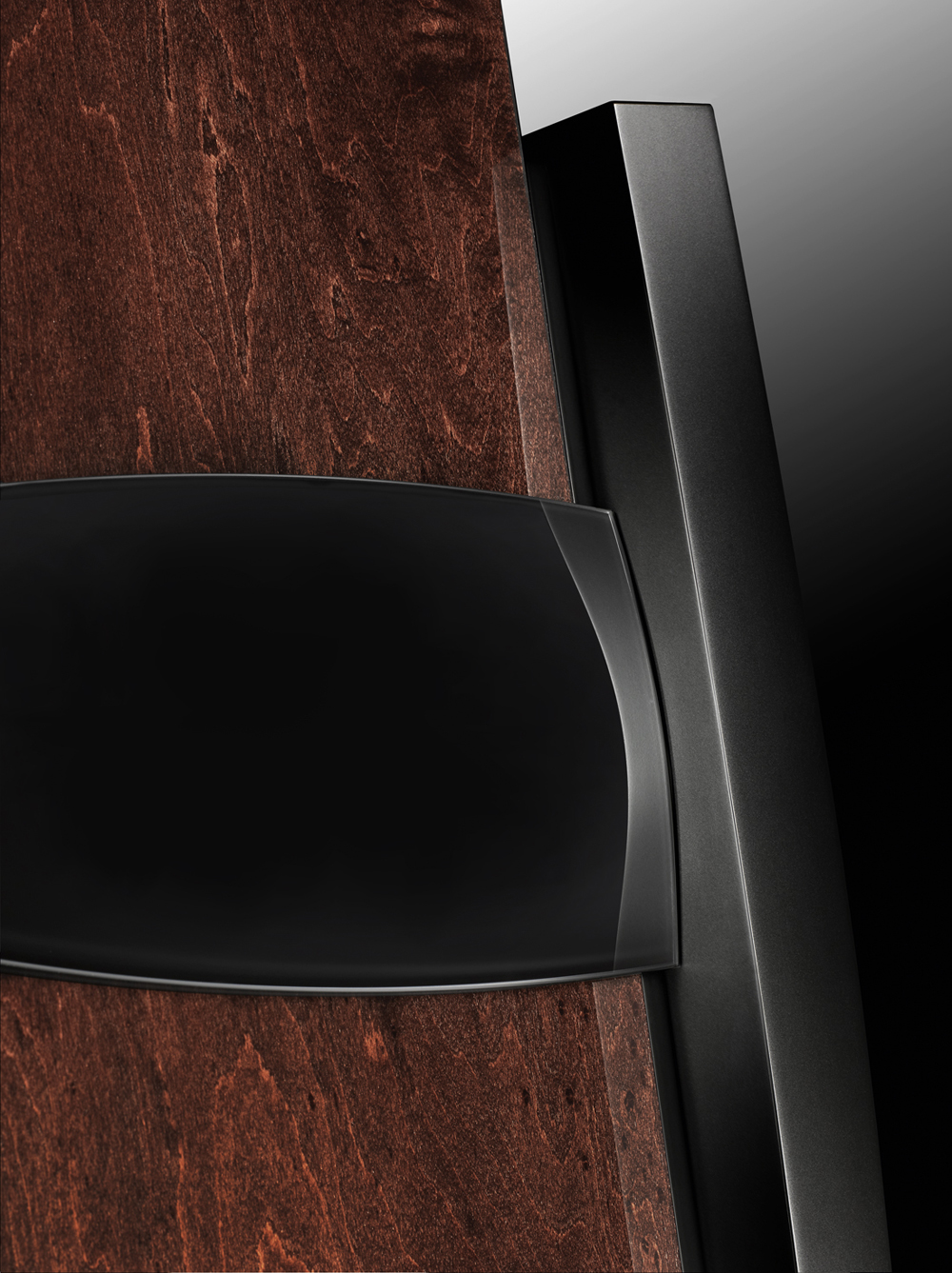
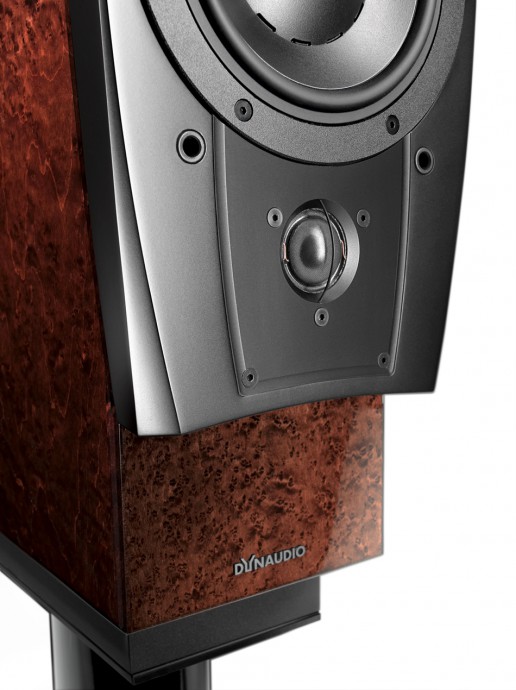
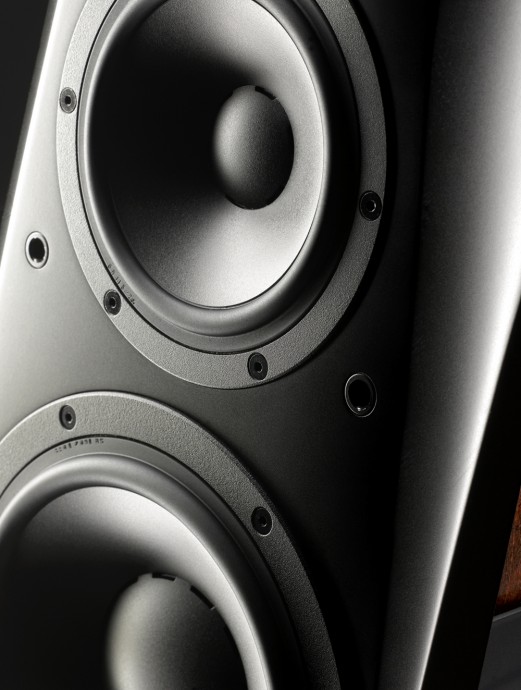
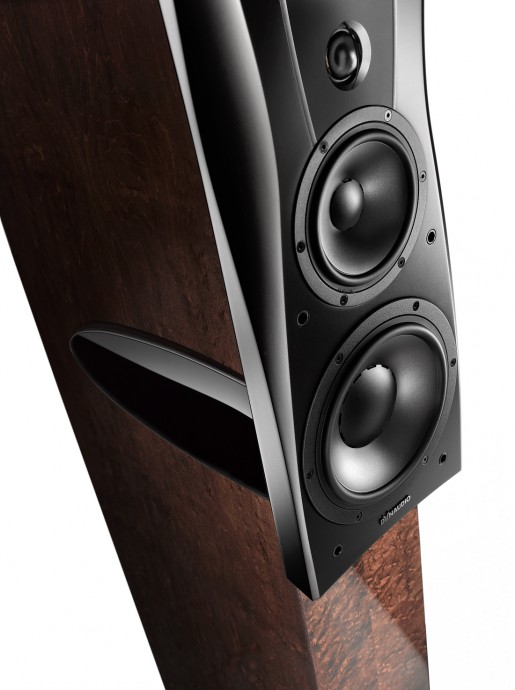
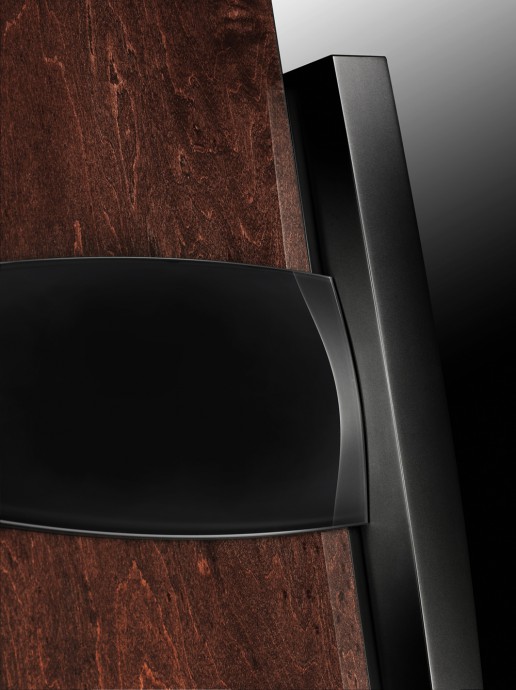
While the Confidence speakers’ advanced technology and unparalleled sound quality remains unchanged since the performance updates that the current generation of models received when introduced in 2011, the new Confidence Platinum design aesthetic features all aluminium parts now finished in satin black. The aluminium tweeter plate received additional glass-blasting to achieve the finest finish effect. The black detailing provides the Confidence Platinum models a stronger, bolder and darker appearance that stands out from all earlier Confidence models.
As a further refinement the Confidence Platinum models are available in the select finishes established with the Evidence Platinum:
Mocca – Bird’s Eye Maple real wood veneer stained in dark brown, finished with clear piano lacquer. Bordeaux – Bird’s Eye Maple real wood veneer stained in dark red, finished with clear piano lacquer. Rosewood – Rosewood veneer stained in a glowing dark red, finished with clear piano lacquer. Piano Black – Deep black piano lacquer
Created and hand-built by Dynaudio in Denmark, the Confidence Platinum models are available in other finishes upon request via special order.
About the Confidence series
The Dynaudio Confidence series is one of the most well-established high-end loudspeaker series on the market, having received many awards and accolades over the years. When the Confidence II/Signature series was introduced in 2011, the sound quality benchmark was pushed to an even higher level: The Esotar2 tweeter was improved via the latest Precision Coating to achieve even finer, more detailed high frequency performance, while the crossover and internal cabling received upgraded components and materials first used in the legendary Dynaudio Sapphire and Consequence Ultimate Edition models.
All these improvements remain in the new Confidence Platinum, combined with the distinctive appearance of the cabinet finished in piano lacquer and all aluminium parts finished in satin black.
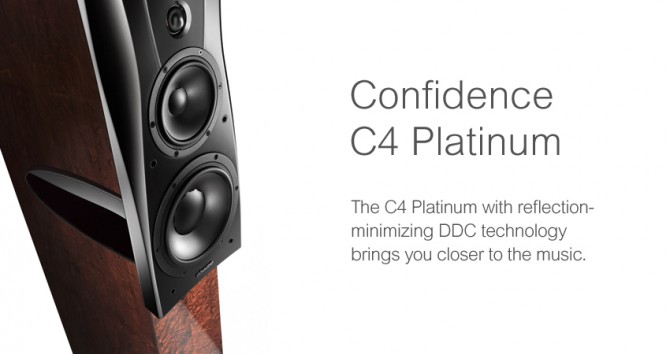
The best possible sound performance in any room: Confidence Platinum with DDC.
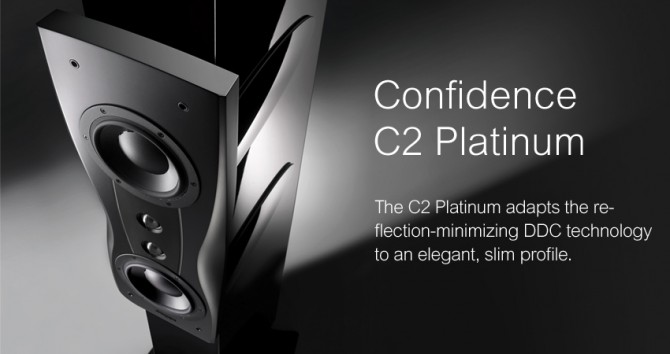
The floor-standing Confidence C2 and C4 Platinum are equipped with DDC – Dynaudio Directivity Control. Understanding that loudspeakers are only as good as the room they are played in, the Dynaudio engineers developed this unique technology in order to reduce the influence of room acoustics and allow the Confidence to perform at its very best in any listener’s room. DDC is a finely tuned balance of advanced crossover design, exact frequency and phase tuning and precise drive unit positioning that reduces sound reflections from floor and ceiling boundaries by 75%. The Confidence Platinum models with DDC allow an authentic, three-dimensional sound stage rendering between the two speakers, as close to the recording as possible. DDC addresses room acoustics without altering the music signal via room correction electronics, and without the need for any visually distracting room acoustic treatments. DDC brings you closer to the music, in your own listing room. Read more about DDC…
Finest Components, fine-tuned to perfection
Every Confidence model incorporates Dynaudio’s best tweeter, the renowned Esotar². In its current version, the 28mm fabric soft is further perfected with Dynaudio’s Precision Coating, which served to improve the exceptionally smooth response and the authentic reproduction of finest musical details.
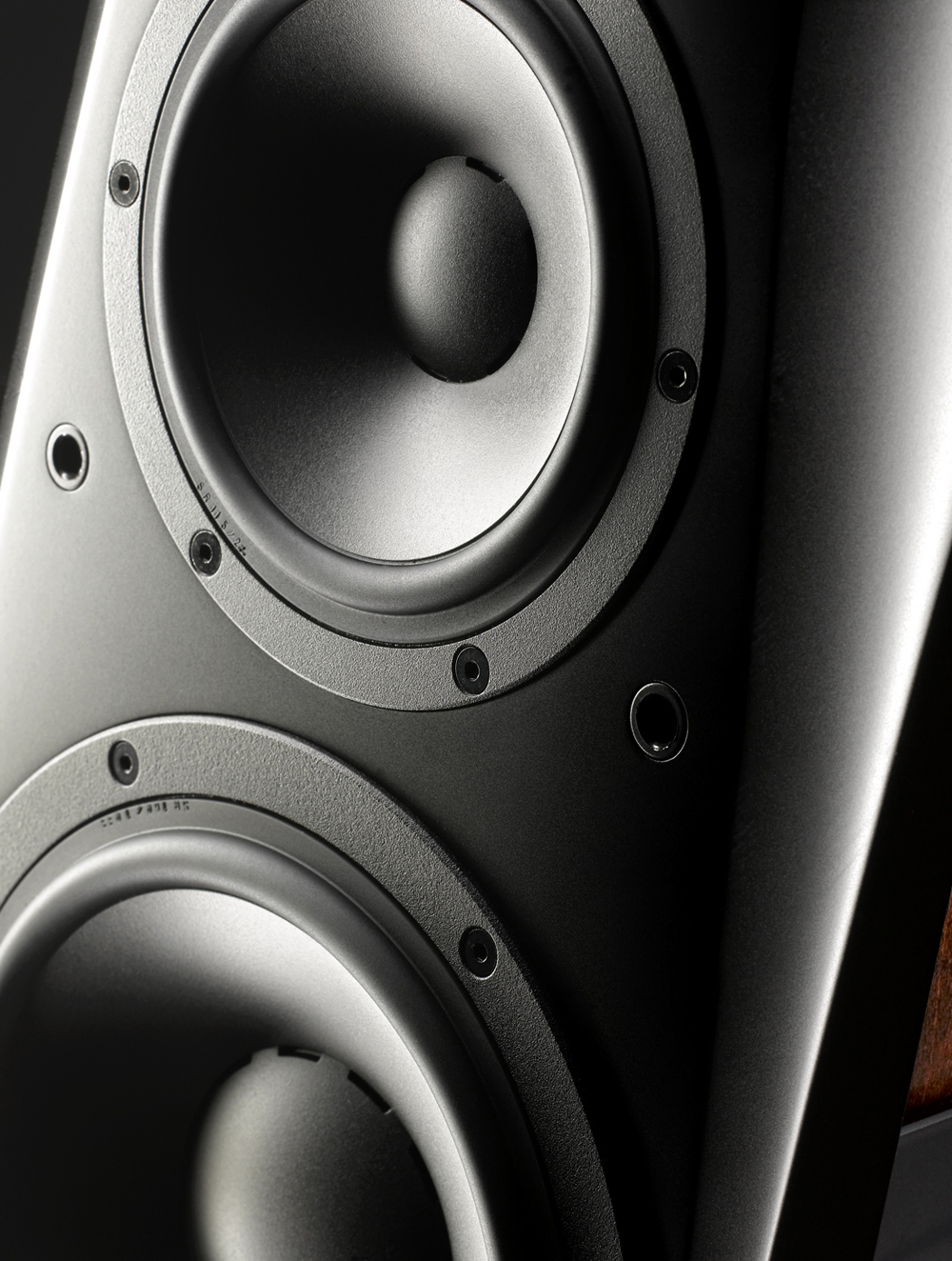
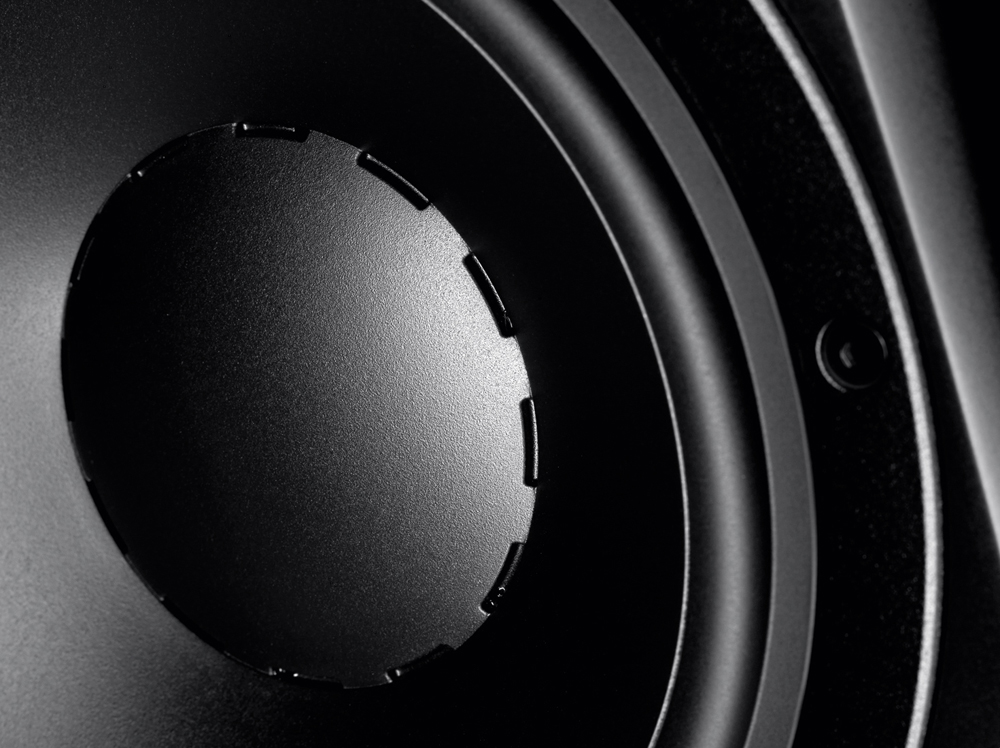
The Confidence woofers feature ultra-light, thermally stable aluminium coils wound on special Kapton formers. Kapton is a high-tech synthetic material which remains extremely light while being extraordinarily heat resistant and stiff. The advanced voice coil construction combined with the Magnesium Silicate Polymer diaphragm and the extra-rigid die-cast aluminium basket combine for a most precise and dynamic bass performance.
The drive units are mounted onto a distinctive sound-optimized baffle. The shape has been designed to reduce unwanted early reflections at the corners, while the baffle itself is further decoupled from the cabinet with a low-resonance medium-density fibre-board between baffle and cabinet. The tweeters are mounted onto a solid aluminium block, itself embedded into the baffle, to achieve the most rigid, low-resonance foundation. These combined efforts ensure perfect sound radiation as well as a dynamic and powerful sound even at higher volumes.
The crossover in the Confidence Platinum features the latest ceramic resistors, air core coils and high-quality capacitors along with the new thin film resistors and new internal wiring incorporated into the Signature/II update. The result is an even better, more authentic reproduction of musical details, especially with delicate sounds from strings, piano and singing voices.
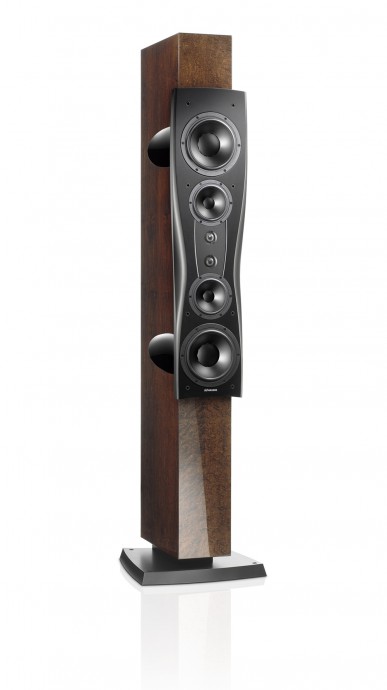
C4 Platinum
Technical Specifications
Sensitivity 88 dB (2,83 V/1 m) IEC Power Handling 400 W Impedance 4 Ohms Frequency Response 27 Hz – 25 kHz (± 3 dB) Box Principle 3-way bass-reflex Crossover Frequencies 730 Hz / 2200 Hz Weight 55 kg Dimensions (W x H x D) 250/420 x 1732 x 445 mm 9.8/16.5 x 68.2 x 17.5″
C2 Platinum
Technical Specifications
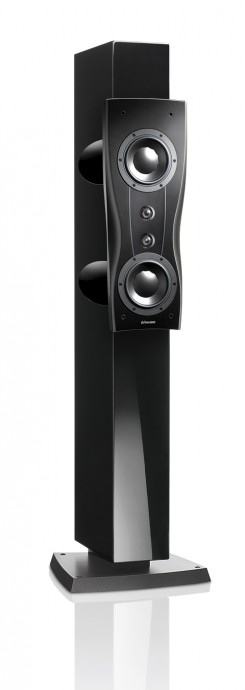
Sensitivity 87 dB (2,83 V/1 m) IEC Power Handling 300 W Impedance 4 Ohms Frequency Response 28 Hz – 25 kHz (± 3 dB) Box Principle 2-way bass-reflex Crossover Frequency 2200 Hz Weight 40 kg Dimensions (W x H x D) 238/420 x 1532 x 445 mm 9.4/16.5 x 60.3 x 17.5″
C1 Platinum
Technical Specifications
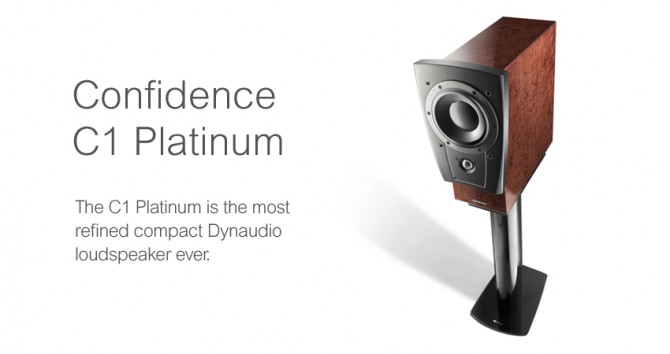
Sensitivity 85 dB (2,83 V/1 m) IEC Power Handling 170 W Impedance 4 Ohms Frequency Response 45 Hz – 22 kHz (± 3 dB) Box Principle 2-way bass-reflex Crossover Frequency 1800 Hz Weight 10.9 kg Dimensions (W x H x D) 200 x 445 x 430 mm 7.9 x 17.5 x 16.9″
Confidence Center Platinum
Technical Specifications
Sensitivity 87 dB (2,83 V/1 m) IEC Power Handling 300 W Impedance 4 Ohms Frequency Response 45 Hz – 22 kHz (± 3 dB) Box Principle 2-way bass-reflex Crossover Frequency 2200 Hz Weight 20.6 kg Dimensions (W x H x D) 800 x 270/300 x 380 mm 31.5 x 10.6/11.8 x 15″
<写真ギャラリー>
海外ニュース速報 [World]
Daniel-Hertz-Master-Class-announcement
購入はこちらのサイトから:http://www.danielhertz.com/index.php/master-class
Master Class
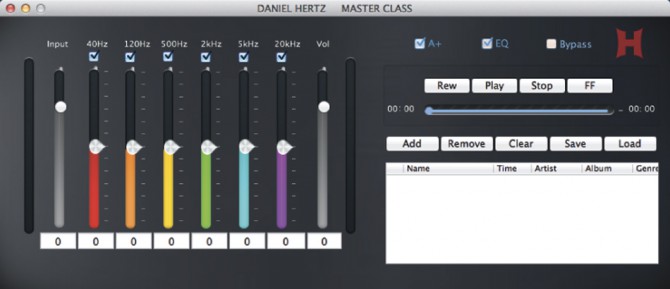
Daniel Hertz Master Class is a highly innovative music player for Mac that offers superior sound quality and unique features designed for people who want the most natural sound. For the first time in history, listeners can have the sound and feeling of the best analog master tapes from digital sources including CD and compressed music downloads.
The Player
The sound quality of music players varies. ITunes, Quicktime, and Windows Media Player all sound different. Master Class is designed to provide the most natural sound and faithful reproduction of recorded music. Master Class will open any music library, folder, or track in AIFF, WAV, AAC or MP3 at any standard resolution. To listen to music, just open a file and play. You can make playlists and save them.
A+
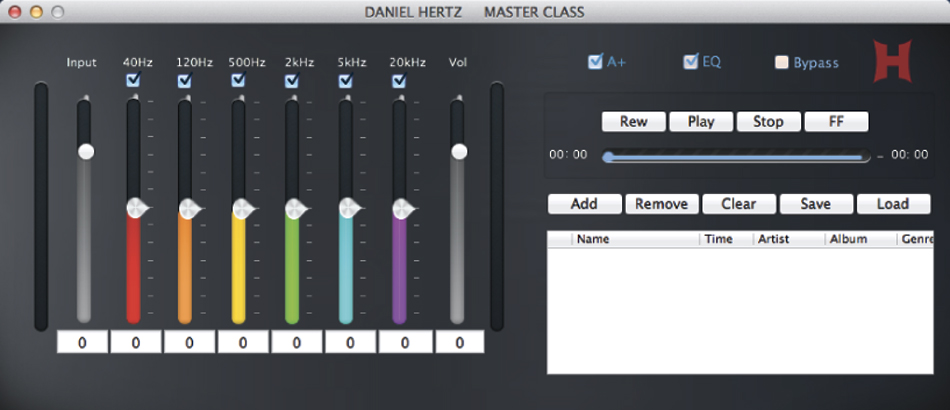
Master Class includes a technology called A+. With A+, the listening experience is much more like analog. Since the introduction of digital audio, many people have noted that, despite its convenience, the actual listening experience is not as enjoyable as analog formats like the LP and analog tape. A+ can be turned on and off by clicking a box in the GUI (graphic user interface). The change is very subtle and many people will not hear it immediately, but the listening experience is not the same. A+ offers the best of analog and the best of digital, for the first time, on Mac. Many listeners will use Master Class with only A+ switched on.
EQ (Equalization)
Master Class enables the listener to make tonal balance corrections from the most subtle to the most dramatic. In 1985, audio designer Mark Levinson created the legendary Cello Audio Palette, the world’s first sonically transparent tone control system. The Cello Audio Palette is today the most expensive and rare audio component, prized for its ability to fine tune the sound with no distortion or noise. Master Class offers the same capability in the digital domain, with some refinements and new and valuable features such as A+ and the ability to save presets and print files that capture the content with A+ and the EQ dialed in by the user.
Why EQ is important?
Content Every recording is optimized for sound in the mastering process. Since the tonal balance of playback systems used by mastering engineers vary in tonal balance, so do the recordings. It is established that mastering systems vary up to +/- 12dB in frequency response; therefore the recordings do as well. In practice, adjustments ranging from tenths of a dB up to 6dB are sufficient to optimize most good recordings, but many need more. Master Class provides up to +/- 12 dB adjustment at 6 frequencies, in 0.1dB steps.
Equipment
The human ear is extremely sensitive to small changes in frequency response. A few tenths of a dB change can be easily heard by many people. Many of the sonic differences provided by “high end audio” cables and other products are actually small changes in frequency response. Spending large amounts of money on such products is not the most efficient and intelligent way to improve the sound of a system. Master Class enables the listener to quickly optimize the sound in the most precise way, with the flexibility needed to achieve the best results.
Examples of ways in which frequency response can be altered in audio systems Most people do not understand the ways in which impedance, resistance, inductance, and capacitance affect frequency response. Every audio electronic component (active or passive) has an output impedance. Every audio amplifier has an input impedance and output impedance. Every speaker has an input impedance that varies with frequency. When one component is connected to another, the frequency response at the input and output might not be the same, due to interactions which are in many cases unavoidable. For example, vacuum tube amplifiers tend to have an output impedance high enough to create significant interactions with the load impedance of the speaker. People may think they prefer one amplifier to another, but in many cases, what they are preferring is the frequency response of one amp/speaker combination to another. The interconnect and speaker cables add another variable that creates sonic differences, many of which are frequency response related. Master Class provides the listener with the ability to optimize the frequency response of a given audio chain in 0.1 dB steps with no distortion or coloration. The user can store an overall system setting (or a number of them) to optimize the sound according to personal taste. Instead of changing equipment, just dial in the correction.
Room acoustics
Most living rooms are good environments for listening to music. A small overall system frequency response correction might improve the sound, but serious problems in room acoustics cannot be addressed with EQ. This is because reflections and resonances affect the time domain, not just amplitude. Master Class is not intended to correct major room acoustics issues.
FILE/SAVE AS
Once a recording has been fine tuned, it can be saved by using the “FILE/SAVE AS” command. Label the file and save it in your music library or a folder, and play it instead of the original file. An easy way is to add “MC” to the end of the file, so it reads, for example, Over the Rainbow MC.AIFF or Over the Rainbow MC.WAV. Then you can easily identify the MC files you have made from the originals.
Presets
You can save presets with the SAVE PRESET command. For example, if you find that a certain preset is great for all classical recordings by RCA, you can make a preset labeled possibly RCA MC. Or a preset for vintage rock and roll might be labeled VINTAGE RR MC. You can save a preset for listening on headphones, and call it HP
MC. If you find a certain correction makes the best sound for your car, you can make files called CAR MC.
Learning to use Master Class
Play the demo file called Honeysuckle Rose by Jane Monheit. Do the following:
Move the 2kHz control up and down. Hear her voice become more aggressive as you increase, and become softer as you decrease. You will probably choose
a setting around -1 to -3.
Increase the 40Hz level so that the bass in more solid. Around +2 to +4dB
Increase the 20kHz level so that the cymbals are more audible. +2 to +6dB
Decrease the 5kHz level so the voice is less aggressive. -1 to -3dB.
The actual settings will vary depending on the performance of your system and your personal taste.
How do I use Master Class? How do I know what is accurate?
From listening, you know what amplifier and speakers you like best. When you buy audio equipment, you choose what sounds most natural and pleasing to you. Apply the same judgment with Master Class. Slowly adjust each control and choose the settings that sound most natural and pleasing to you, one by one. Check or uncheck the EQ box to turn your settings on and off. You can check or uncheck A+. Most people will leave A+ on all the time. Check or uncheck the BYPASS control to turn off both A+ and all EQ. It’s easy. Have fun! Master Class enables you to bring the music to life.
Why Mac only?
Many people are likely to ask this question. Mark Levinson says, “From my experience, Windows is not stable enough and has too many issues. Daniel Hertz is a small company and cannot provide a tech support line to help Windows users make things work. With Mac, it is plug and play. It just works.”
What about CD players?
CD players are inherently limited in many ways. The best recordings are mastered on Macs. The bitstream is fine, we just need to convert it to analog in the best way and allow the user to optimize the sound. Mark Levinson says, “With Master Class, you can download music files from iTunes and have sound quality that is equal to or superior to the most expensive high end audio CD and SACD players. “
Summary
Master Class is a highly engineered product with deep roots. Audio legend Mark Levinson is a professional musician, recording and mastering engineer, and audio equipment designer with 40 years experience in making music and reproducing it. In 1984, in collaboration with Dick Burwen and the Cello engineering team led by Tom Colangelo, Mark produced the Cello Audio Palette which introduced no- compromise EQ to the residential and professional audio worlds. Like the Cello Audio Palette, Master Class is a mastering-level product that goes beyond the limits of the conventional audio mindset. Master Class is a powerful tool that is easy to use. It is not a sound effect or gimmick. Rather, it is a no-compromise audio software that enables the listener to overcome limitations in quality of recorded content and equipment to have a superior listening experience with recorded music from all eras and genres in every digital format.
History of EQ
Of all the parameters that influence our perception of audio quality, frequency response is the most important. Every speaker, amplifier and electronic device is designed with circuits that optimize the frequency response. Every recording of music is optimized in the recording and mastering process for optimum tonal balance with EQ.
The first audio amplifiers produced in the 1940’s and 1950’s had tone controls. They were seen as necessary for obtaining the best sound from a wide variety of recordings.
Later, Mark Levinson introduced the idea of preamplifiers and amplifiers without tone controls to get the most pure and natural sound. An audio industry perception developed that considers tone controls (EQ) a source of distortion. True, typical tone controls often added unwanted coloration. But the reality is that without good tone controls, the listener is deprived of ways to get the best sound from the playback system and most refined listening experience.
In 1984, Mark Levinson collaborated with audio pioneer Dick Burwen to create the legendary Cello Audio Palette, the first and only analog equalizer with no distortion, noise, or unwanted sonic coloration. It was produced for 15 years straight with almost no changes. The Cello Audio Palette is now the most expensive and rare audio component on the used market, often fetching $10,000 to $20,000 or more.
Now, in 2014, Mark Levinson has designed audio software called Master Class. Master Class offers the same frequency response correction as the Cello Audio Palette plus powerful additional features. The differences are:
Instead of rotary controls with fixed steps, Master Class has 0.1dB resolution.
The Audio Palette has a signal to noise ratio of 110dB. Master Class adds essentially zero noise.
The Audio Palette must be adjusted manually for each recording every time it is played. Master Class can retain unlimited numbers of presets and will also print new files with all corrections captured, in AIFF and WAV formats.
Master Class is available at a price most people can afford.
Master Class is installed on an Apple computer, so the user has an integrated solution for downloading, storing, and playing recordings in all formats from MP3 to 24 bits with a click of the mouse.
Master Class takes up no additional space, consumes no electricity, is not subject to aging and never needs repairs.
The Cello Audio Palette operates in the analog domain. Master Class operates in the digital domain. For reproduction of all digital recordings, Master Class is inserted into the digital signal throughpath, the most transparent and elegant way to modify the signal.
The sonic signature of PCM digital audio is undesirable but until now listeners have had no way to eliminate it. Master Class, with A+, offers a real solution that cannot be achieved with a device working in the analog domain.
« 古い記事
新しい記事 »