We are excited to announce that starting in 2026, the HIGH END will take place in the beautiful capital of Austria, Vienna, at the Austria Center Vienna! This marks an exciting new chapter in the history of the world’s leading audio exhibition.
𝗜𝗺𝗽𝗼𝗿𝘁𝗮𝗻𝘁: The HIGH END 2025 will still take place as usual at the MOC in Munich, from 𝗠𝗮𝘆 𝟭𝟱𝘁𝗵 – 𝟭𝟴𝘁𝗵, 𝟮𝟬𝟮𝟱, promising another unforgettable event in Munich.
Get ready for cutting-edge innovations, stunning sound experiences, and a new, fascinating location starting in 2026!
The Totaldac streamer is now certified by Audirvana. So the streamer is automatically detected as a upnp/dlna device by a computer running Audirvana. All pre-filled parameters are also automatically detected by Audirvana.
Our Audiophile Streaming Architecture (ASA) of the third generation is the audiophile connection of the MP 2000 R G3 to the connected world. The focus of its development was on maximizing sonic potentials and source diversity. Therefore, its network boards process incoming WLAN, LAN, and USB master mode signals, allowing the MP 2000 R G3 to access not only streaming services like Deezer, Qobuz, and Tidal but also local network files up to 384/32 (HD) as well as incoming streams from mobile devices via Connect or AirPlay services in audiophile quality. In addition to convenient Connect services, the MP 2000 R G3 also offers the option to play uncompressed Flac files via aptX Bluetooth technology. For the first time in T+A’s history, the ASA G3 is capable of playing DSD files natively from the network. For the highest quality playback, this stream is passed on to the T+A True-1Bit converter, which processes DSD files in their native bitstream without any loss of quality.
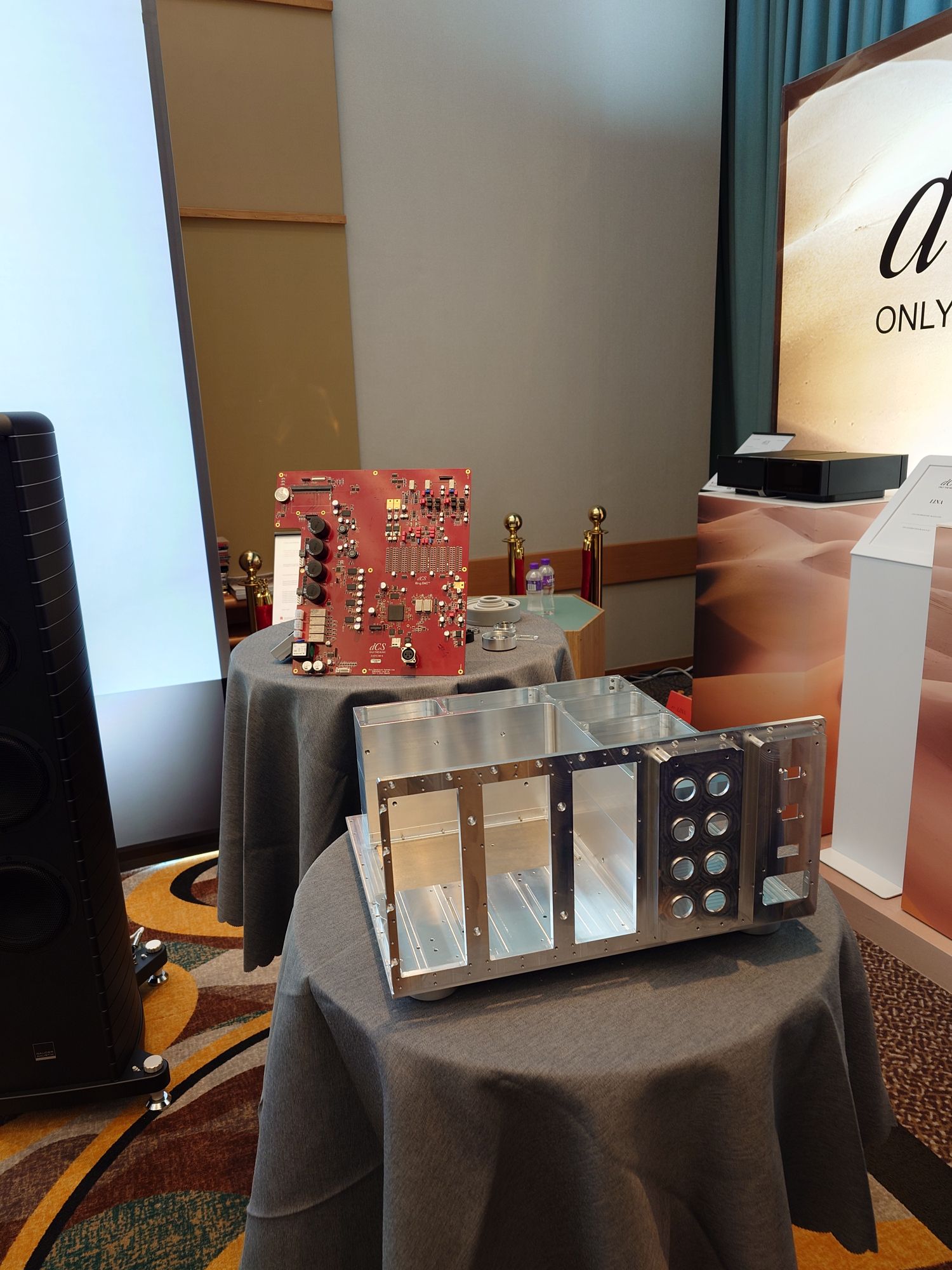
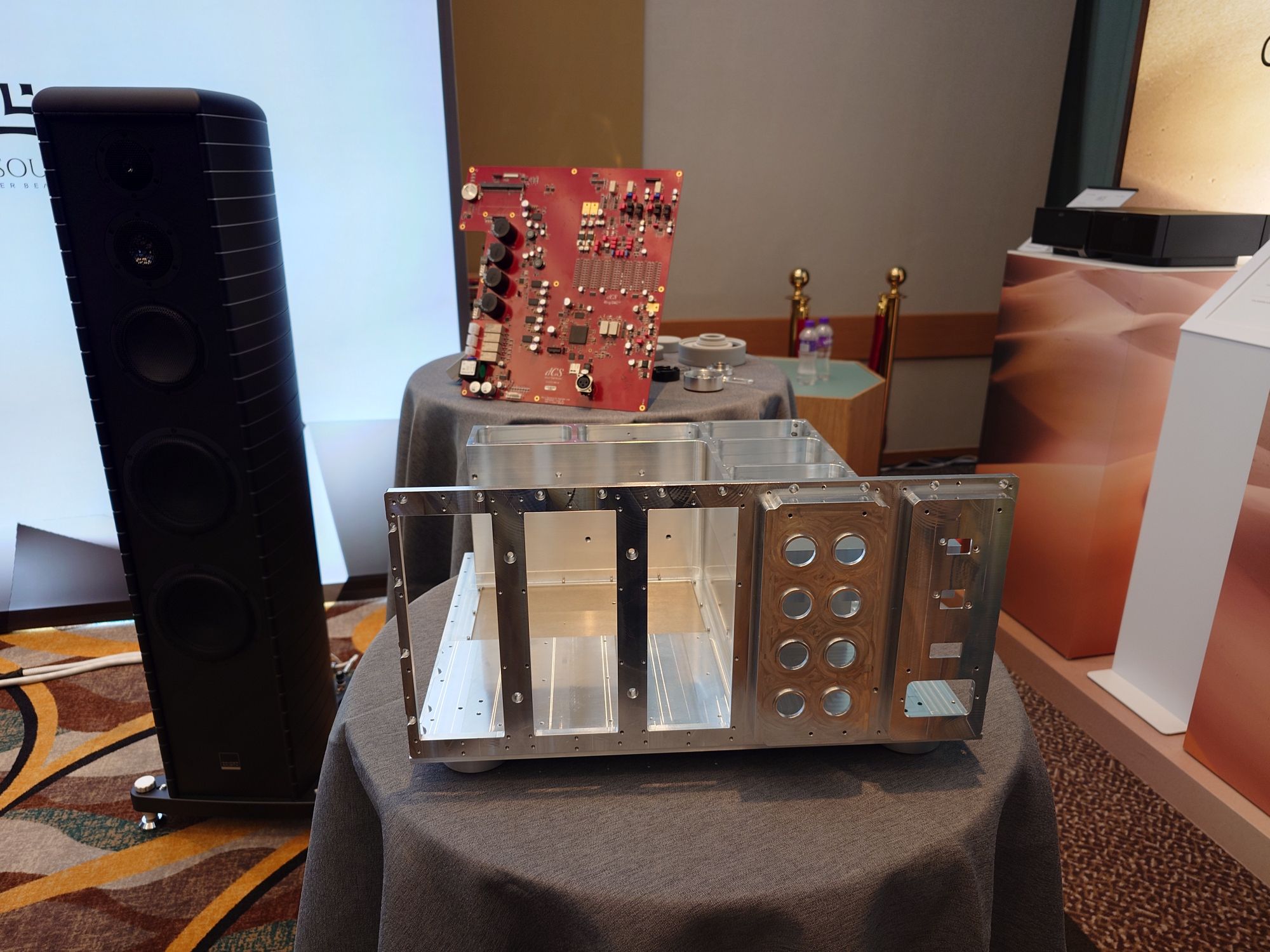
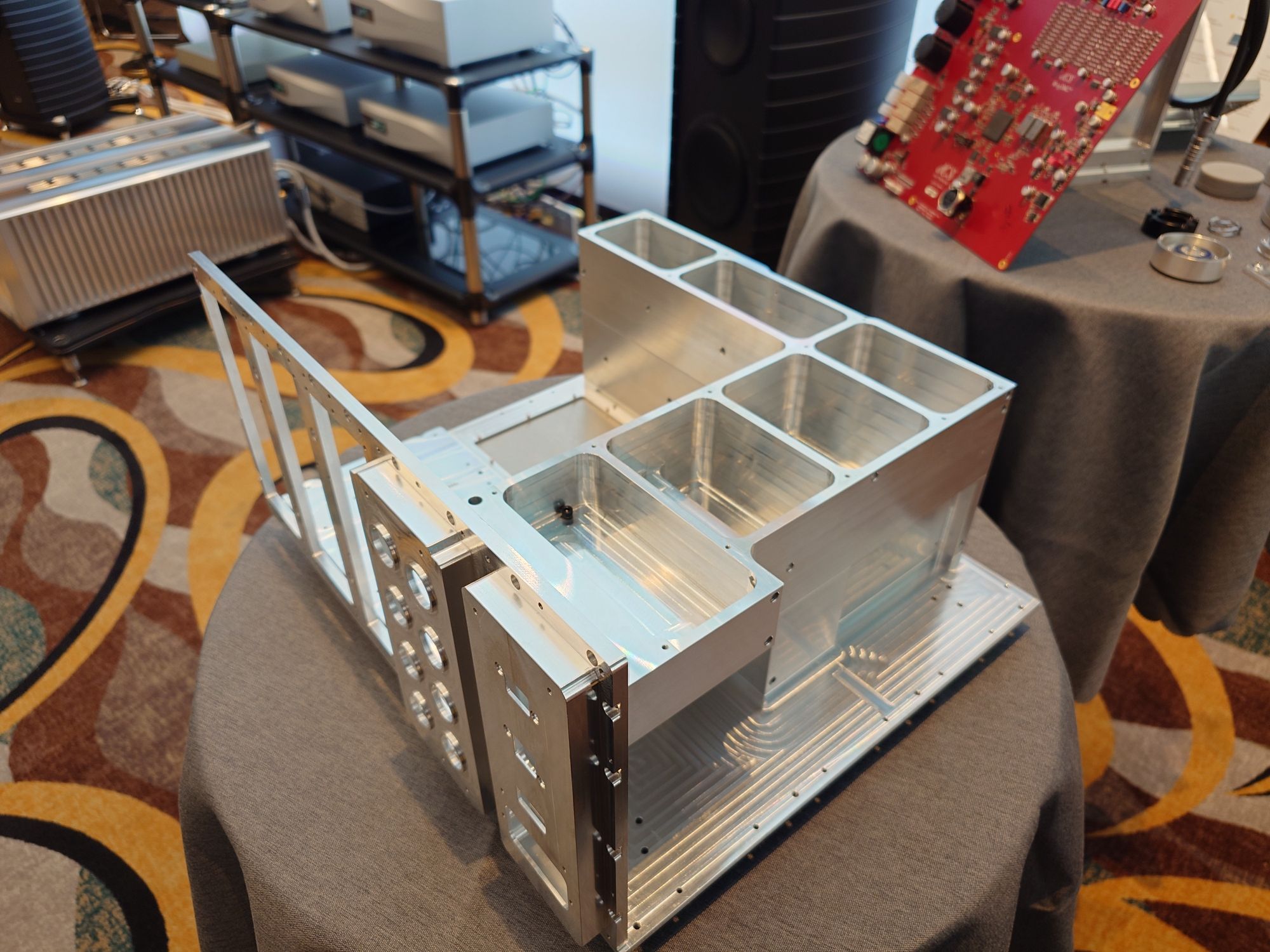
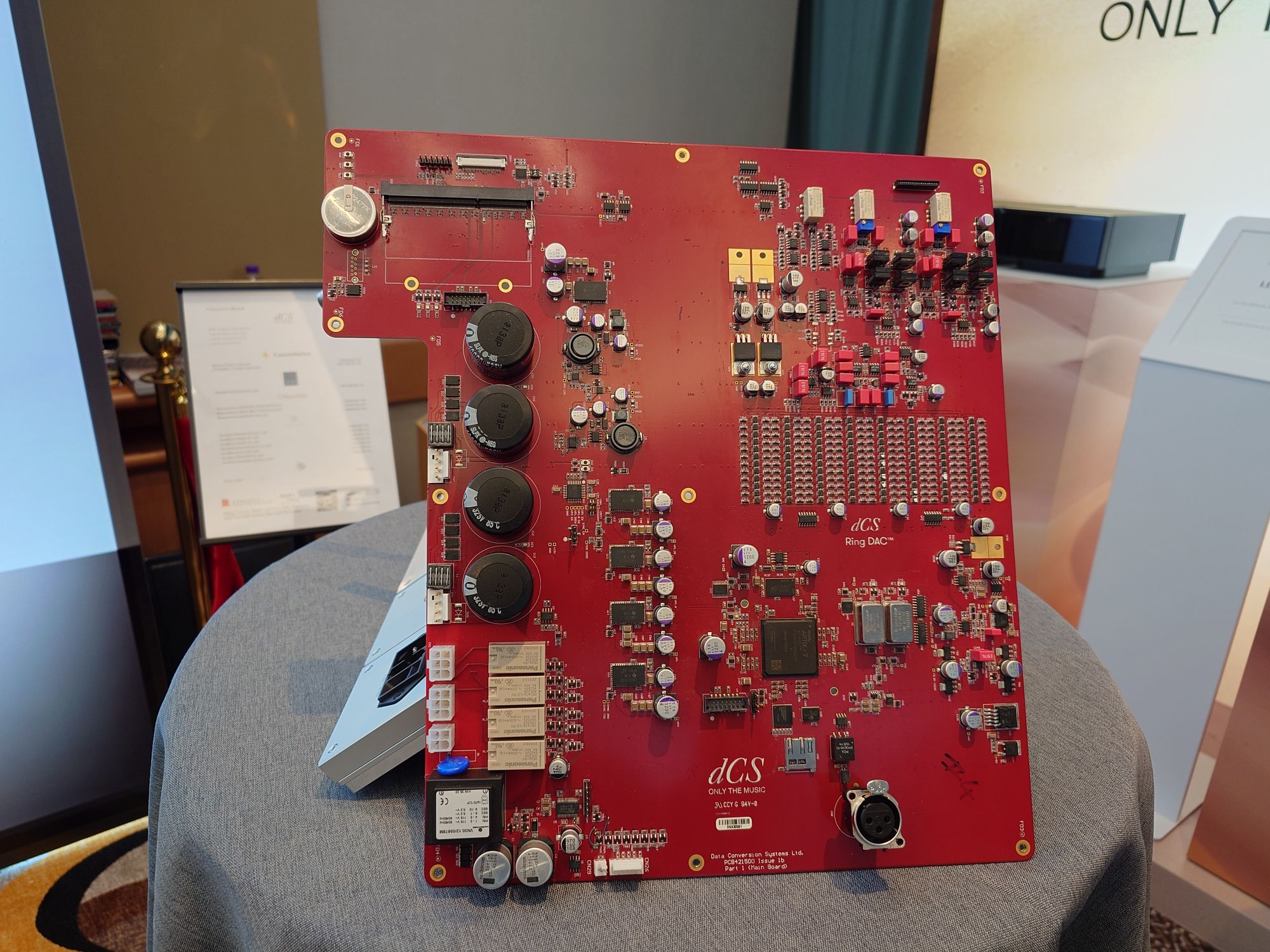
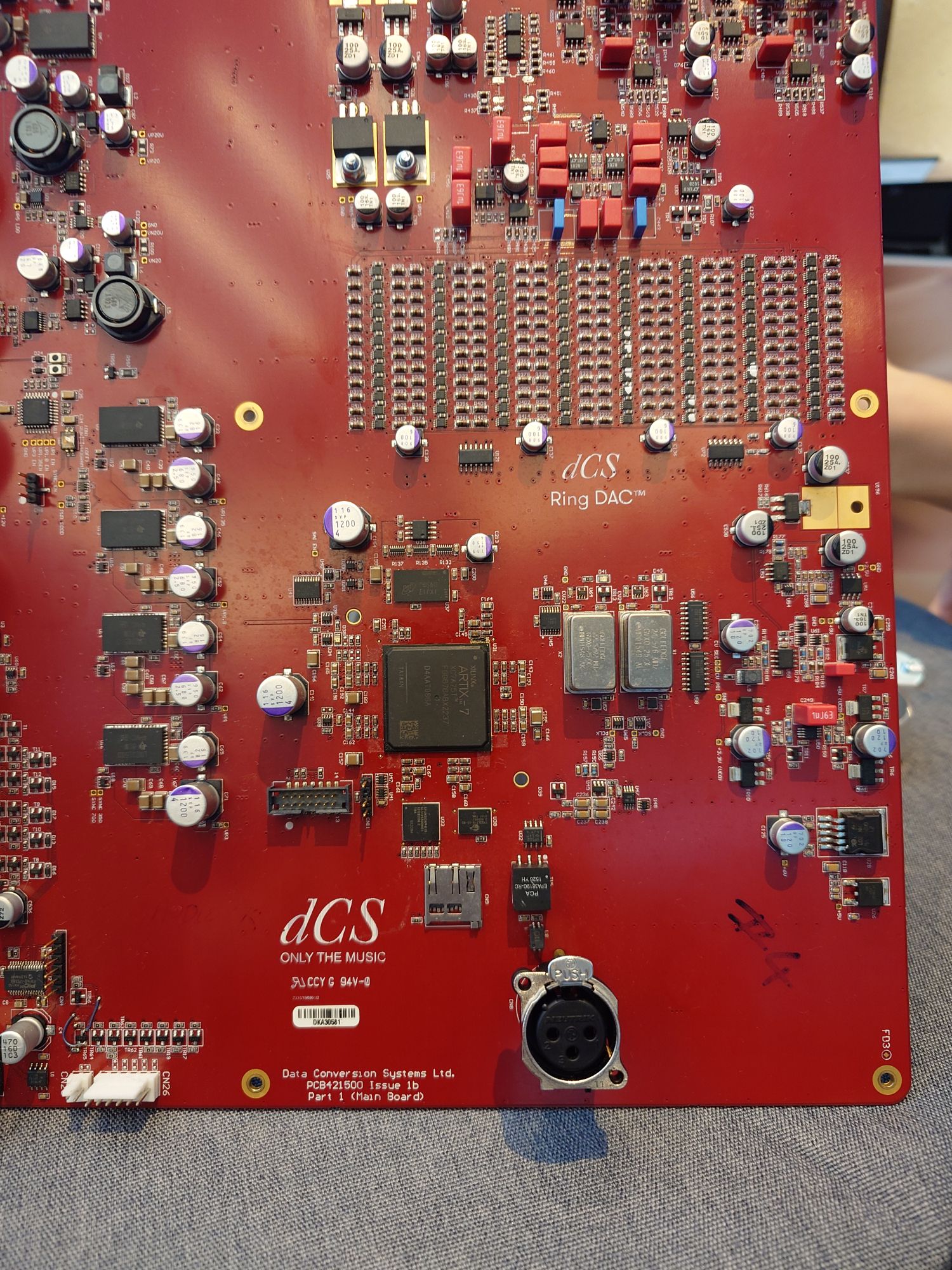
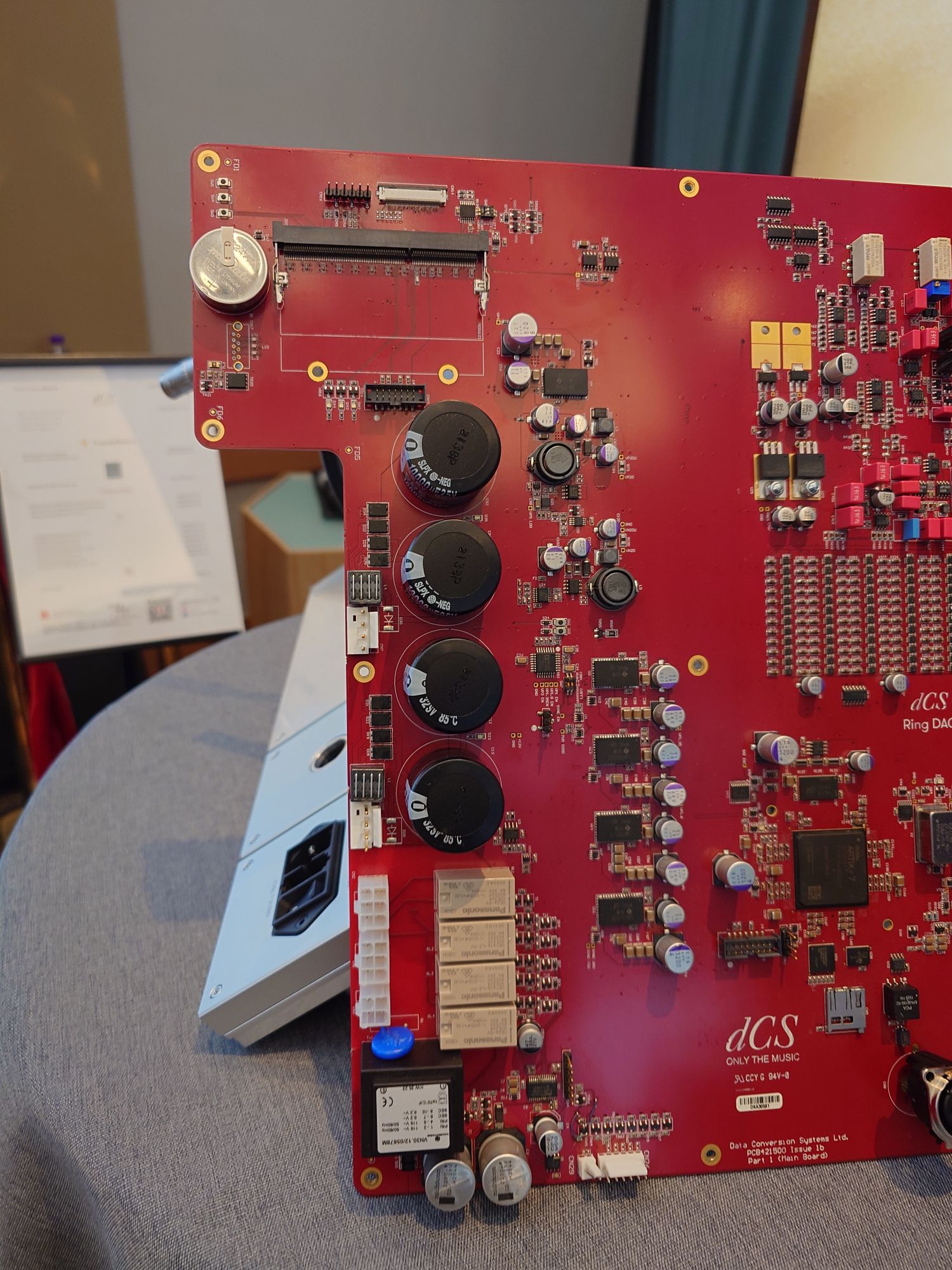
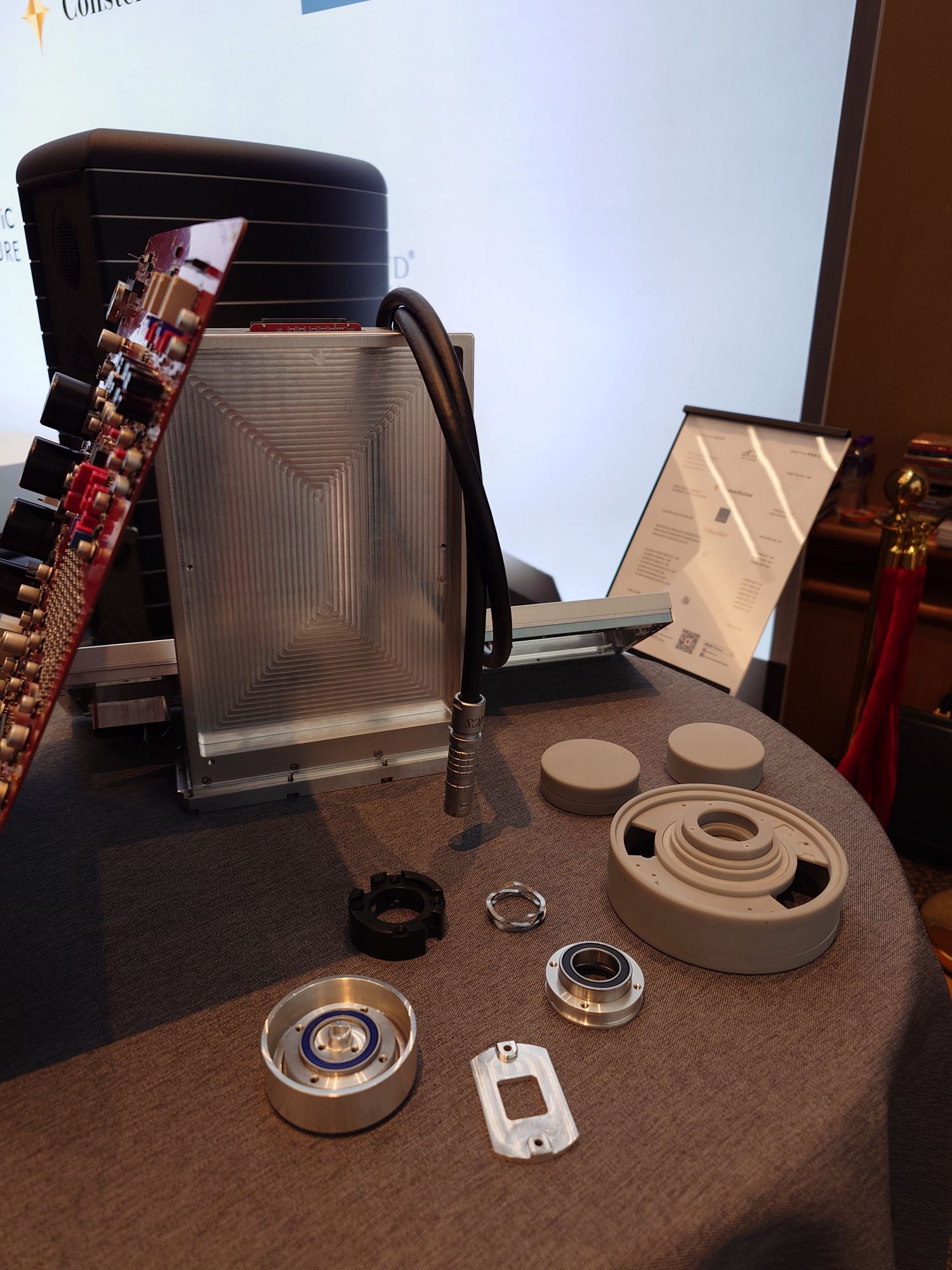
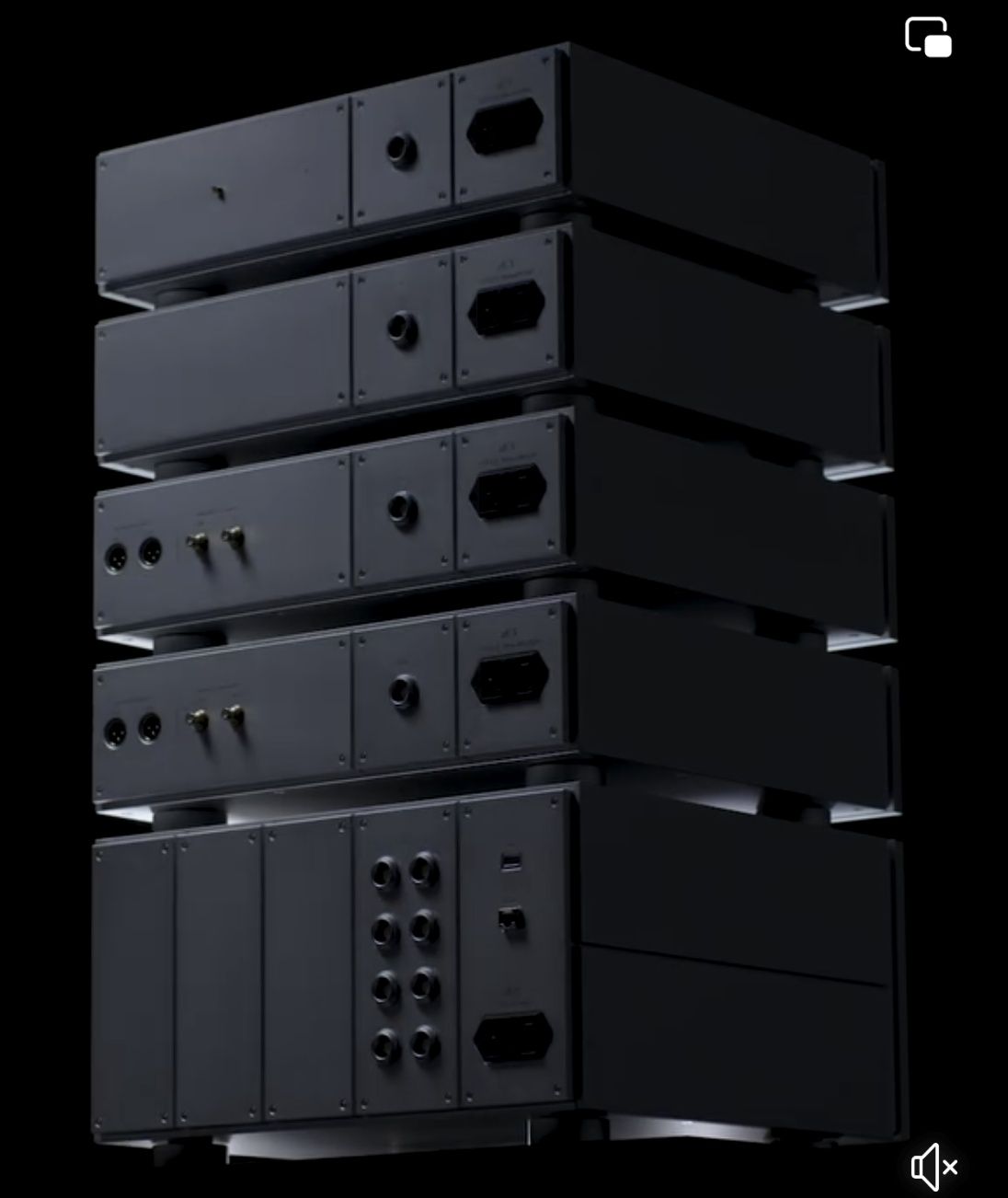
Central power distribution module. This is a multi-layered stack up that takes the incoming DC power from the powerbase and delivers it to both the Right and Left Mono DAC modules and the clock circuitry.
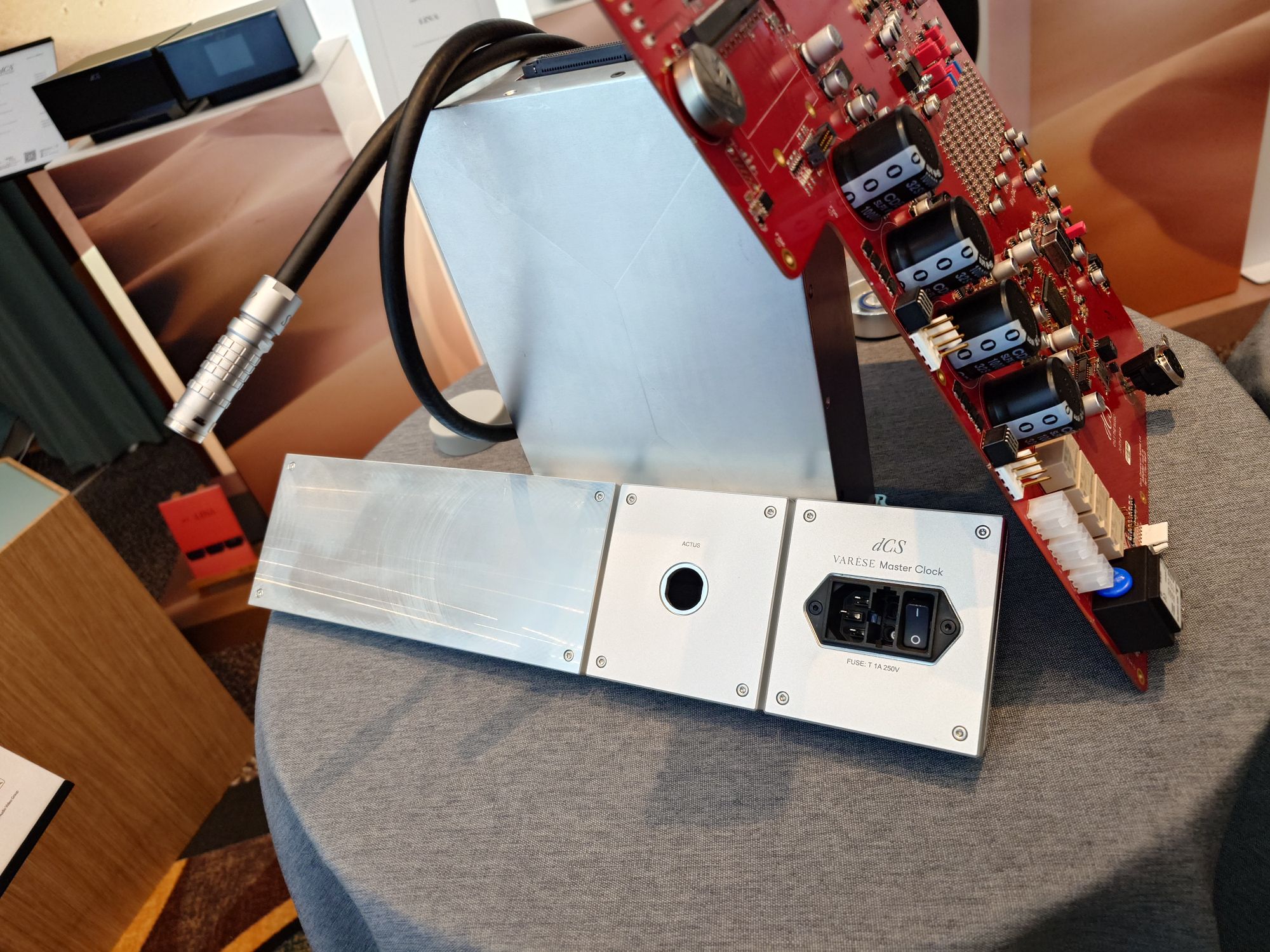
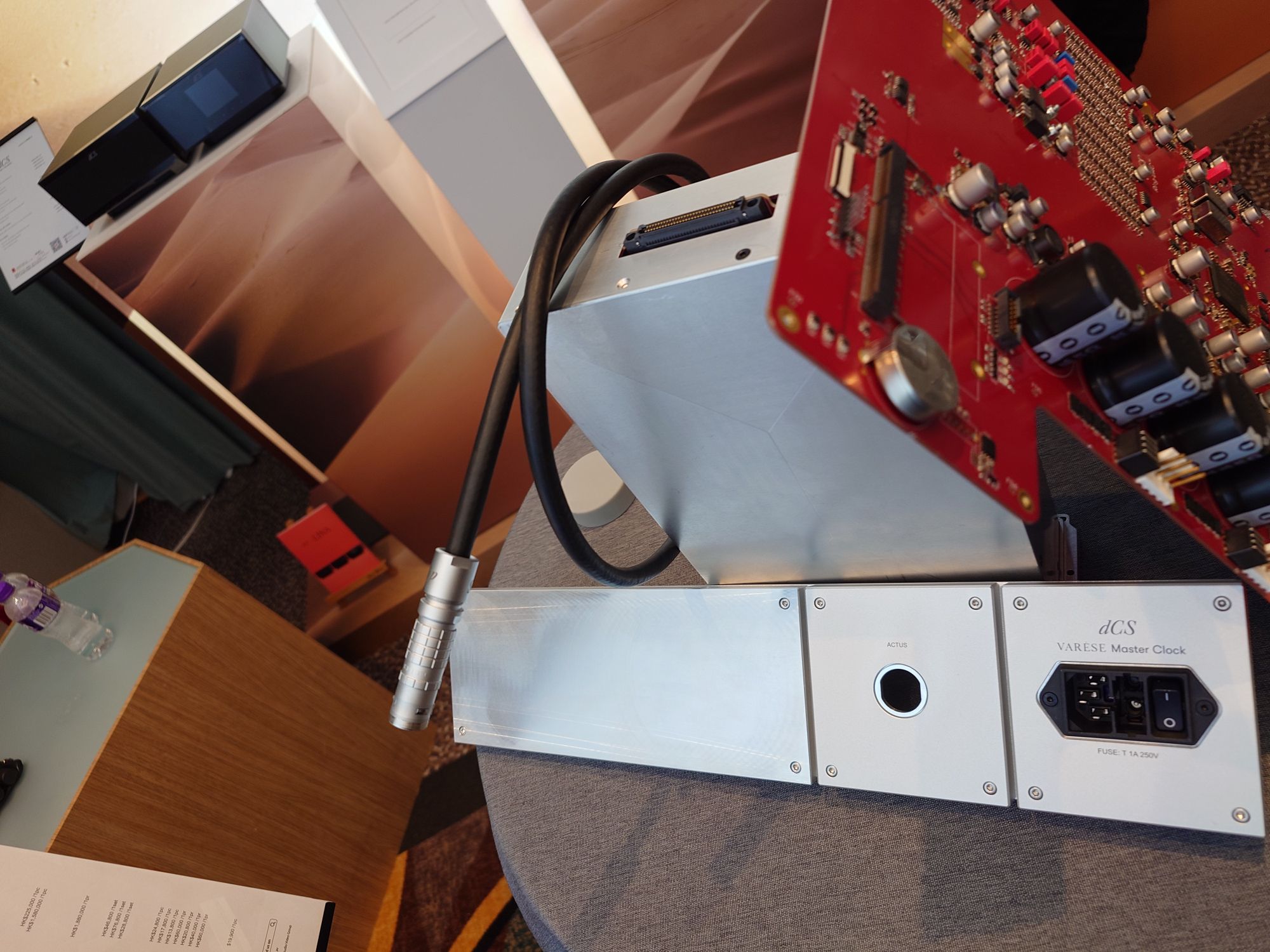
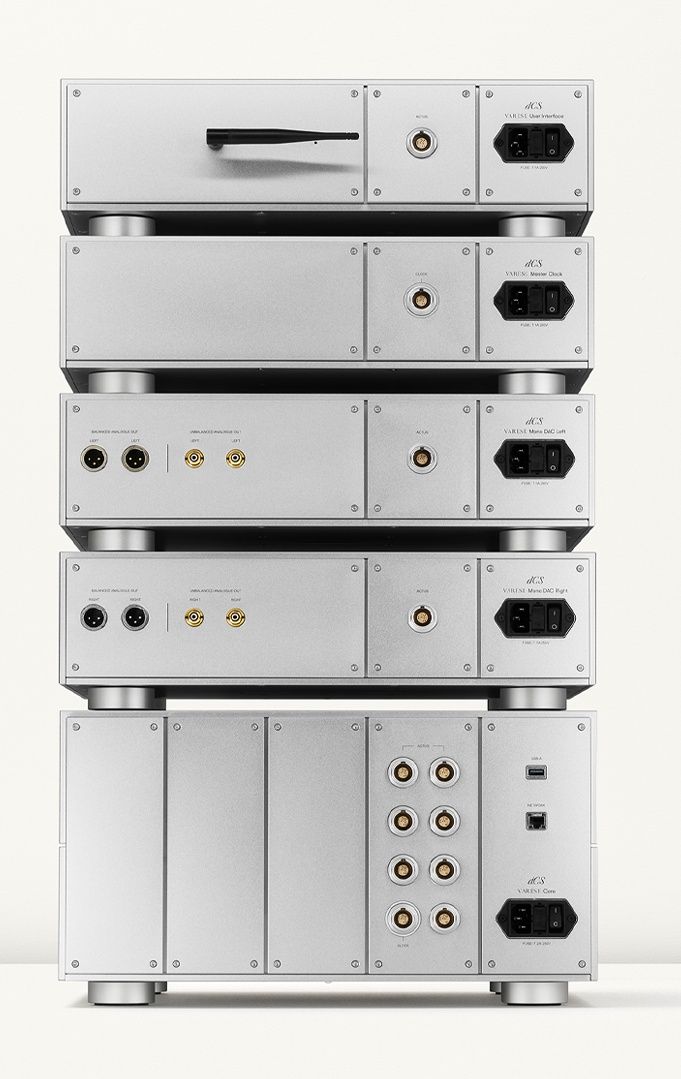
Looking at the jackpanel, the bottom center through hole represents the incoming DC umbilical linking to the Sentinel Powerbase.
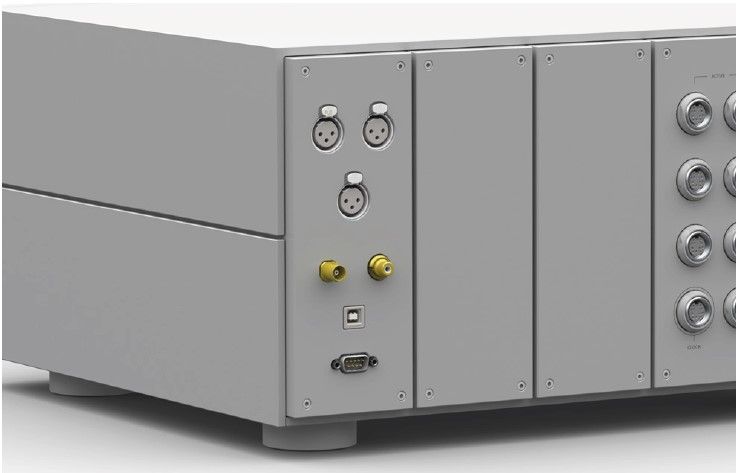
On each mono DAC, the rectangular socket will be the dedicated fiber input coming from the Sentinel Digital Director.
Above and below the fiber connections are 2 XLR and 2 RCA analog inputs. Closer to the center, we have two XLR outputs per channel.
And between those… is an experimental proprietary link for the Sentinel Edition M500’s.
The heart of the system.
Dedicated circuits for both the 44 and 48 (and their multiples) playback. E
ach crystal is in a removeable ovenized chamber.
The clock module is floating on an isolated platform. Using cable isolators, energy in and out of the system is dissipated into heat as the ultra fine fibers rub together. Since the crystal itself is a mechanical part by its nature, we have found measurable improvements by isolating this clock circuitry from unwanted inputs and vibration.
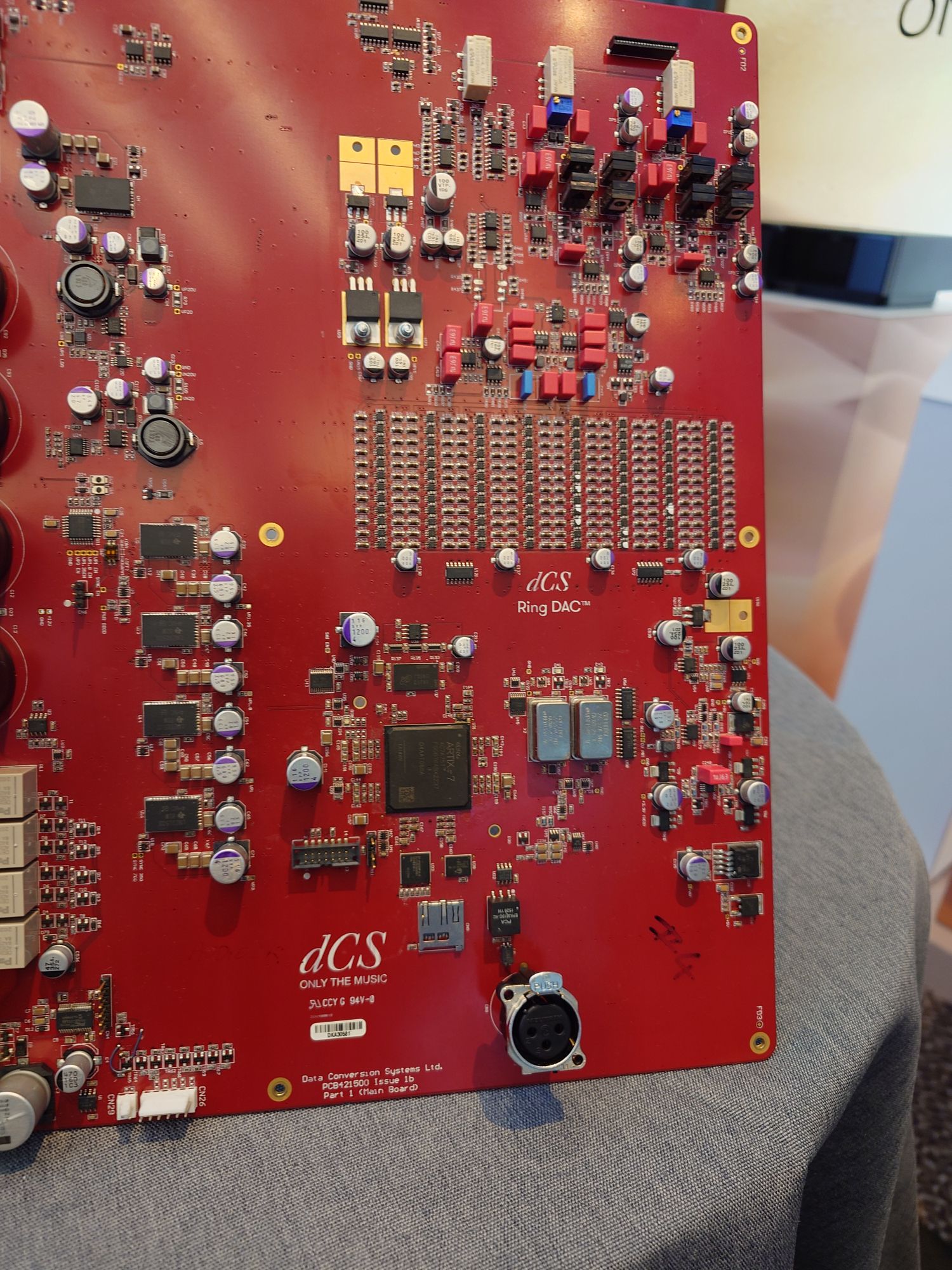
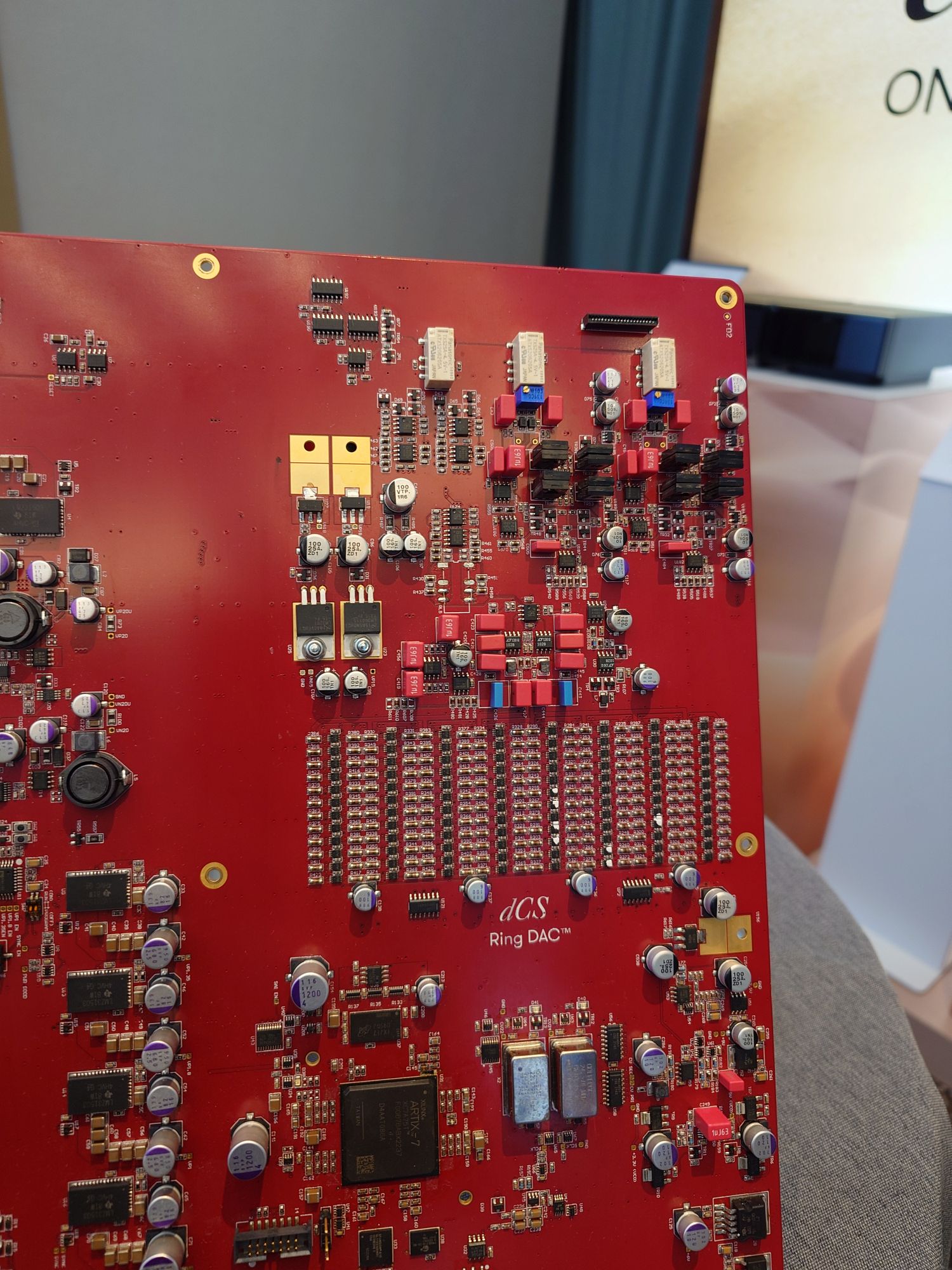
The dCS Ring DAC's inherent sound quality is achieved through the application of state-of-the-art technology with extremely low distortion, extending beyond the reach of most other DACs, especially at low signal levels.
However, as is the case with all fields of engineering, the truth is that you gain what you sacrifice. The trade-off for this exceptional distortion performance is that this DAC configuration can generate more noise than slower-acting architectures like ladder DACs. Taken alone, this is a very good trade-off, since the human ear prefers random noise to artificial harmonic content that correlates with the music signal, such as produced by inferior DACs. In fact, the level of residual noise provided by the Ring DAC is surprisingly low; most of the noise is outside the audio frequency range and can therefore be easily removed with a gentle analog filter on the DAC output.
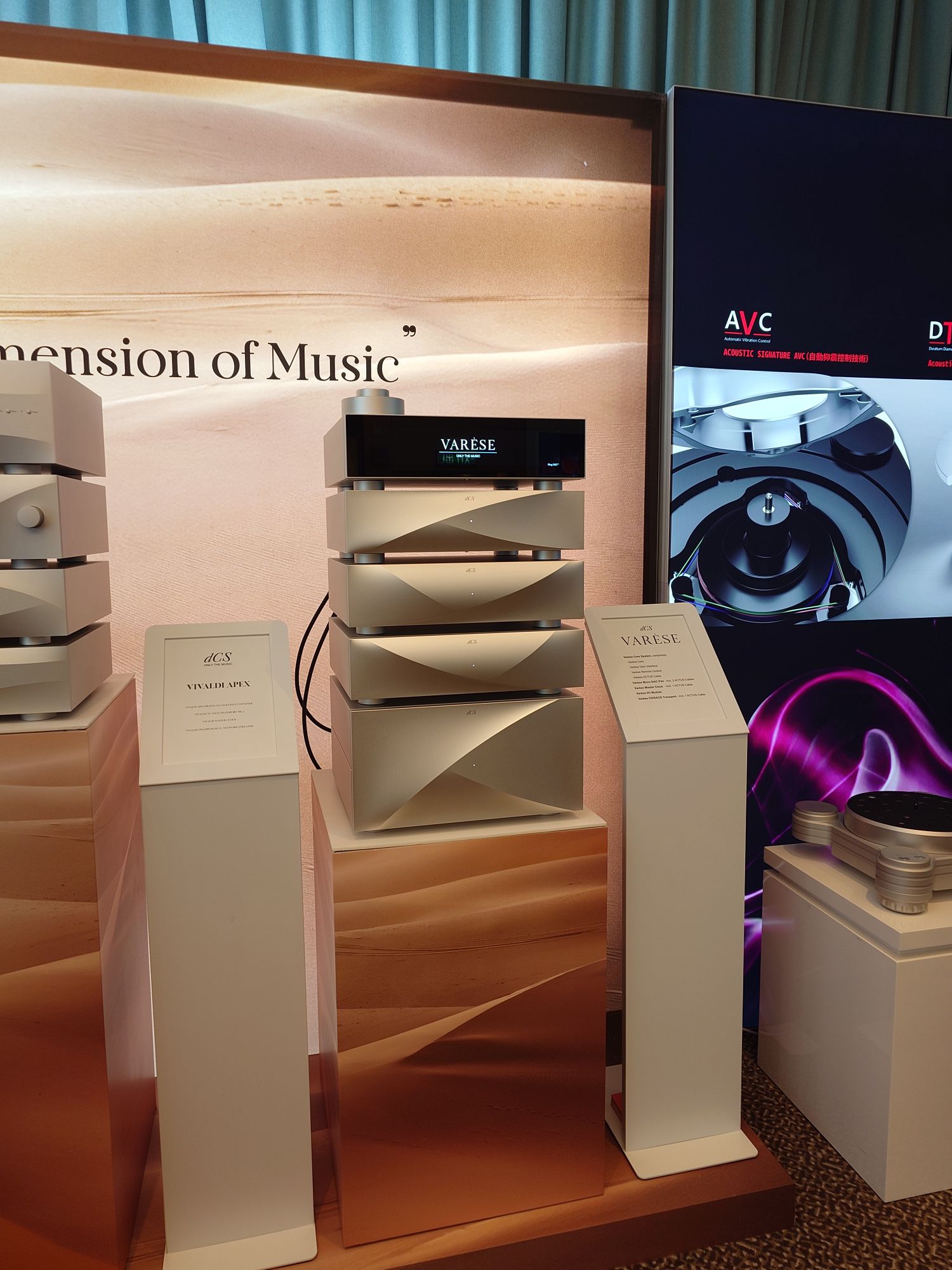
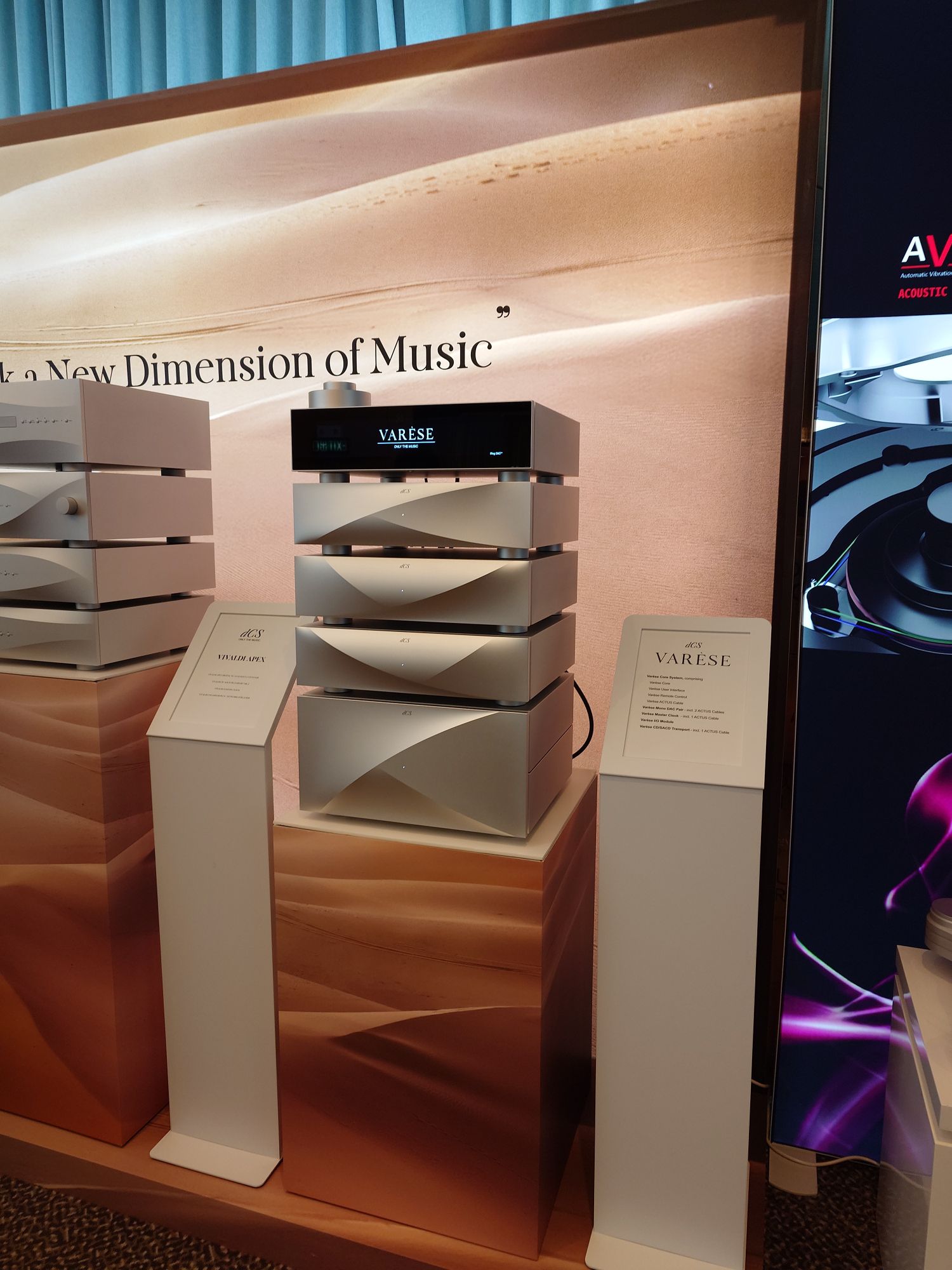
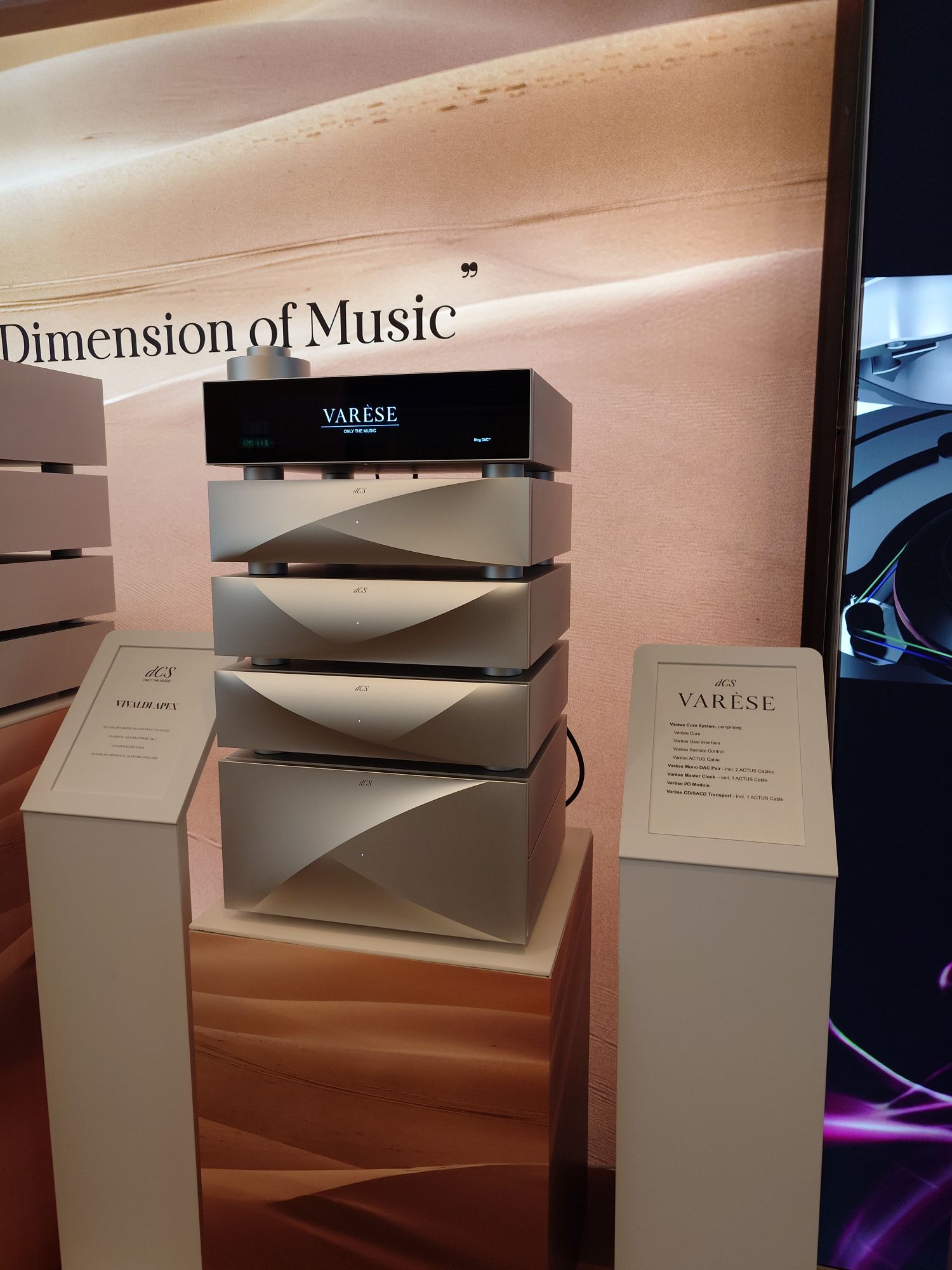
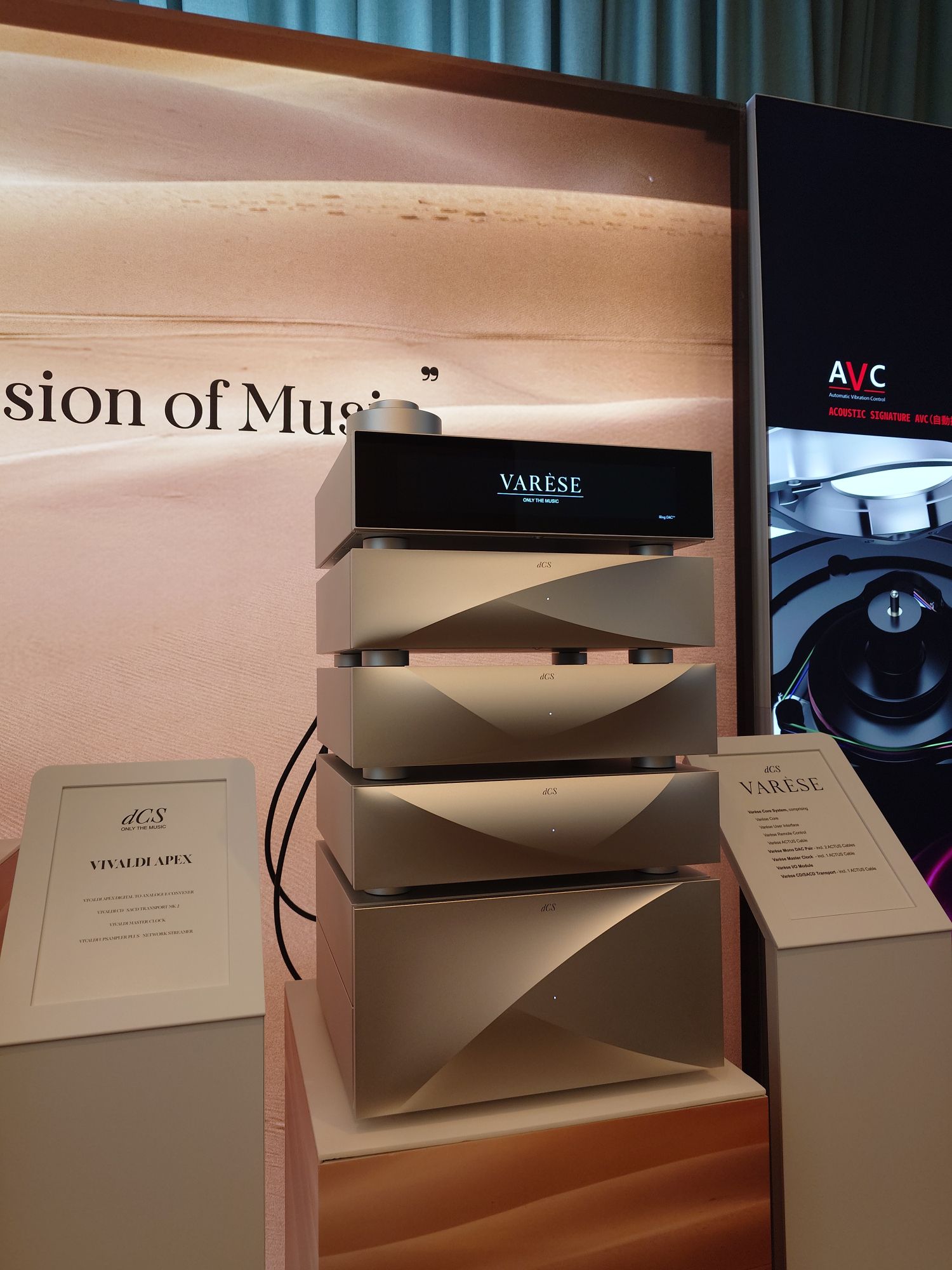
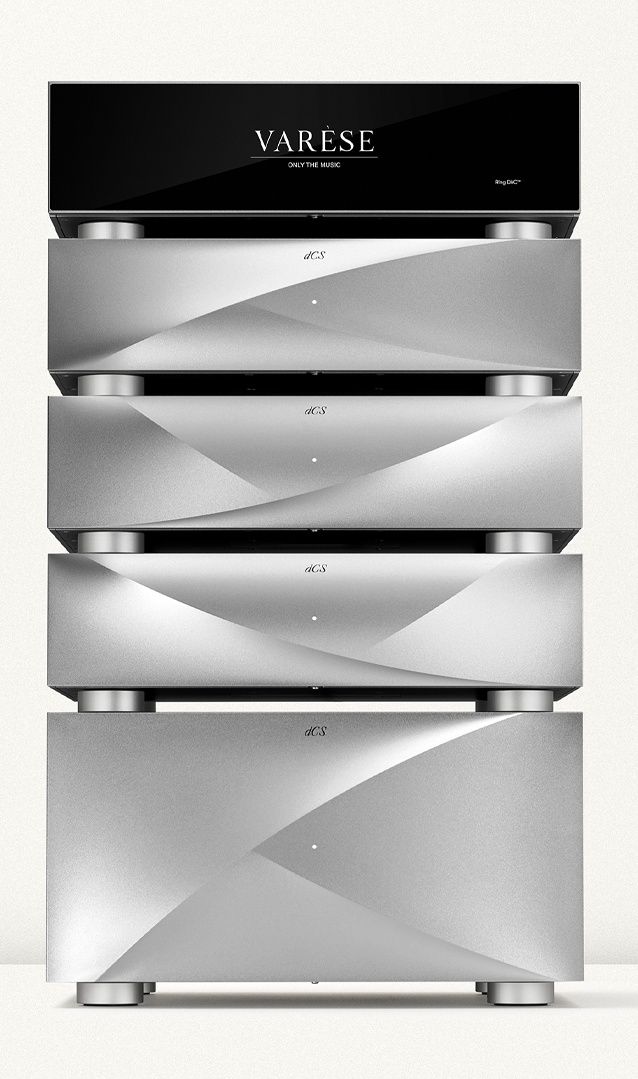
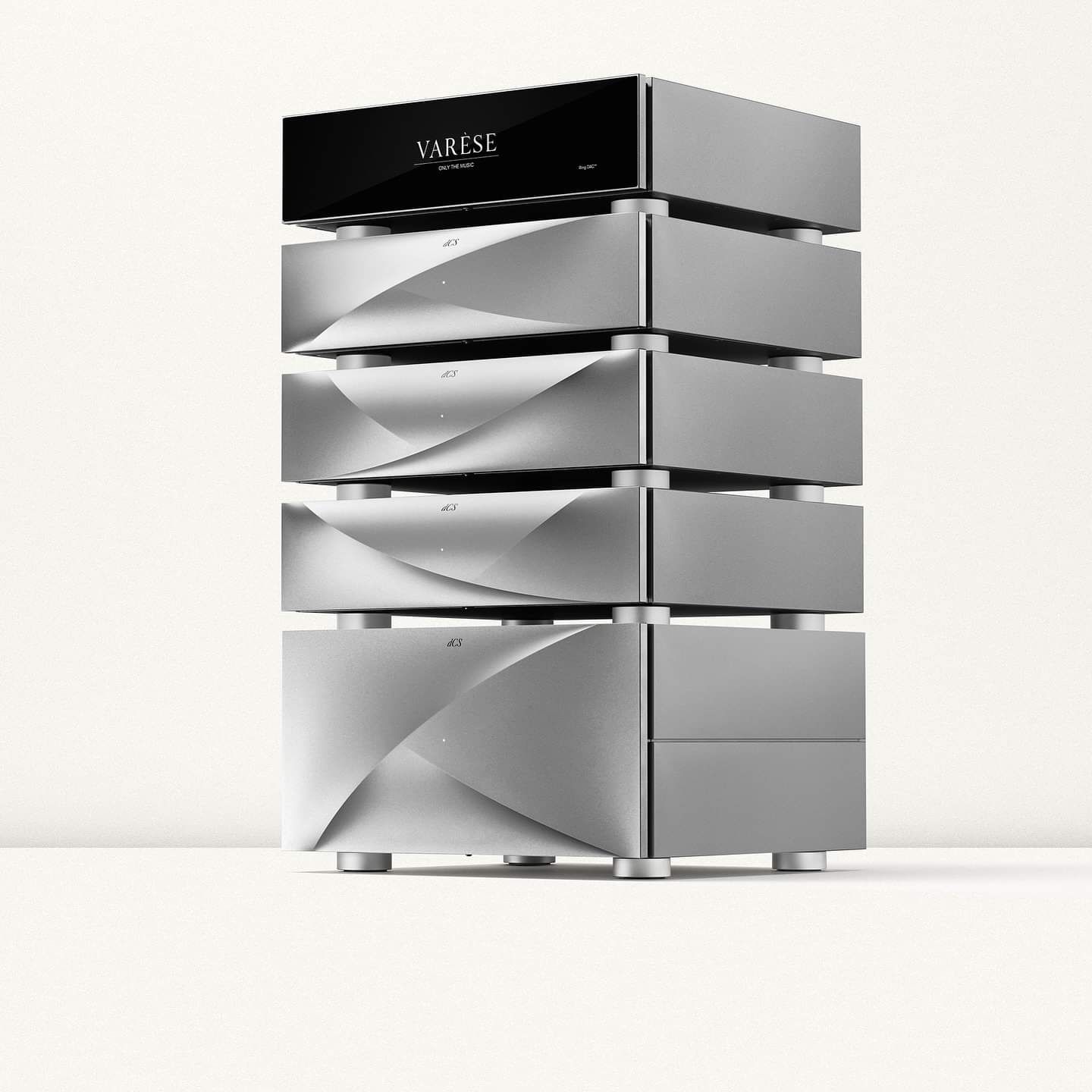
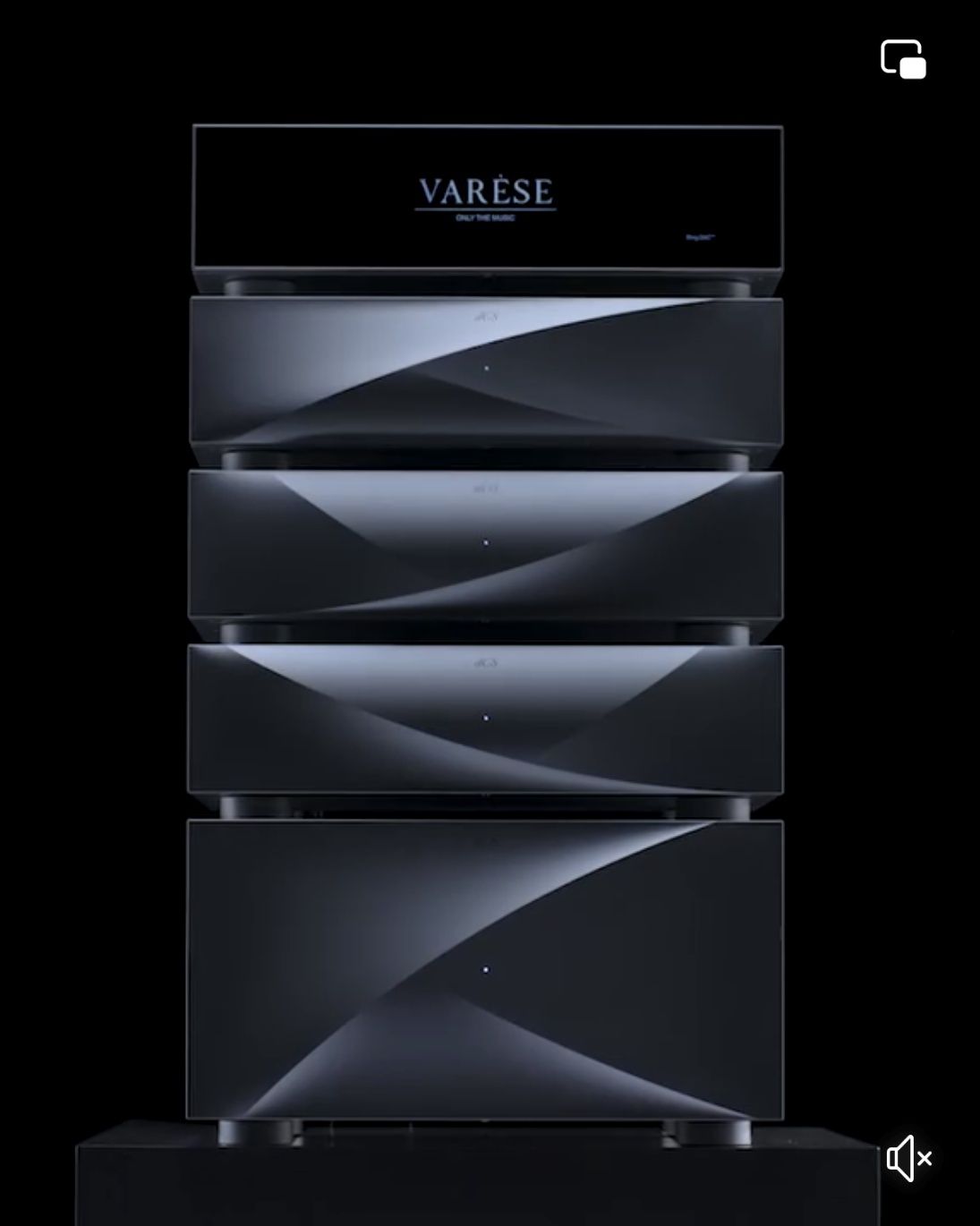
The design of the Varèse system began with the goal of further increasing the performance of the DAC. The result is an entirely new DAC architecture, moving forward from the groundbreaking third-generation products represented by the Vivaldi series. This marks the biggest shift in Ring DAC implementation in dCS' history of producing audio products. From there, the dCS allows these DACs to operate at the highest level possible without being compromised by aspects that have been considered to have limited DAC performance to some extent over the years, such as interconnections with clocks, upsamplers, etc. A unique new technology has been created.
Varèse Mono DACs & the Differential Ring DAC
In the third generation Ring DAC (including the APEX variant), the Ring DAC consists of 96 current sources (48 for the left channel, 48 for the right channel), each generating the same amount of voltage, It operates to disperse component errors (resistance value tolerance) included in these current sources as random noise. A total of 96 current sources are placed on one RingDAC board within the DAC, and the left and right channels are separated on the board.
2. Ring DAC内の2次高調波性能を改善。特定のデジタル・オーディオ・サンプルに対してRing DACのどの電流源がオン/オフになるかを決定するマッピング・アルゴリズムでは、正と負のハーフ・サイクル(正と負のハーフ・サイクルとは、Ring DACが出力でそれぞれ正電圧または負電圧を再生しているときを意味します)で電流源から発生するスイッチング・ノイズの量が異なります。ふたつの逆位相リングでの差動動作は、信号の両方のハーフサイクルにわたってこの非対称性を均等化し、よりリニアな性能をもたらします。
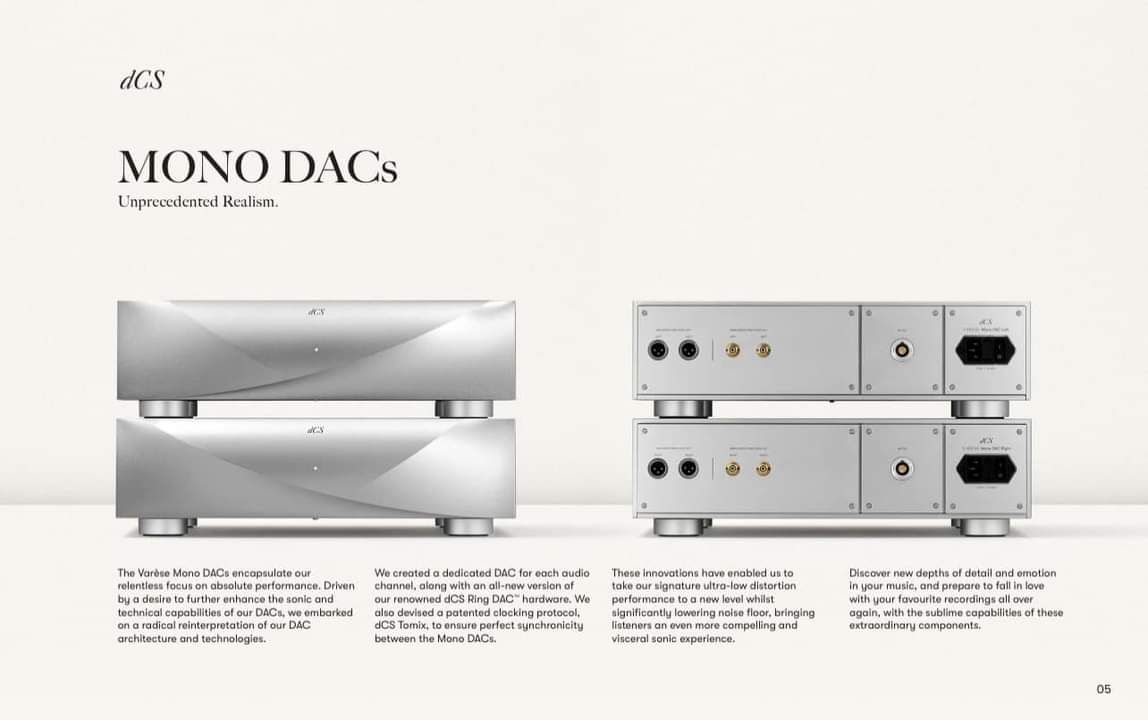
In Varèse, the left and right channels are separated into Mono DACs, with an entire DAC unit for each audio channel. In addition to general engineering improvements, this has allowed us to make significant advances in dCS’ proprietary technology. The Varèse Mono DAC has 96 current sources per audio channel, twice as many as those used in the third generation products. These current sources are fed with 5-bit PCM signals synchronously modulated to 5.644MHz or 6.144MHz. (Depends on the sampling rate of the source content)
The "Varèse" Ring DAC operates on a differential architecture. The 96 current sources on the Ring DAC board are divided into two groups of 48 each, one group plays the music signal in phase, and the second group of 48 current sources plays the signal out of phase. Play. The outputs of these two sets of current sources are differentially set, with the phase of the current source being reversed and summed with the current source having the same phase. Operating the Ring DAC in this differential manner provides many performance improvements compared to the superior performance of the 3rd generation Ring DAC.
1. Balance the current drawn by the reference supply. A reference power supply is a voltage supplied to a current source that is multiplied no matter how many current sources are turned on. The positive side of the Ring is high voltage, and the cold side is low voltage. This means that the power dissipation of the reference supply is independent of the signal since both current sources have complementary operation. This removes the mechanism that generates second harmonics within the RingDAC, improving distortion performance.
2. Improved 2nd harmonic performance within Ring DAC. The mapping algorithm that determines which current sources of the Ring DAC are turned on and off for a given digital audio sample uses the positive and negative half cycles (positive and negative half cycles are the Ring (meaning when the DAC is reproducing a positive or negative voltage at its output, respectively) the amount of switching noise generated by the current source is different. Differential operation with two antiphase rings equalizes this asymmetry across both half cycles of the signal, resulting in more linear performance.
3. Equalizes the offset at each summing node, eliminating the need for explicit DC offset correction while improving the symmetry of the summing/filter circuit. While current dCS DACs utilize multiple boards to perform different aspects of the D/A conversion process, the Varèse Mono DAC uses a single all-in-one that performs all processing and analog functions. Equipped with a board. This improves many aspects of the design and improves the consistency of the Varèse Mono DAC's performance. The all-in-one board is a technology used in the Lina DAC and was adopted for the Varèse as it has proven to benefit from improved consistency in product performance.
Varèse's dual-mono DAC approach, with each differential Ring DAC, takes the already low-distortion DAC's already excellent sound quality to a whole new level of performance, while simultaneously lowering the noise floor. We were able to further reduce it by about 3dB. Ring DAC APEX is already at the forefront of digital-to-analog conversion technology, but the "Varèse Differential Ring DAC" shows that compared to other DACs in specs and sound quality, dCS's superiority is It has grown noticeably and is something I can be proud of.
Power Supply
Ring DACは「乗算DAC」であると定義されます。すべてのカレントソース電流源に供給される基準電圧を受け取り、それにコード(Mapperを通して供給されるデジタル・オーディオ・サンプル)を掛け合わせます。電流源に供給される基準電圧が完全にクリーンなDC電圧から変動する場合、──例えば基準電圧に干渉がある場合──、この干渉や変動は、その時点でオンになっている電流源の数だけ出力に乗算されます。つまり、DAC内部の基準電圧はシステム・パフォーマンスにとって極めて重要なのです。留意するべき大切な点は、どんなに優れた設計の電源であっても、それが駆動している回路の影響からは完全に分離できないという点です。しかし、明瞭で透明なRing DACのような構成では、細部は音楽再現にはとても大切ということです
Power supply
A Ring DAC is defined as a "multiplying DAC". It takes the reference voltage supplied to all current sources and multiplies it by a code (a digital audio sample supplied through the Mapper). If the reference voltage supplied to a current source varies from a perfectly clean DC voltage - for example, if there is interference on the reference voltage - then this interference or variation will cause The output is multiplied by the number. This means that the reference voltage inside the DAC is critical to system performance. An important point to remember is that no matter how well designed a power supply is, it cannot be completely isolated from the effects of the circuitry it is driving. But with a configuration like the crisp and transparent Ring DAC, details matter when it comes to musical reproduction.
In existing dCS DACs, i.e. stereo Ring DAC configurations, the left and right channel current sources will most likely reproduce different signals (mono recordings where the left and right channels are identical will , almost the only exception). This means that if you compare the left and right channel current sources, you will see different numbers of current sources turning on and off at different times. When the current source turns on and off, its impedance to the reference power source changes, potentially causing a ripple effect on the reference power source.
The aforementioned power supply ripple effects due to the change in impedance relative to the reference power supply caused by turning the power on and off are multiplied through all operating current sources and affect the sound quality of the system. By lowering the impedance of the signal path that supplies the reference supply to the Ring DAC's current source, APEX provides robust protection against the effects of this interaction between the current source's switching and the reference supply. We have improved this by making the system more consistent.
In the design of the "Varèse Differential Ring DAC", the positive-phase and anti-phase current sources are different from each other (signal (in terminology) works the same way. Additionally, as mentioned earlier, the two sets of current sources inside each mono DAC reproduce the same signal, but with opposite phases, so the reference voltage draw is equalized between the two sets. For a multiplying DAC like the Ring DAC, this means that the reference voltage, which is critical to musical performance, continues to operate very stably.
The hardware that powers the Varèse system has been improved compared to current dCS products.
- Rossini and Vivaldi DACs are equipped with two main transformers, and the analog and digital elements of the DAC are powered by separate transformers, improving the sonic performance of the DAC. The Varèse Mono DAC also features two transformers, each optimized for use with analog or digital power supplies, improving both analog and digital performance of the Mono DAC.
- The secondary circuit of the power supply is a newly designed transformer that reduces the magnetic distortion of the transformer core and reduces the mechanical hum noise generated by the transformer.
- The power regulator adopts different topology, and the power sequencing is realized by the power management IC, which strictly and flexibly controls the power start and stop at a high level.
- The balanced output stage analog supply provides an additional level of regulation to further reduce common-mode noise at the output and improve analog performance.
ACTUS
In an ideal music system, each component would be able to "talk" to other components in the system, allowing important information and commands to be sent between each component. Vivaldi achieves this through two main mechanisms: a 3-way RS232 interconnect that connects the DAC and transport to the upsampler, and a dual AES connection. Utilizing the RS232 connection to send tunnel commands from the DAC to the Upsampler and from the Transport to the Upsampler, built into the Dual AES connection, the Vivaldi system seamlessly controls each unit's settings, volume control, source changes, and more. You can. Audio signals are sent synchronously via Dual AES connections.
To achieve the ultimate in sound quality, Varèse is equipped with a dCS proprietary interface developed by dCS, allowing users seamless control of the entire system.
このインターフェースは「ACTUS(Audio Control and Timing Unified System)」と呼ばれています。「ACTUS」は、dCS独自のハードウェアとソフトウェアの組み合わせによって構成され、各ユニット(コア、ユーザーインターフェース、クロック、モノラルDAC)間をたった1本のケーブルで接続します。インターフェイスには、非同期&エラー補正デジタルオーディオ、コントロール信号、マスタークロック信号(特許取得済みのTomixクロック技術により送信)が含まれます。
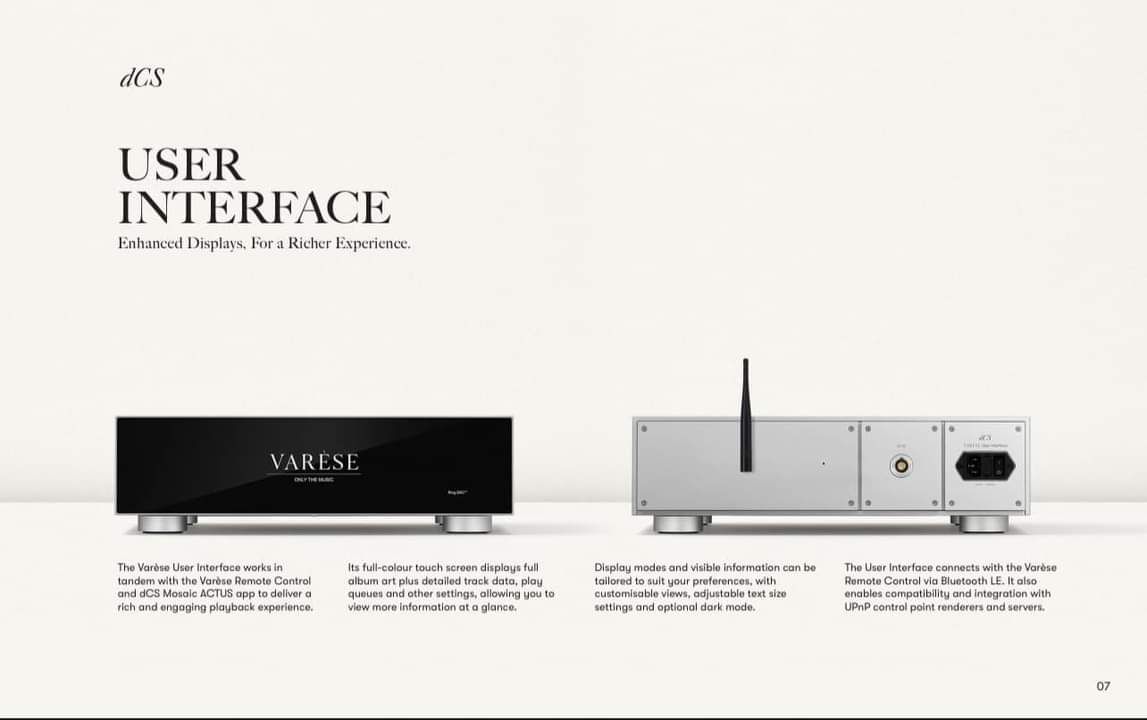
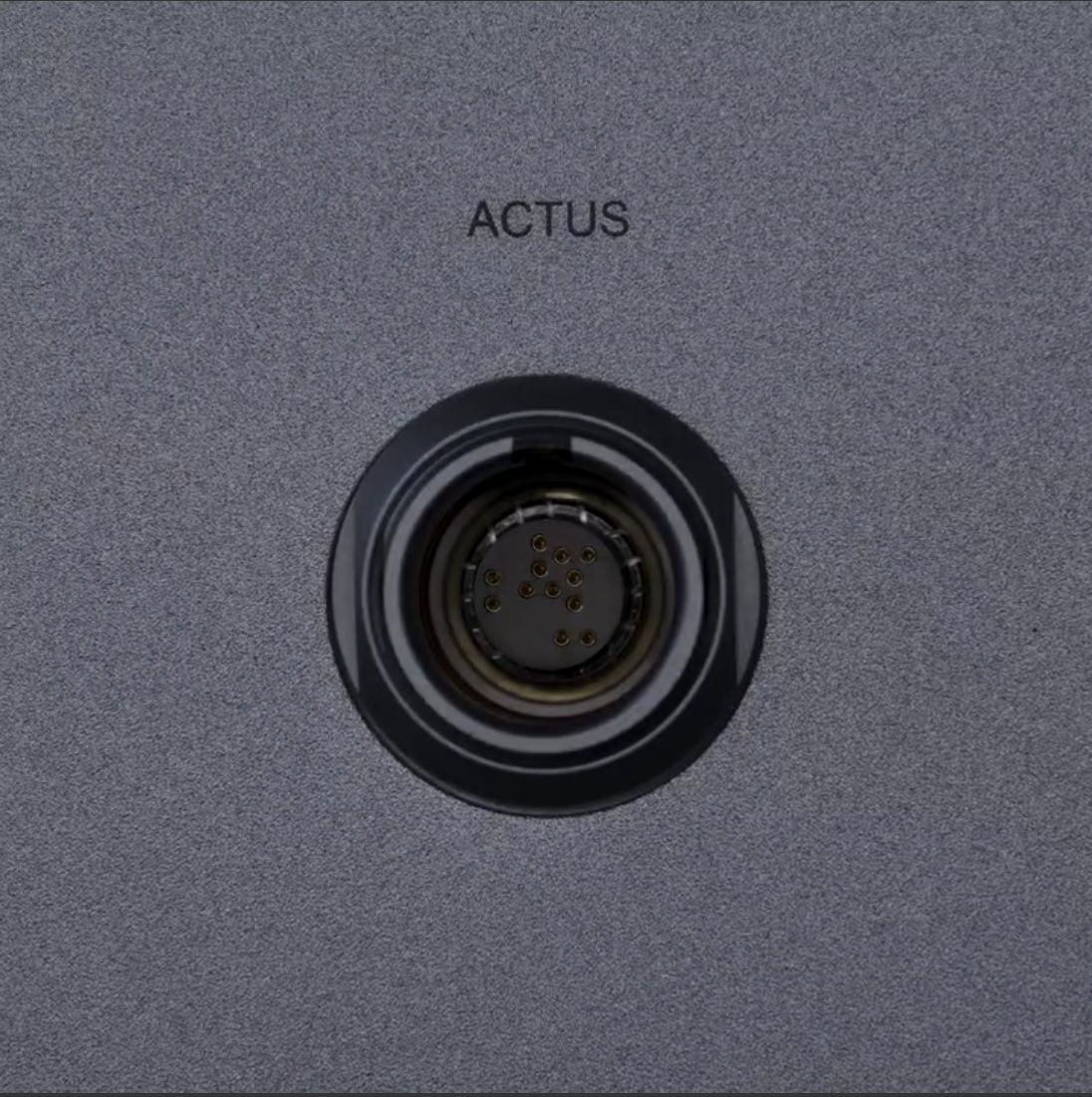
This interface is called ACTUS (Audio Control and Timing Unified System). ACTUS consists of a combination of dCS' unique hardware and software, connecting each unit (core, user interface, clock, and mono DAC) with just one cable. The interface includes asynchronous & error-corrected digital audio, control signals, and a master clock signal (transmitted by patented Tomix clock technology).
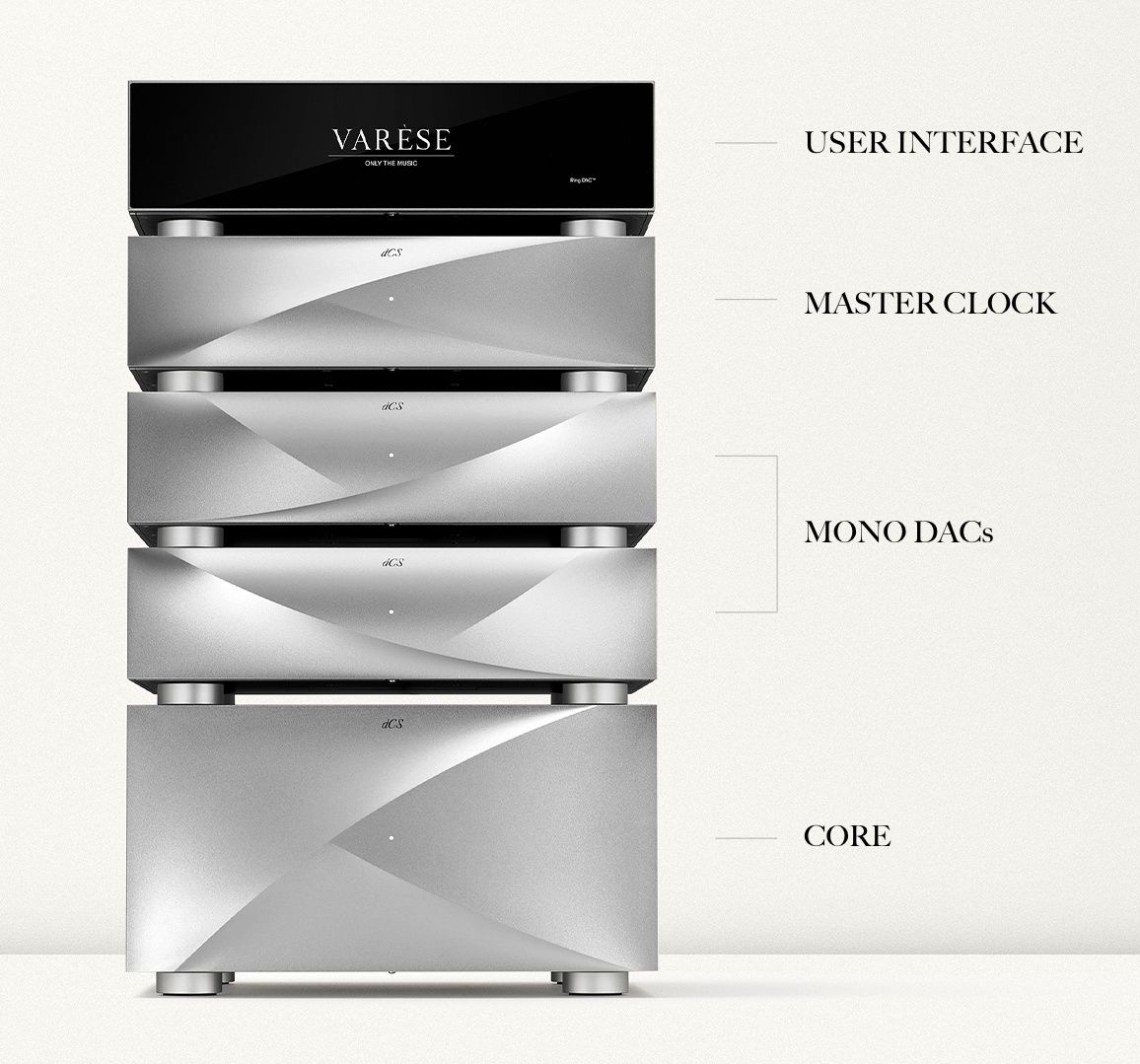
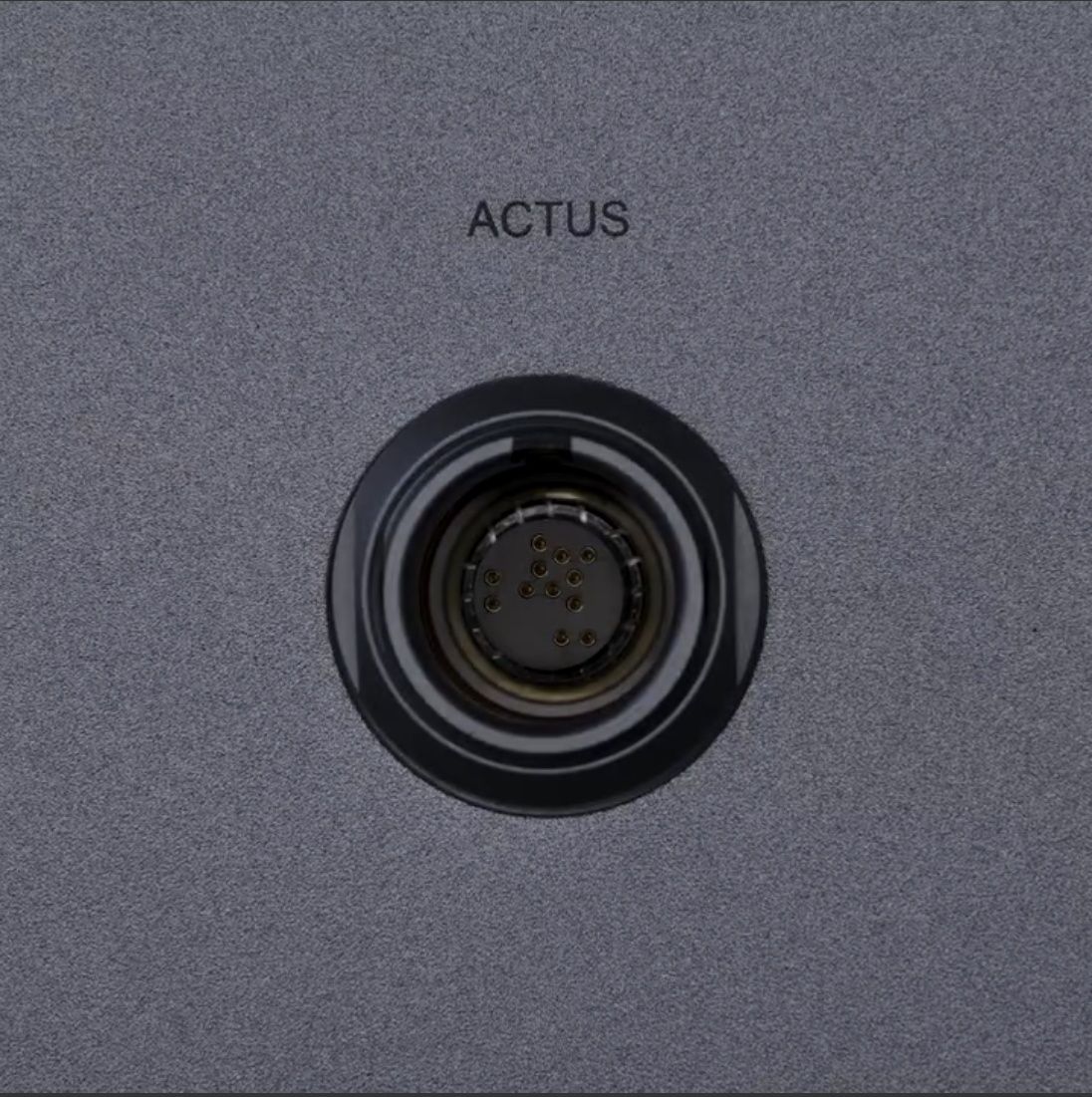
The "Varèse Core" acts as the hub of the system, and other Varèse units are connected by "ACTUS cables". The connectors used on the ACTUS cable and Varèse unit are custom made by dCS. The connector is keyed and can only be inserted in the correct direction. In other words, the same cable can be shared between Varèse user interface and Core, and between Core and monaural DAC. This makes setting up a Varèse system with ACTUS cables incredibly easy. The only specific requirement for the "ACTUS Interface" is that the "Varèse Master Clock" must be connected to the "ACTUS Socket (labeled Clock)" of the "Varèse Core".
The ACTUS cable consists of 6 pairs of copper cables, each with the following roles:
- One twisted pair carries a 44.1kHz Tomix signal.
- One twisted pair transmits 48kHz Tomix signal
- Four twisted pairs form an IP (Internet Protocol) link.
An IP link connects each Varèse unit to the Varèse core. This IP link allows you to fully control the system. Allows information, configuration changes, and other control information to be transmitted seamlessly between units without the need for additional control interfaces such as RS232.
This level of control also allows the system to intelligently notify the user of misuse, such as the left mono DAC being incorrect, the clock being connected to the wrong ACTUS port on the Core, etc., to prevent system failures. It is also very convenient to find.
The IP link is also responsible for audio signal transmission between Varèse units. Instead of using asynchronous interfaces like AES3 or S/PDIF, ACTUS utilizes IP to transmit audio over an asynchronous error correction interface. Please note that ACTUS does not use established industry standards for transmitting audio over IP, such as AES67. (This will be explained later in the TOMIX section)
dCS flagship systems commonly used an upsampler, a unit external to the DAC that performs most of the digital-to-digital conversion, filtering, and DSP required as part of the oversampling process. We have found from our experience providing professional equipment that this contributes significantly to increased performance by offloading much of this processing to an external unit separate from the DAC, and it can also be used in audio equipment. This means that it is reflected in
The job of handling most of these elements is done by Varèse Core, decoupling the DAC from the majority of the digital workload. This means that the FPGA inside the DAC has less work to do because it performs fewer operations. This means that the power supply has less microdrain (a small amount of continuous current), further improving the performance of the mono DAC.
Varèse Core oversamples the input PCM source to 705.6kS/s or 768kS/s and digitally filters the signal to remove the Nyquist image. When playing PCM sources, users can also optionally select DSD mode. This mode converts this signal to DSD (standard DSD/64 to DSD/512). This oversampled and filtered digital audio signal is routed through ACTUS to a mono DAC where it is modulated into a 5-bit to 6MHz signal that is fed to the Ring DAC.
By further removing DSP from the Varèse Mono DAC and instead allowing the Varèse core to do the processing itself, the work of the Varèse Mono DAC is reduced and its performance is further increased.
Operating a mono DAC presented a fairly unique challenge when it comes to clocking. Traditional digital audio systems with stereo DACs have a circuit inside the DAC that generates the clock signal.
This clock signal is fed to both left and right DAC channels simultaneously, causing both channels to convert digital audio samples to analog voltages simultaneously. However, when operating a monaural DAC, all of the DAC's circuitry is divided into left and right channels. Each has tasks to deal with, and these include power supplies, DAC circuitry, and, importantly here, clock circuitry.
A mono DAC requires two DACs to convert audio samples at the same time. If the DAC converts the left and right channel samples at different times, there will be a time delay between the left and right audio channels, resulting in an unacceptably significant drop in audio quality. To ensure that the samples are converted at the same time, the rising edge of both DAC's clock signals (the change in the square wave that makes up the clock signal, where the voltage changes from a low state such as 0V to a high state such as 5V) is required. You need to make sure that the left and right DACs are aligned in time.
But this alone is not enough. Even if the rising edges of the two clock signals across the left and right DACs are perfectly aligned, it is possible that the left DAC is running one sample ahead of the right DAC, for example. In this case, the DACs are converting samples at the same time, but not each converting the same sample.
Again, this will compromise the sound quality of your system. Therefore, the clocking of the two DACs must be tightly aligned so that both clocks rise at the same time, generate edges, and convert the same samples with these synchronized clock signals.
The audio industry now has a solution to address this problem. One could utilize a traditional AES/SPDIF signal to synchronize the devices, but such signals do not have the bandwidth to work in the way required by Varèse.
AES67 has the necessary bandwidth and presents another option that addresses the problem of synchronizing left and right DACs. The problem here is that AES67 requires a time server and the interface reconstructs the clock from the network clock. Therefore, this clock signal cannot be as good as one generated locally by a physical clock device generated using an audio rate crystal oscillator inside the DAC.
Due to this issue, dCS determined that it was necessary to develop a new method to tightly synchronize the clocks of two separate products. At the same time, each DAC needed a local, high-quality VCXO-based clock circuit to control each Ring DAC circuit and maximize system performance.
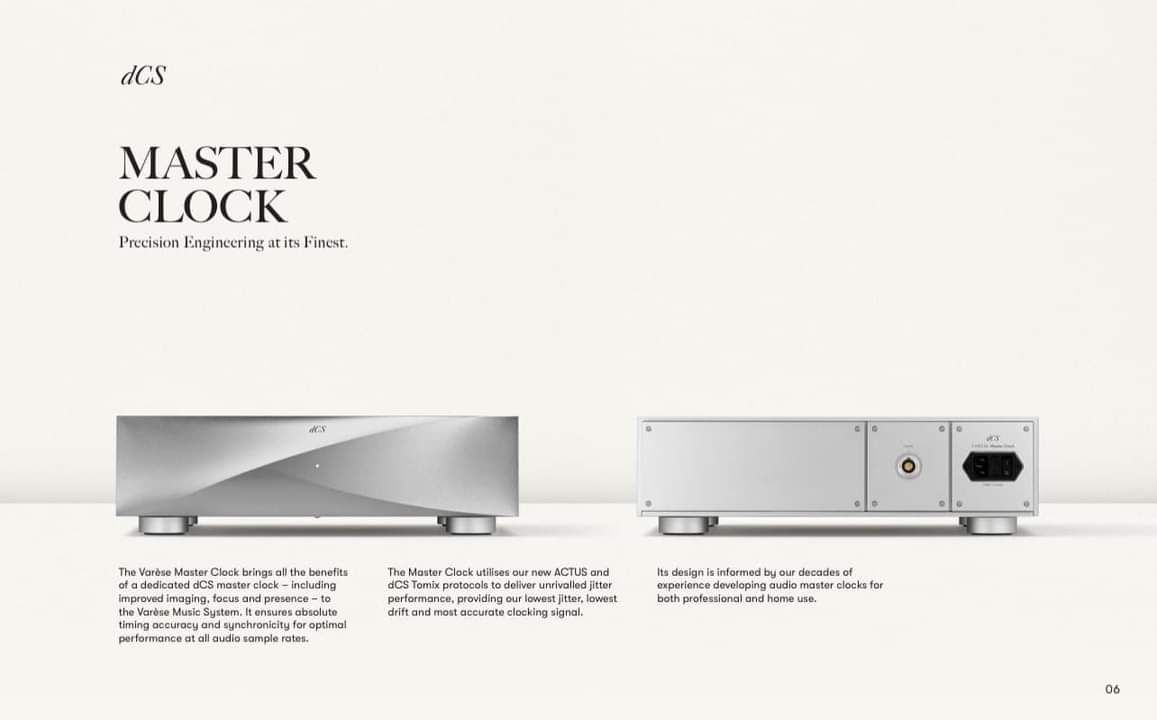
"Tomix" is a patented solution developed by dCS to the clock synchronization problem of mono DACs used in Varèse systems. Here, the Varèse core operates much like a master clock in a traditional audio system. It ensures that the DAC's clocks run at the same rate on average, and provides a clock signal to both the mono DACs that they synchronize. However, this alone does not solve the problem of synchronizing D/A conversion.
The Core is the hub of the Varèse system, and all audio and clock signals always pass through the Core, regardless of source, system configuration or settings. Core adds a timestamp to each audio sample that passes through it before the sample is sent to the DAC via ACTUS.
When the sample arrives at the DAC, a timestamp is displayed on the DAC's FPGA. A DAC can know exactly when a sample was sent, but in order to convert the sample to analog at the correct time, it also needs to know exactly the current time.
That's where "Tomix" comes into play. As previously mentioned, it is not enough to align the rising edges of the clock signals provided by the processor to the DAC; the DAC must utilize the same rising edges. To achieve this, "Tomix" is deterministic in time. In other words, the clock signal itself is timestamped, and this timestamp allows the DAC to understand and adapt to the overall system latency to align its outputs.
The way a clock signal is timestamped is critical to audio performance. The DAC must be able to perfectly recover the original clock signal and the timestamp information, without introducing harmful levels of noise or interference to the DAC. The Tomix signal is generated by the Varèse Master Clock or, if the system does not use a Master Clock, by the Varèse Core.
For Tomix, the base frequency of the clock signal is doubled. In other words, the example clock signal of 44.1k㎐ will be doubled to 88.2k㎐. The rising edge of the Tomix clock signal is not modified as it is used by the DAC for clock recovery. The falling edge of the Tomix clock signal is encoded with timestamp information. This is done by narrowing or widening the pulse width of the signal to bring the falling edge of the Tomix signal around the detection point (same frequency as the Tomix signal, but 180 degrees out of phase).
If the falling edge is before the detection point, the DAC recovers the zero from the Tomix signal. If the falling edge is after the detection point, the DAC recovers a 1 from the Tomix signal.
The recovered bitstream is used by the DAC to timestamp the recovered clock signal, allowing tight synchronization of the DAC. Simply transmitting timestamp information encoded in the clock signal creates patterns and correlations in the data, and the electrical noise generated by the Tomix signal becomes a problem for the DAC.
The graph below shows two traces. Red is when the timestamp data is simply a linear counter, encoded on the rising edge as above, and is the noise generated by the Tomix clock signal. For example, rising edges are timestamped as 1, 2, 3, 4... The green trace shows the noise that occurs when the timestamp data is counter-based by a counter based on the type of counter used in Tomix.
The above graph is insufficient to explain the audible impact of these effects. As you can see from the graph, the linear counter (red trace) produces a series of discrete frequency components. The red trace is above the green trace for most of the audible range and does not behave like random noise. This therefore interferes with the audio circuitry within the Varèse mono DAC and reduces performance.
The number generator must have a carefully controlled frequency spectrum with no discrete frequency components within the audio band. However, it is also possible to transmit deterministic* timing data. For this purpose, special counters are used in Tomix. This counter produces a repeatable data stream because it has a finite number of outputs, and restarts when they are all executed, but the data is sufficiently random that the resulting noise is linear Compared to the periodic noise generated by counters, it is uncorrelated and spreads linearly.
As a result, with Tomix (dCS' patented technology), the Varèse mono DAC has tightly synchronized clocks, allowing the mono Ring DAC to convert the left and right channels of the same audio sample at exactly the same time. It can be done. This is accomplished while using a dedicated clock circuit inside each mono DAC to control each Ring DAC circuit. Tomix allows the Varèse system to utilize a mono DAC while maintaining the high clocking performance inherent in dCS and maintaining excellent time alignment between channels.
*Deterministic meaning that the delay time required for signal transmission from the terminal to the destination node can be determined.
The DALI CD Volume 6 is the latest release of highly appraised music from DALI. As advancements in technology rarely seem to be a guarantee for sonic improvement in itself, we have carefully selected another broad variation of musical genres, with tracks beautifully created by artists from Denmark and the world over.
All the featured tracks have one common denominator: great-sounding, inspiring music, regardless of the recording venue or method!
We decided to use, again, the CD (Redbook) format in order to secure distribution quality to the broadest possible audience, without the risk of degradation through unknown grade internet streaming transmission. CD is, still today, a great sound format, providing the 16 Bits / 44,1 kHz sampling PCM technology is utilized to the limit with well-produced, well-mastered content!
Trust your senses, and make your own judgment!
Is the extraordinary world of hi-fi one of the best-kept secrets in the modern World? For 40 years we, at DALI, have considered ourselves as more than a supplier of hi-fi speakers of the highest quality. We’re on a mission – a determined quest to exceed expectations for those with the highest demands, but even more importantly, to inspire “new” audiences to experience the wonderous world of hi-fi.
Many of us are incurable believers, who still remember how our lives changed the second we experienced the immense joy of listening to music on a great sound system. To many of us it was a completely unexpected audible sensation, as musical sounds, compositions and words were replaced with emotions and appreciation. WOW!
Since DALI was founded back in 1983, it has been of the utmost importance for us to spread that “auditory gospel” to hi-fi minded music lovers. It all revolves around listening to music and sound productions the way the artists intended it to be – while activating all the emotional channels in our mind.
Let the DALI CD Volume 6 also be our celebration and tribute to the 40th Anniversary of the CD as a musical format!
Enjoy!
VOLUME 6 – CD ONE TRACKLIST
MELANIE DE BIASIO – With All My Love (8:22)
JACOB GUREVITSCH – Mexican Margarita (4:39)
MADELEINE PEYROUX – Dance Me to the End of Love (3:57)
KUNIHIKO SUGANO – Lonely Blues (4:42)
BJØRN FJÆSTAD – I’m Not in Love (4:19)
VESTBO TRIO – 497 (5:04)
TINGSEK – Maggie and Al (4:56)
IBRAHIM MAALOUF – Will Soon Be a Woman (5:16)
NICOLAI KORNERUP – Circles in f sharp minor (3:53)
KRELL THE LEADER IN AUDIO ENGINEERINO Subject: Update on Krell Industries Reopening Process Dear Valued Dealers, Distributors, and Customers, I hope this message finds you well. I am writing to provide an importantupdate regarding the reopening of Krell Industries following the recentpassing of our beloved leader, Rondi D’Agostino. We have made significant progress over the past weeks in our efforts toresume operations. Our team has been working diligently to ensure that allaspects of the company are prepared to continue Rondi’s legacy ofexcellence.While we are much closer to reopening, we are still in the midstof the ongoing probate process, which is taking slightly longer than initiallyanticipated. Please be assured that we are doing everything within our power toexpedite this process. We are confident that we will be able to complete itvery shortly and resume full operations soon after. We understand the importance of this to your business, and we deeplyappreciate your patience and understanding during this challenging time.We are committed to keeping you fully informed as we move forward andwill provide further updates as soon as we have more concrete informationto share. Thank you for your continued support of Krell Industries. We look forward toworking together again soon. Warm regards, Wm.R. Kennedy Buhler (Wil) wkb@krell.industries
Dual mono symmetrical amplifier layout with copper-plated 3-layer chassis
In partnership with Purifi, we have developed a new amplifier that uses two units in dual mono operation
MODEL 10 operates as a fully balanced amplifier from input to output
Each channel has its own power supply, and all line level inputs are supplied with separate linear power supplies
Distortion is only 0.05% THD across the entire audio band at full power
New preamplifier using the latest generation Marantz HDAM analog circuit
Solid aluminum side panels achieve an ultra-low resonance structure. The front of the amplifier is made of extruded aluminum with a hairline finish
CNC-machined spun-finish aluminum control knobs for volume and input
Output power of up to 250W at 8Ω and up to 500W at 4Ω
If more power is needed, a second MODEL 10 can be added and the two amplifiers can be linked and controlled using Marantz’s floating control bus system to create a bi-amp stereo system
Up to four MODEL 10s can be connected as needed
OLED display screen
When combined with the LINK 10n Reference Network Audio Player, the built-in preamp can be bypassed and the amplifier can operate only as a power amplifier
The LINK 10n is equipped with a HEOS system Plays up to 384kHz/32-bit, 4x DSD bit-perfect without downsampling or conversion Supports services and technologies such as Airplay 2, Spotify Connect, Tidal Connect, Bluetooth, TuneIn, Deezer, Pandora, etc.
Prepare to be amazed: The SOtM Network Player & Server is on its way, setting a new benchmark in audio excellence and performance.
Experience the next level of sound evolution!
Due to unforeseen delays in the delivery of some components, the launch of the sMS-2000 has been postponed. However, we are committed to having it available later this year. Detailed product information, including final specifications, will be updated on our website soon.
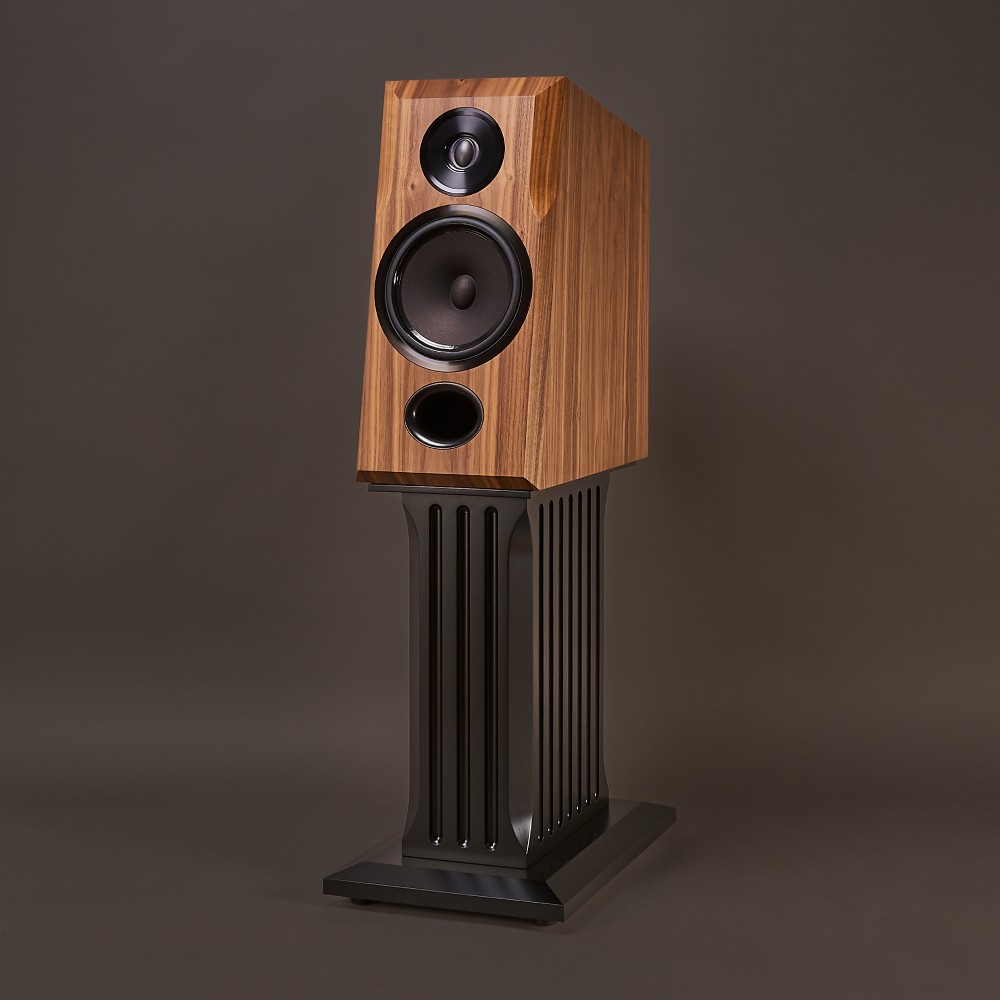
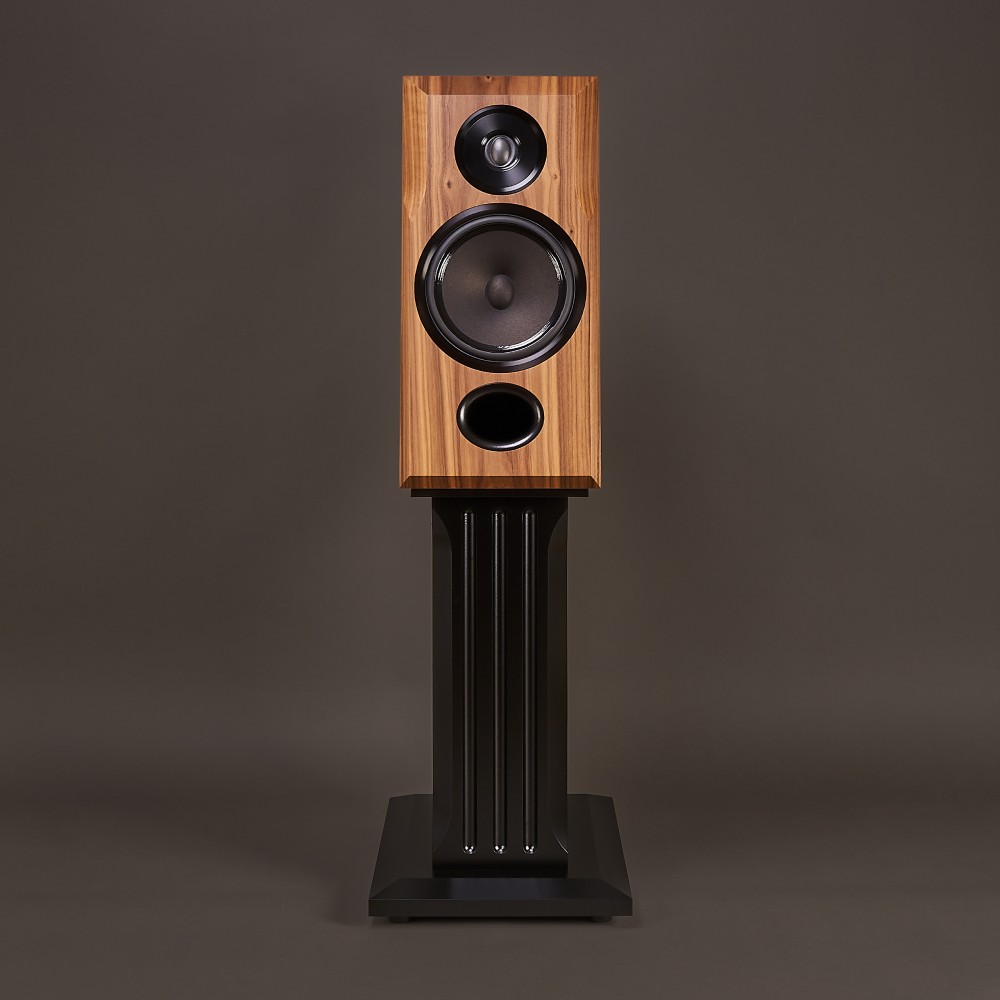
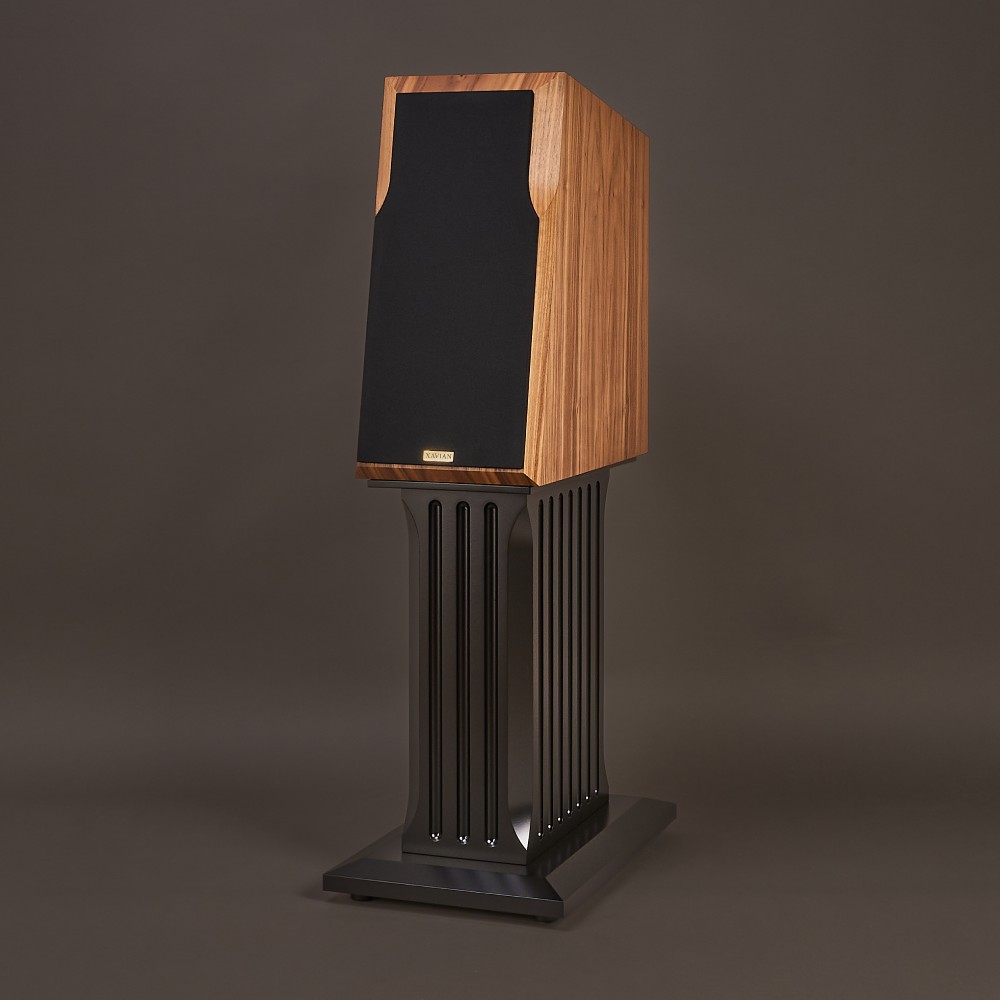
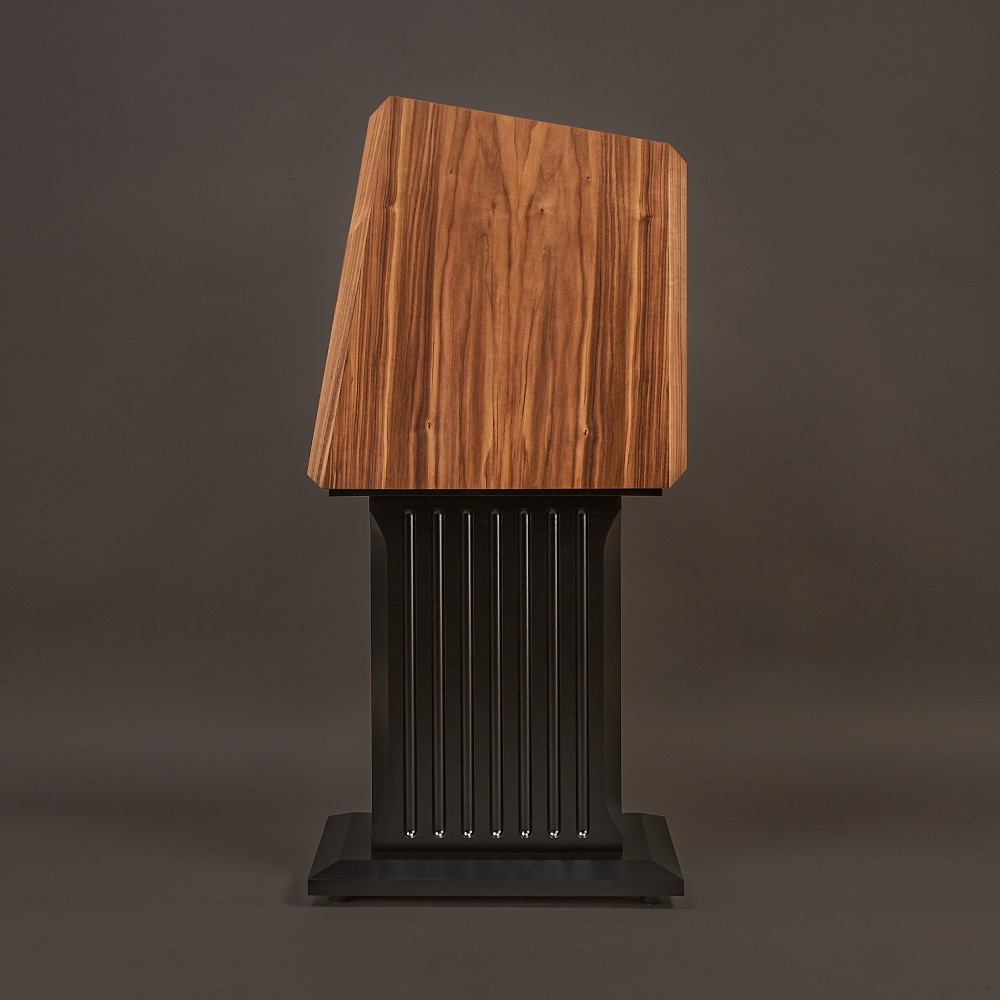
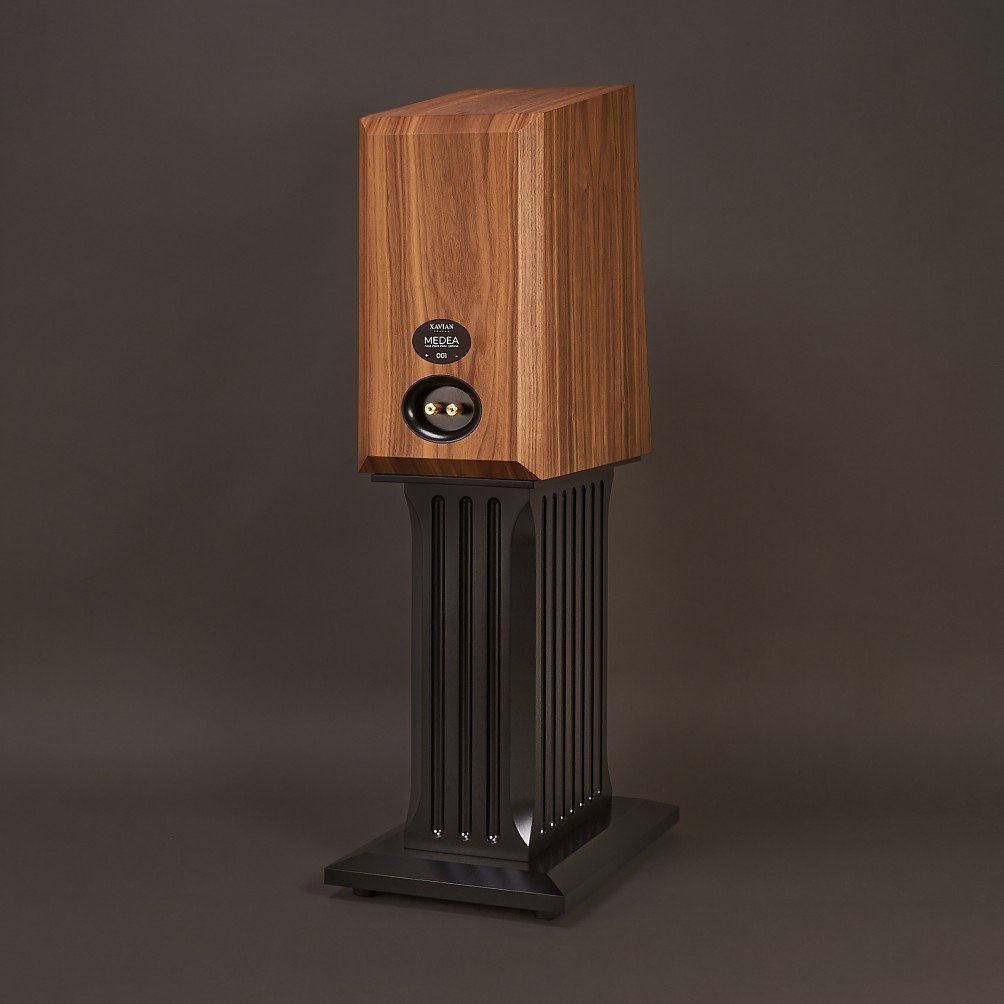
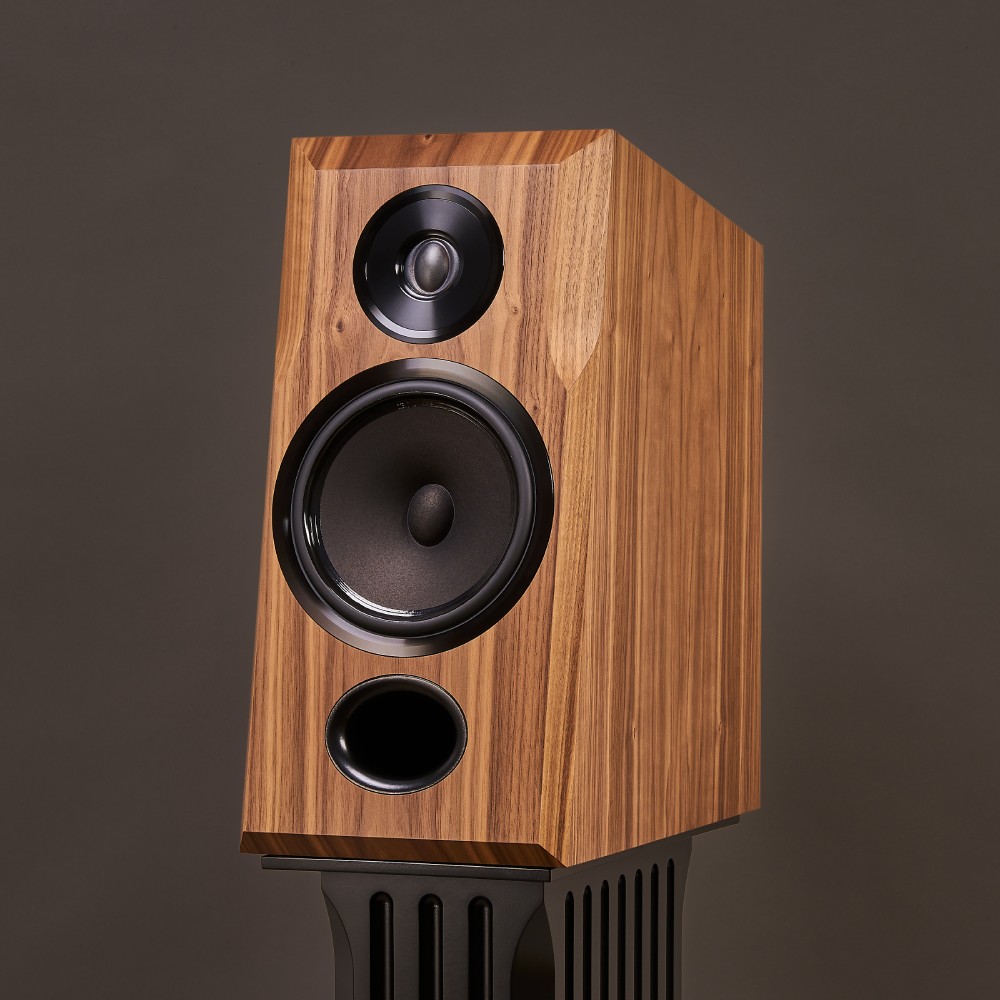
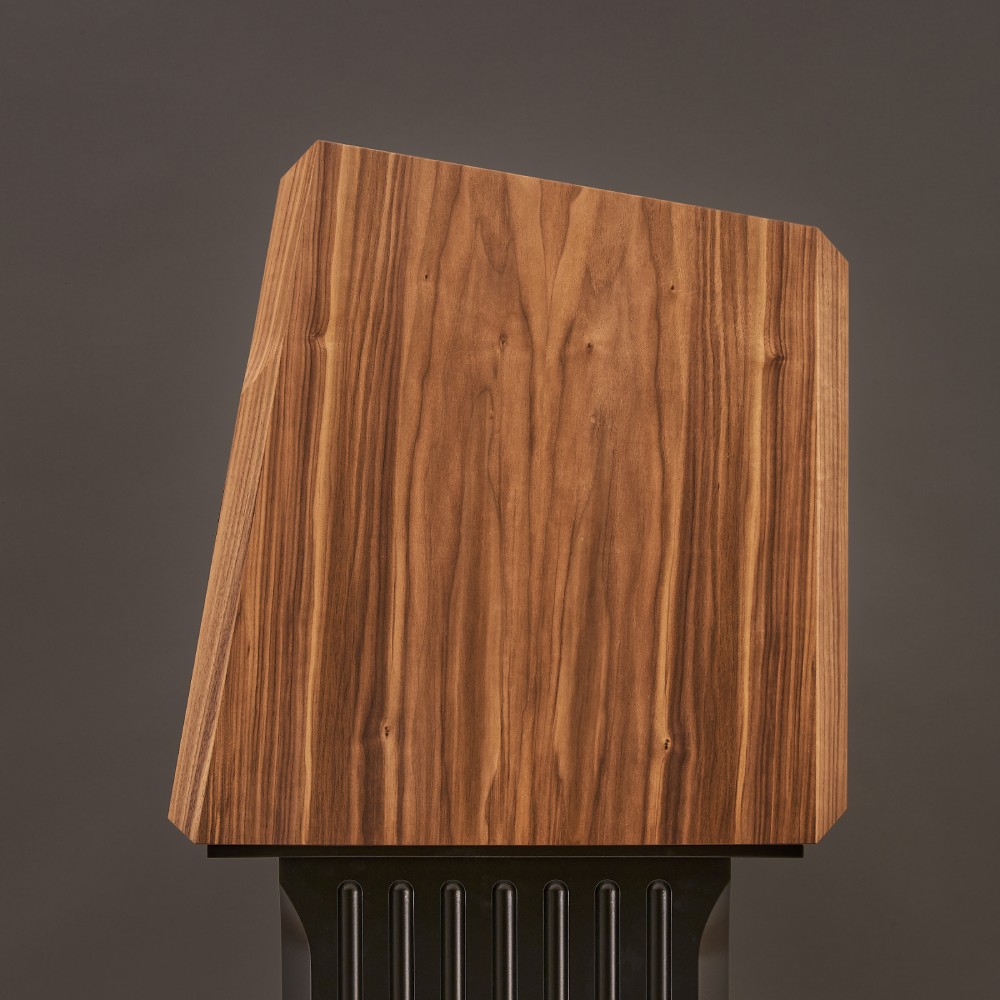
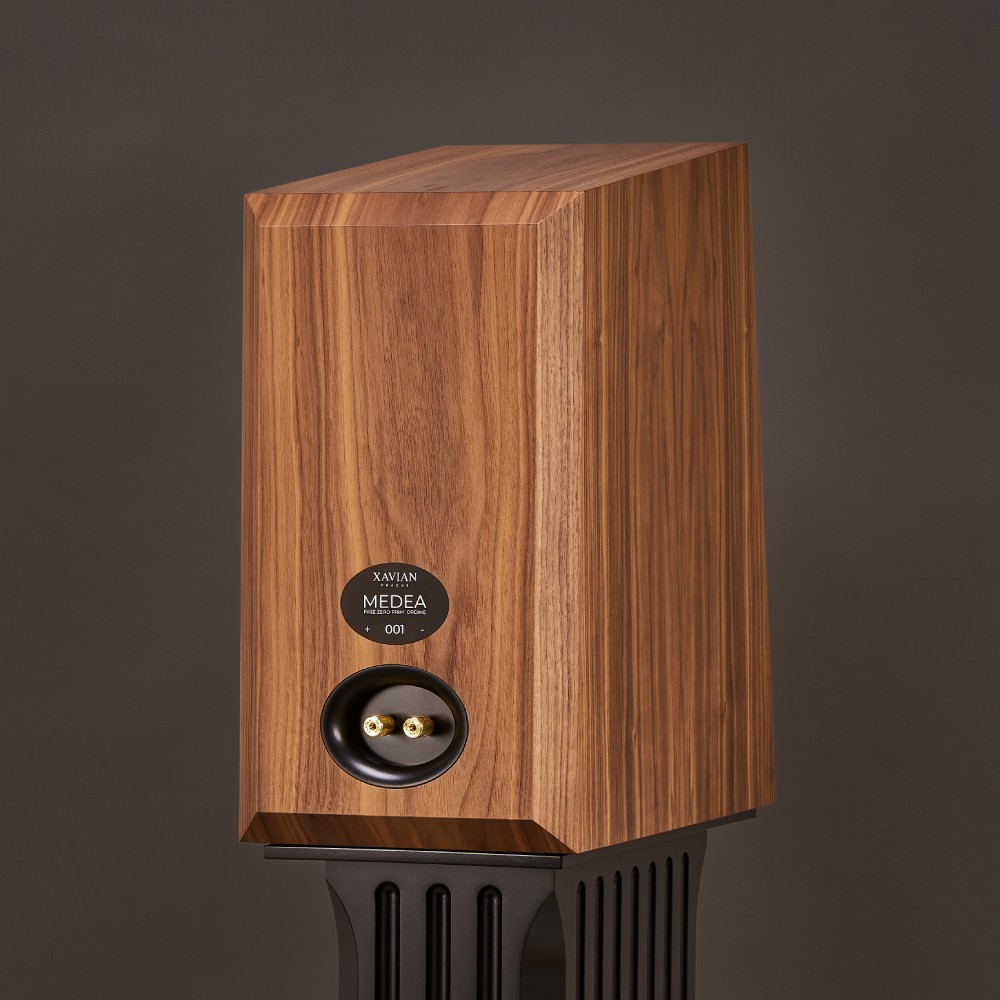
The latest generation of transducers – the ultimate Scan-Speak Ellipticor – has created a two-way system with unparalleled integrity, clarity and musicality, with the ability to play music with extraordinary fidelity and emotion. The Medea project was not limited by anything. The goal was to achieve an authentic XAVIAN solution at the highest standard that the stand-mounted concept allows. With our Medea, you can boldly venture into the deepest layers of your favourite music and hear it like never before, thanks to the fantastic resolution and large sound proportions.
Along with the Medea, an equally unique stand was created to complement its confident aesthetic. We chose slightly eccentric proportions and style, the product of an extremely laborious manufacturing process, to not only ensure completely optimal working conditions, but also to underline the uniqueness of the whole solution.
EXCLUSIVE SOLUTIONS ・one of the first mass-produced Scan-Speak Ellipticor fully equipped loudspeakers ・the ultimate Danish Ellipticor transducers ・completely separate working chamber for the tweeter ・technologically innovative and original design: the crossover does not use capacitors ・1st order Fase Zero series connection ・precision Danish ribbon inductors and “ultra-resistors” with copper body and heat sink: the transducers are equalized with only 3 components ・phase timing of the drivers using XN front panel geometry ・exceptional impulse response ・exceptional soundstage and space ・extraordinary organics of musical expression ・extraordinary naturalness ・suitable for use with tube amplifiers ・rigid cabinet with internal bracing and composite bitumen damping ・cover grille with hidden magnet attachment (extra charge) ・matching of drivers within +/- 0.5 dB ・high-efficiency, low-distortion wooden elliptical bass-reflex in front panel for easy placement in the room ・easy installation of spikes or feet with M8 thread as required (optional stand) ・integrated Soundcare adjustable anti-vibration system (removable; on optional stand) ・stand filled with 10 kg of sand ・4 screws for attaching the speakers to the stands
“TIDAL Atelier” – our new concept for bespoke masterpieces, meticulously engineered and tailored as limited editions beyond our masterpieces collection.
First of this concept: the “Type D”. Born from the request of TIDAL collectors to have “Akira” performance in “Contriva” dimensions. Limited to 10 pairs.